Texas TEKS 8.15.E
The Standard
- 8.15
- Government. The student understands the American beliefs and principles reflected in the Declaration of Independence, the U.S. Constitution, and other important historic documents. The student is expected to:
explain the role of significant individuals such as Thomas Hooker, Charles de Montesquieu, and John Locke in the development of self-government in colonial America.
Texas Essential Knowledge and Skills for Social Studies
Teacher's field guide
What This Standard Means
What Students Need to Do
- Students identify the political ideas linked to Hooker, Locke, and Montesquieu. They explain how those ideas supported representative government, limited power, and rule based on the people's consent in colonial America.
What Mastery Looks Like
- A student can match Hooker with popular consent and the Fundamental Orders, Locke with natural rights and social contract, and Montesquieu with separated powers. The student can explain how each idea gave colonists a reason or structure for governing themselves.
Common Misconceptions
- Students often assign separation of powers to Locke or natural rights to Montesquieu. They may treat all three as colonial officials or claim each directly wrote an American governing document. Some name an idea without explaining its effect on self-government.
How to Assess It
- Exit ticket: Match Hooker, Locke, and Montesquieu to their main ideas. Then explain in one sentence how one idea supported colonial self-government.
Lesson moves
Ways to Teach It
Give groups nine cards with names, ideas, and colonial examples, then have them build three correct sets and explain each match.
Have students write: Which person's idea gave colonists the strongest case for self-rule, and what evidence supports your choice?
Play a three-round clue game where teams identify Hooker, Locke, or Montesquieu, then state the linked idea for a bonus point.
Students inspect a student council constitution and label examples of consent, protected rights, and divided powers, then connect each to one individual.
Free download
Printable 8.15.E Worksheet
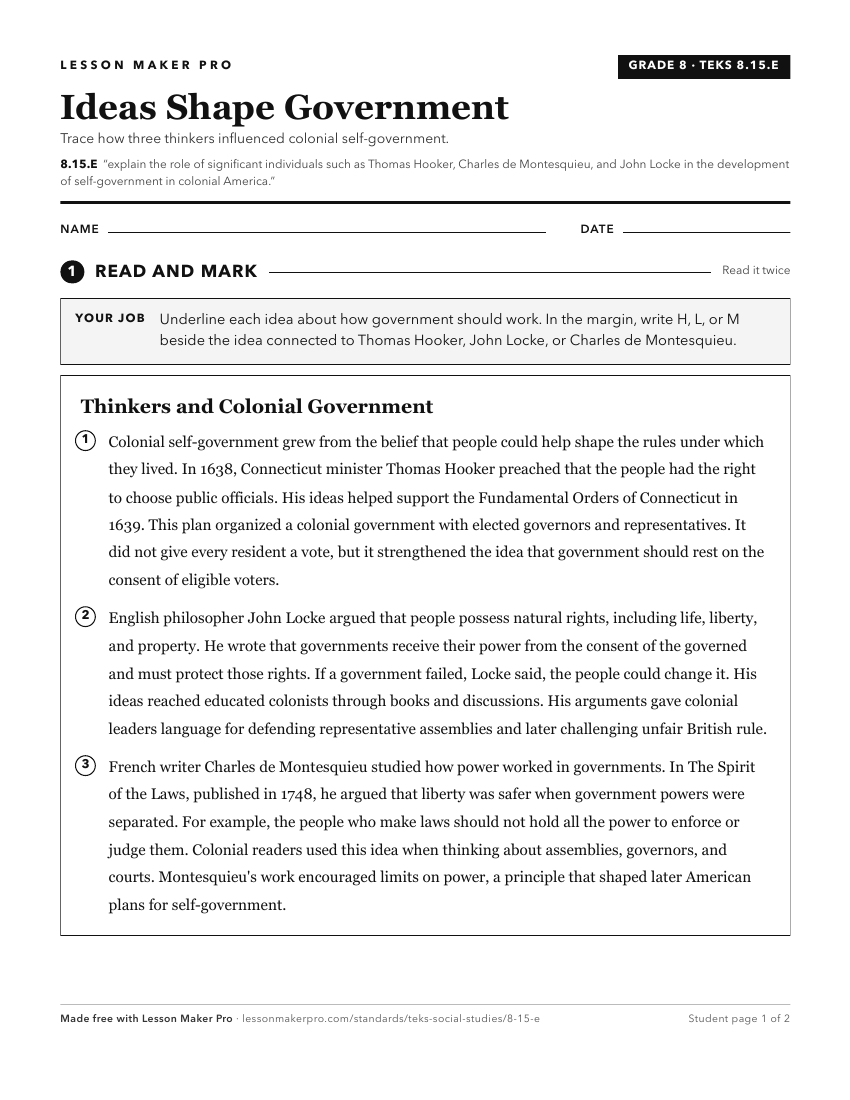
A ready-to-print activity worksheet aligned to 8.15.E, with an answer key for the teacher on its own page. No account needed.
PDF, US Letter, prints cleanly in black and white.
Download the worksheetKeep exploring
Related Standards
- 8.3.A
explain the reasons for the growth of representative government and institutions during the colonial period
- 8.3.B
analyze the importance of the Mayflower Compact, the Fundamental Orders of Connecticut, and the Virginia House of Burgesses to the growth of representative gove...
- 8.15.A
identify the influence of ideas from historic documents, including the Magna Carta, the English Bill of Rights, the Mayflower Compact, and the Federalist Papers...
- 8.4.B
explain the roles played by significant individuals during the American Revolution, including Abigail Adams, John Adams, Wentworth Cheswell, Samuel Adams, Mercy...
Turn this exact standard into a lesson
Grade, subject, topic, and the complete standard are prefilled. Create one free, no account needed.
Also for this standard:Make a WorksheetMake a QuizMake a Sub Lesson