Texas TEKS 8.4.B
The Standard
- 8.4
- History. The student understands significant political and economic issues of the revolutionary and Constitutional eras. The student is expected to:
explain the roles played by significant individuals during the American Revolution, including Abigail Adams, John Adams, Wentworth Cheswell, Samuel Adams, Mercy Otis Warren, James Armistead, Benjamin Franklin, Crispus Attucks, King George III, Patrick Henry, Thomas Jefferson, the Marquis de Lafayette, Thomas Paine, and George Washington
Texas Essential Knowledge and Skills for Social Studies
Teacher's field guide
What This Standard Means
What Students Need to Do
- Students identify each person’s actions before and during the Revolution. They explain how writing, protest, diplomacy, spying, military leadership, and royal decisions affected the conflict. They compare people whose contributions took different forms.
What Mastery Looks Like
- A student can match each person to accurate actions and explain why those actions mattered. The student distinguishes similar names, such as John Adams and Samuel Adams, and supports claims with specific evidence.
Common Misconceptions
- Students often confuse John Adams with Samuel Adams or treat Abigail Adams and Mercy Otis Warren as the same kind of political voice. They may overlook James Armistead’s espionage, Wentworth Cheswell’s public service, or Crispus Attucks’s death before the war began.
How to Assess It
- Exit ticket: For Abigail Adams, James Armistead, Benjamin Franklin, and George Washington, write one action each person took and one effect of that action.
Lesson moves
Ways to Teach It
Give pairs action cards and name cards to sort, then require students to justify four matches using dates, places, or outcomes.
Ask students to write: Which person influenced the Revolution most without commanding an army, and what evidence supports your choice?
Run a clue game where teams identify a person from three facts, then earn a point by explaining that person’s impact.
Create museum labels for four figures, including an artifact image, a two-sentence role summary, and a statement explaining historical significance.
Free download
Printable 8.4.B Worksheet
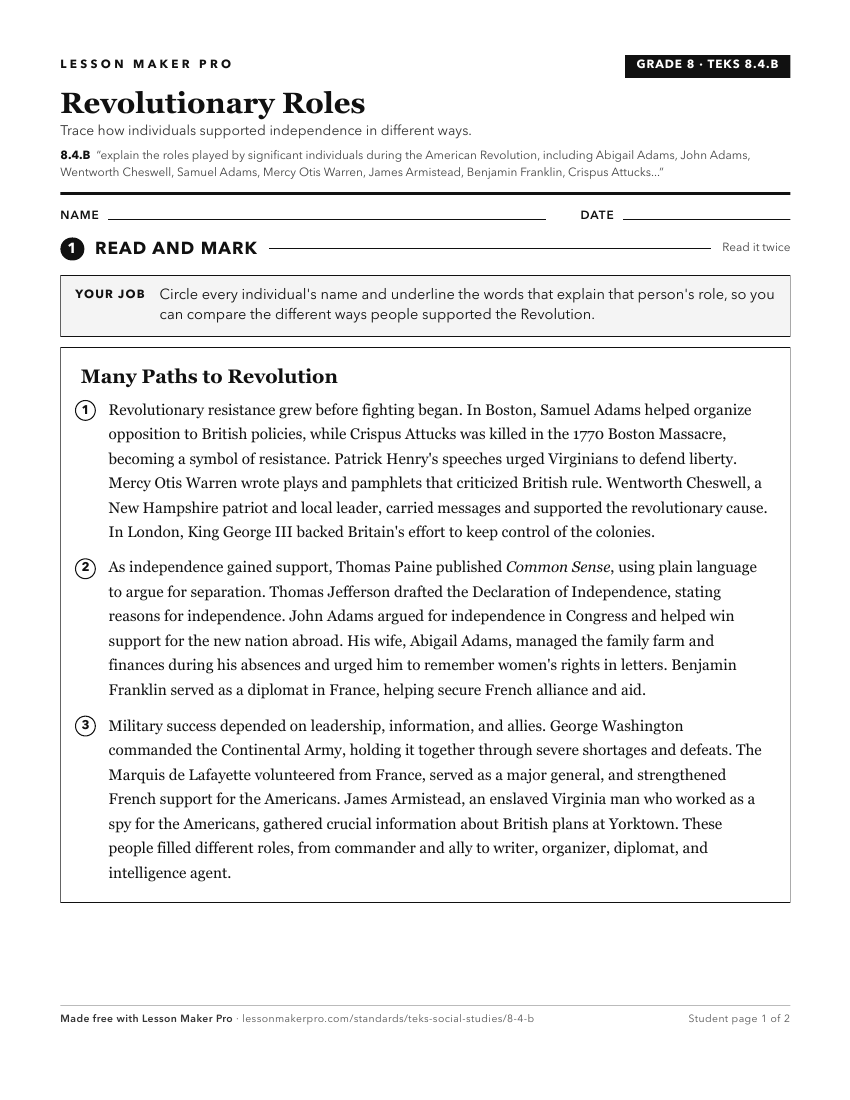
A ready-to-print activity worksheet aligned to 8.4.B, with an answer key for the teacher on its own page. No account needed.
PDF, US Letter, prints cleanly in black and white.
Download the worksheetKeep exploring
Related Standards
- 5.2.B
identify the Founding Fathers and Patriot heroes, including John Adams, Benjamin Franklin, Thomas Jefferson, the Sons of Liberty, and George Washington, and the...
- 8.4.A
analyze causes of the American Revolution, including the Proclamation of 1763, the Intolerable Acts, the Stamp Act, mercantilism, lack of representation in Parl...
- 8.15.E
explain the role of significant individuals such as Thomas Hooker, Charles de Montesquieu, and John Locke in the development of self-government in colonial Amer...
- 8.4.C
explain the issues surrounding important events of the American Revolution, including declaring independence; fighting the battles of Lexington and Concord, Sar...
Turn this exact standard into a lesson
Grade, subject, topic, and the complete standard are prefilled. Create one free, no account needed.
Also for this standard:Make a WorksheetMake a QuizMake a Sub Lesson