Texas TEKS 8.3.A
The Standard
- 8.3
- History. The student understands the foundations of representative government in the United States. The student is expected to:
explain the reasons for the growth of representative government and institutions during the colonial period
Texas Essential Knowledge and Skills for Social Studies
Teacher's field guide
What This Standard Means
What Students Need to Do
- Students identify why colonists created elected assemblies, town meetings, and written agreements for self-government. They connect English traditions, distance from Britain, local needs, and experience with self-rule to named institutions.
What Mastery Looks Like
- A student can explain how several conditions led colonists to take part in governing. They support each cause with an example such as the House of Burgesses, Mayflower Compact, or New England town meetings.
Common Misconceptions
- Students may assume all colonists could vote or that colonial governments were fully democratic. They may confuse a governing document with a representative body or claim self-government began only during the Revolution.
How to Assess It
- Give an exit ticket: Choose two reasons colonial self-government grew, and explain how each reason shaped one named institution. Require two complete cause-and-effect statements.
Lesson moves
Ways to Teach It
Have pairs sort cards labeled English tradition, local need, distance, assembly, compact, and town meeting, then connect causes to institutions with yarn.
Ask students to write: Which factor most encouraged colonial self-government, English traditions, distance from Britain, or local needs, and why?
Play a matching relay where teams pair colonial conditions with institutions, then earn each point by explaining the connection aloud.
Compare a colonial town meeting agenda with a current city council agenda, then identify why local residents need a voice in decisions.
Free download
Printable 8.3.A Worksheet
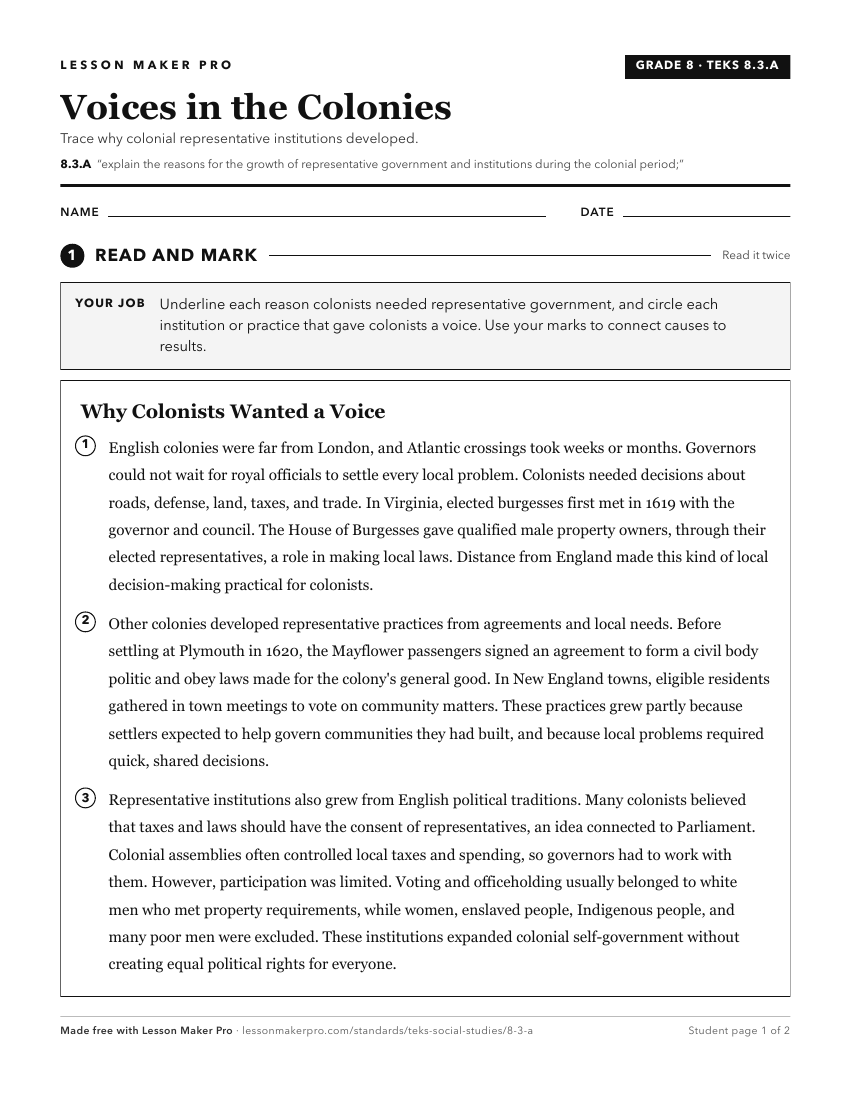
A ready-to-print activity worksheet aligned to 8.3.A, with an answer key for the teacher on its own page. No account needed.
PDF, US Letter, prints cleanly in black and white.
Download the worksheetKeep exploring
Related Standards
- 8.3.B
analyze the importance of the Mayflower Compact, the Fundamental Orders of Connecticut, and the Virginia House of Burgesses to the growth of representative gove...
- 8.3.C
describe how religion and virtue contributed to the growth of representative government in the American colonies.
- 5.13.B
identify examples of representative government in the American colonies, including the Mayflower Compact and the Virginia House of Burgesses.
- 5.13.A
compare the systems of government of early European colonists, including representative government and monarchy
Turn this exact standard into a lesson
Grade, subject, topic, and the complete standard are prefilled. Create one free, no account needed.
Also for this standard:Make a WorksheetMake a QuizMake a Sub Lesson