Texas TEKS 8.3.C
The Standard
- 8.3
- History. The student understands the foundations of representative government in the United States. The student is expected to:
describe how religion and virtue contributed to the growth of representative government in the American colonies.
Texas Essential Knowledge and Skills for Social Studies
Teacher's field guide
What This Standard Means
What Students Need to Do
- Students explain how covenant beliefs, congregational decision making, and concern for the common good shaped colonial voting, town meetings, and written compacts. They support each link with a specific colonial example.
What Mastery Looks Like
- A student can explain how the Mayflower Compact reflects government by agreement and how town meetings encouraged public participation. The student connects moral responsibility to serving the community and obeying shared laws.
Common Misconceptions
- Students may treat religion as only private belief or virtue as simply good manners. They may assume every colonist could vote or that all colonies followed the same religious practices.
How to Assess It
- Give students a short excerpt from the Mayflower Compact. Ask: How do religious covenant language and promises to the common good support government by agreement? Cite two phrases.
Lesson moves
Ways to Teach It
Give pairs source cards from the Mayflower Compact, colonial church covenants, and town records, then sort them by political effect.
Ask students to write: How could shared religious beliefs and civic virtue make self-government more workable in a colony?
Run a matching relay where teams pair colonial practices with effects, such as elected leaders, written laws, or public participation.
Compare a colonial town meeting rule with a current city council public comment policy, then identify shared expectations for civic behavior.
Free download
Printable 8.3.C Worksheet
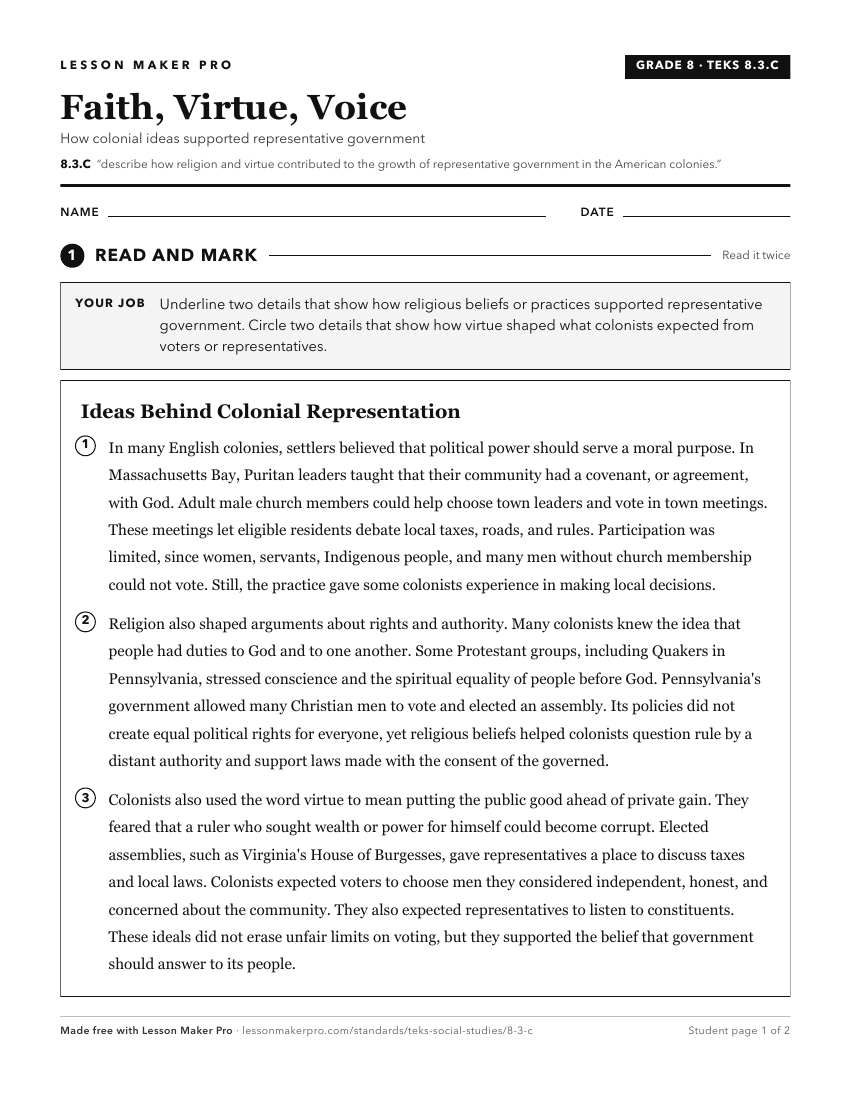
A ready-to-print activity worksheet aligned to 8.3.C, with an answer key for the teacher on its own page. No account needed.
PDF, US Letter, prints cleanly in black and white.
Download the worksheetKeep exploring
Related Standards
- 8.3.A
explain the reasons for the growth of representative government and institutions during the colonial period
- 8.3.B
analyze the importance of the Mayflower Compact, the Fundamental Orders of Connecticut, and the Virginia House of Burgesses to the growth of representative gove...
- 8.15.E
explain the role of significant individuals such as Thomas Hooker, Charles de Montesquieu, and John Locke in the development of self-government in colonial Amer...
- 5.13.B
identify examples of representative government in the American colonies, including the Mayflower Compact and the Virginia House of Burgesses.
Turn this exact standard into a lesson
Grade, subject, topic, and the complete standard are prefilled. Create one free, no account needed.
Also for this standard:Make a WorksheetMake a QuizMake a Sub Lesson