Texas TEKS 8.5
TEKS Knowledge Statement (Expectation Cluster)
Recurring themes and concepts. The student understands that recurring themes and concepts provide a framework for making connections across disciplines. The student is expected to: identify and apply patterns to understand and connect scientific phenomena or to design solutions; identify and investigate cause-and-effect relationships to explain scientific phenomena or analyze problems; analyze how differences in scale, proportion, or quantity affect a system's structure or performance; examine and model the parts of a system and their interdependence in the function of the system; analyze and explain how energy flows and matter cycles through systems and how energy and matter are conserved through a variety of systems; analyze and explain the complementary relationship between the structure and function of objects, organisms, and systems; and analyze and explain how factors or conditions impact stability and change in objects, organisms, and systems.
Texas Essential Knowledge and Skills for Science
Cluster contents
Student Expectations in This Statement
8.5 is a TEKS knowledge and skills statement. These are the student expectations under it.
- 8.5.A
identify and apply patterns to understand and connect scientific phenomena or to design solutions
- 8.5.B
identify and investigate cause-and-effect relationships to explain scientific phenomena or analyze problems
- 8.5.C
analyze how differences in scale, proportion, or quantity affect a system's structure or performance
- 8.5.D
examine and model the parts of a system and their interdependence in the function of the system
- 8.5.E
analyze and explain how energy flows and matter cycles through systems and how energy and matter are conserved through a variety of systems
- 8.5.F
analyze and explain the complementary relationship between the structure and function of objects, organisms, and systems
- 8.5.G
analyze and explain how factors or conditions impact stability and change in objects, organisms, and systems
Teacher's field guide
What This Cluster Means
What Students Need to Do
- Students use patterns and cause-and-effect evidence to explain events and solve problems. They compare scales, model interacting parts, and trace matter and energy through systems. They connect structure to function and predict how changing one condition affects stability.
What Mastery Looks Like
- Students can choose a useful way to analyze an unfamiliar phenomenon and support their explanation with evidence. Their models show system boundaries, interacting parts, quantities, energy transfers, matter cycling, and predicted changes.
Common Misconceptions
- Students may treat correlation as proof of cause or assume one factor always produces one outcome. They may think matter disappears, energy cycles like matter, or system parts work independently. They also may overlook how scale and quantity change performance.
How to Assess It
- Give students a pond food web. Ask them to trace energy and matter, identify one cause-and-effect relationship, and predict how removing algae changes the system.
Lesson moves
Ways to Teach It
Build a closed terrarium in a clear jar, then label matter cycling, energy entering, interacting parts, and one condition that could disrupt stability.
Write a claim explaining how changing one part of a bicycle affects the whole system, using structure, function, and cause-and-effect evidence.
Sort phenomenon cards by pattern, cause, scale, system, energy and matter, structure and function, or stability, then defend each choice.
Analyze a school air-conditioning failure by mapping system parts, energy transfers, likely causes, and how outdoor temperature changes performance.
Free download
Printable 8.5 Worksheet
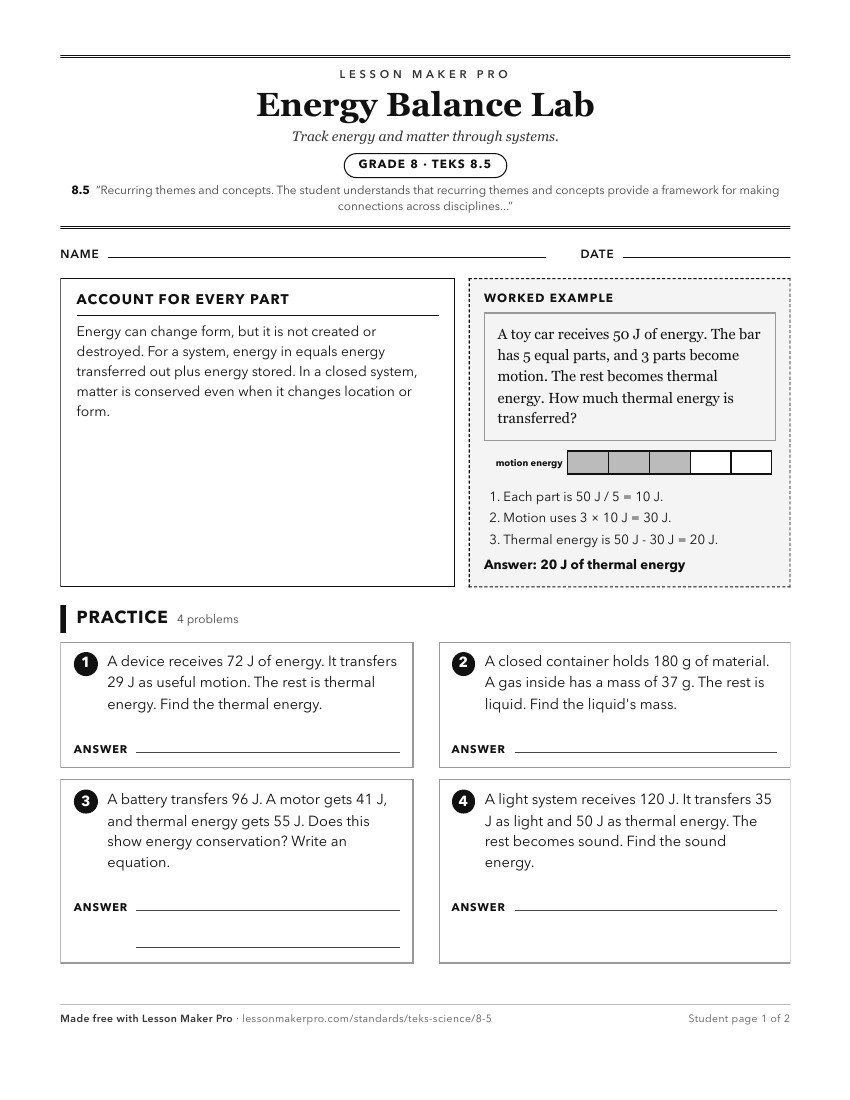
A ready-to-print activity worksheet aligned to 8.5, with an answer key for the teacher on its own page. No account needed.
PDF, US Letter, prints cleanly in black and white.
Download the worksheetKeep exploring
Related Standards
- 6.5
Recurring themes and concepts. The student understands that recurring themes and concepts provide a framework for making connections across disciplines. The stu...
- 5.5
Recurring themes and concepts. The student understands that recurring themes and concepts provide a framework for making connections across disciplines. The stu...
- 4.5
Recurring themes and concepts. The student understands that recurring themes and concepts provide a framework for making connections across disciplines. The stu...
- 3.5
Recurring themes and concepts. The student understands that recurring themes and concepts provide a framework for making connections across disciplines. The stu...
Turn this cluster into a lesson
Grade, subject, topic, and the complete cluster are prefilled. Create one free, no account needed.
Also for this cluster:Make a WorksheetMake a QuizMake a Sub Lesson