Texas TEKS 6.8
TEKS Knowledge Statement (Expectation Cluster)
Force, motion, and energy. The student knows that the total energy in systems is conserved through energy transfers and transformations. The student is expected to: compare and contrast gravitational, elastic, and chemical potential energies with kinetic energy; describe how energy is conserved through transfers and transformations in systems such as electrical circuits, food webs, amusement park rides, or photosynthesis; and explain how energy is transferred through transverse and longitudinal waves.
Texas Essential Knowledge and Skills for Science
Cluster contents
Student Expectations in This Statement
6.8 is a TEKS knowledge and skills statement. These are the student expectations under it.
- 6.8.A
compare and contrast gravitational, elastic, and chemical potential energies with kinetic energy
- 6.8.B
describe how energy is conserved through transfers and transformations in systems such as electrical circuits, food webs, amusement park rides, or photosynthesi...
- 6.8.C
explain how energy is transferred through transverse and longitudinal waves.
Teacher's field guide
What This Cluster Means
What Students Need to Do
- Students identify energy stored by height, stretched or compressed objects, and chemicals, then compare it with energy of motion. They trace energy as it moves or changes form without disappearing. They also explain that transverse and longitudinal waves carry energy through a material or space.
What Mastery Looks Like
- Students can label energy types at several points in a circuit, food web, roller coaster, or photosynthesis model. They can account for the starting energy and explain where it goes, including energy released as heat or sound. They can use particle or rope models to show how both wave types transfer energy.
Common Misconceptions
- Students may think energy is used up, created by a battery, or lost when motion stops. They often confuse gravitational potential energy with kinetic energy and overlook chemical energy in food or batteries. They may also think waves carry matter from the source to the receiver.
How to Assess It
- Give students a roller coaster diagram and a slinky wave sketch. Ask them to label energy changes on the coaster and explain how the wave transfers energy without carrying matter across the slinky.
Lesson moves
Ways to Teach It
Roll a marble down ramps from three heights, then measure travel distance and identify gravitational potential and kinetic energy at each stage.
Ask students to write where energy goes when a moving bicycle stops, including motion, heat, and sound.
Run a card sort matching energy examples, transfer arrows, transformations, and transverse or longitudinal wave models.
Trace energy from sunlight to grass, a cow, and a student eating lunch, noting each transfer and transformation.
Free download
Printable 6.8 Worksheet
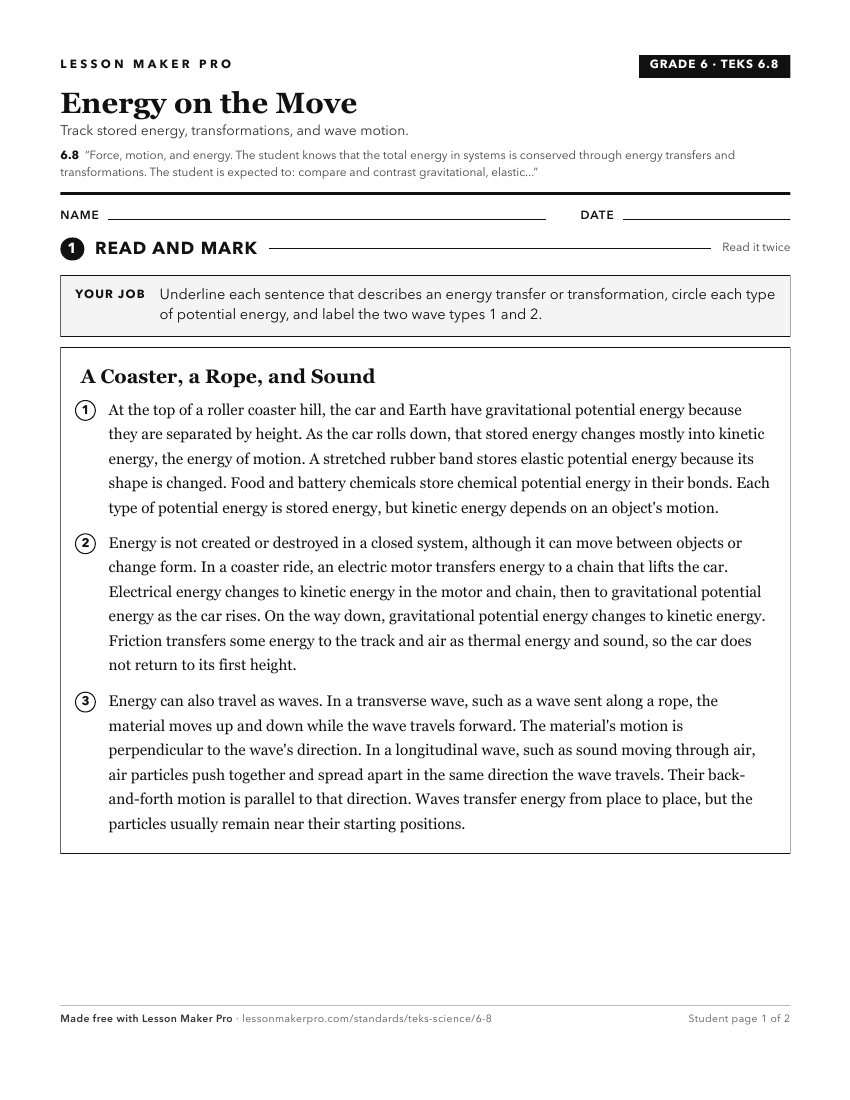
A ready-to-print activity worksheet aligned to 6.8, with an answer key for the teacher on its own page. No account needed.
PDF, US Letter, prints cleanly in black and white.
Download the worksheetKeep exploring
Related Standards
- 6.7
Force, motion, and energy. The student knows the nature of forces and their role in systems that experience stability or change. The student is expected to:
- 3.8
Force, motion, and energy. The student knows that energy is everywhere and can be observed in cycles, patterns, and systems. The student is expected to:
- 4.8
Force, motion, and energy. The student knows that energy is everywhere and can be observed in cycles, patterns, and systems. The student is expected to:
- 5.8
Force, motion, and energy. The student knows that energy is everywhere and can be observed in cycles, patterns, and systems. The student is expected to:
Turn this cluster into a lesson
Grade, subject, topic, and the complete cluster are prefilled. Create one free, no account needed.
Also for this cluster:Make a WorksheetMake a QuizMake a Sub Lesson