Texas TEKS 4.8
TEKS Knowledge Statement (Expectation Cluster)
Force, motion, and energy. The student knows that energy is everywhere and can be observed in cycles, patterns, and systems. The student is expected to: investigate and identify the transfer of energy by objects in motion, waves in water, and sound; identify conductors and insulators of thermal and electrical energy; and demonstrate and describe how electrical energy travels in a closed path that can produce light and thermal energy.
Texas Essential Knowledge and Skills for Science
Cluster contents
Student Expectations in This Statement
4.8 is a TEKS knowledge and skills statement. These are the student expectations under it.
Teacher's field guide
What This Cluster Means
What Students Need to Do
- Students use observations to trace energy from one object or place to another during collisions, water waves, and sound. They test materials to decide whether heat or electricity passes through them. They build a complete circuit and explain how it changes electrical energy into light and heat.
What Mastery Looks Like
- A student can point to evidence, such as a moved cup, bobbing cork, or vibrating rice, and explain where the energy came from. They correctly classify common materials based on test results, not appearance. They can draw and build a closed battery-and-bulb circuit, then identify light and warmth as outputs.
Common Misconceptions
- Students may think matter travels with a water wave, or that sound moves without vibrations. They may assume every shiny object conducts heat and electricity. They may expect a bulb to light with one wire, an open gap, or two wires touching the same battery terminal.
How to Assess It
- Use an exit ticket with diagrams of colliding marbles, ripples moving a cork, and a drum moving rice, then have students add energy-transfer arrows. Add a broken battery-and-bulb circuit to repair, plus foil, wood, rubber, and plastic to classify for thermal and electrical conduction.
Lesson moves
Ways to Teach It
Set up stations where students roll a marble into cups, make ripples move a cork, and strike a tuning fork near rice.
Ask students to write: Where did the energy start, what carried it, and what evidence showed it arrived?
Teams sort foil, paper, wood, plastic, and spoons, then check electrical claims with a battery tester and thermal claims using warm water.
Use a battery, wires, and mini incandescent bulb to model a flashlight, then trace the closed path and carefully feel the bulb’s warmth.
Free download
Printable 4.8 Worksheet
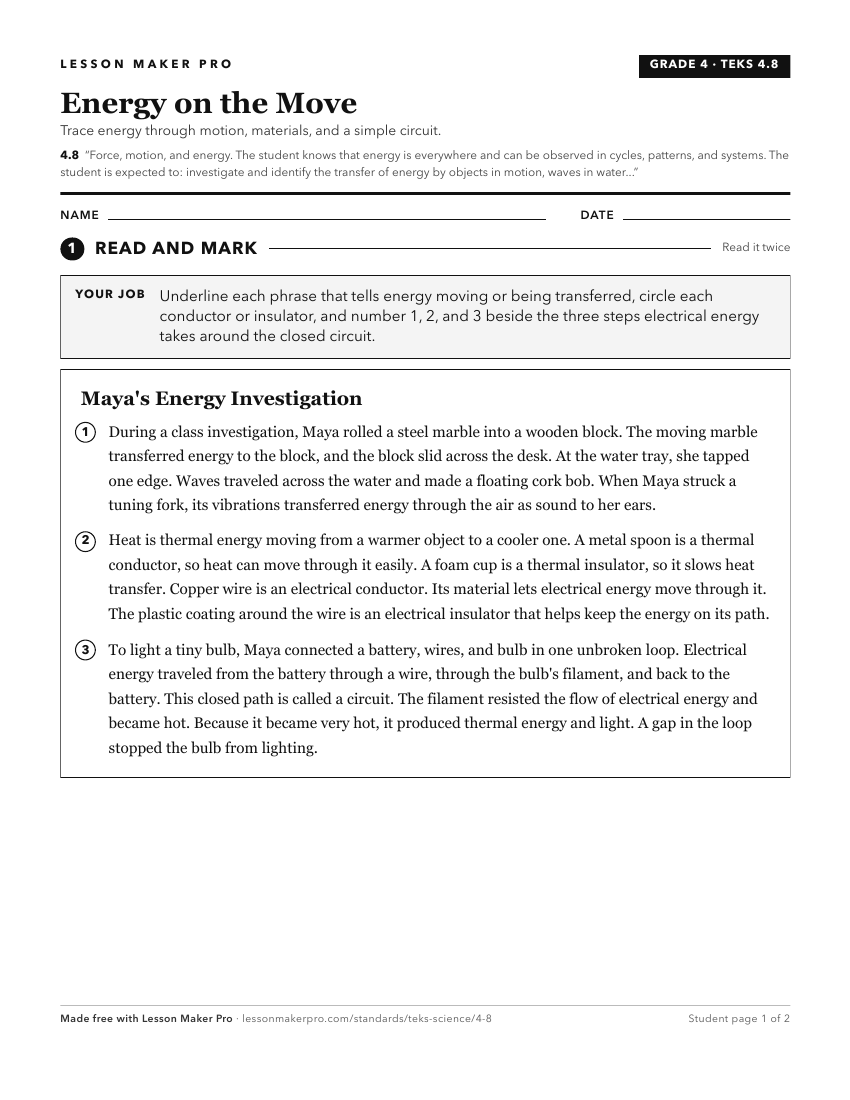
A ready-to-print activity worksheet aligned to 4.8, with an answer key for the teacher on its own page. No account needed.
PDF, US Letter, prints cleanly in black and white.
Download the worksheetKeep exploring
Related Standards
- K.8
Force, motion, and energy. The student knows that energy is everywhere and can be observed in everyday life. The student is expected to:
- 3.8
The 3rd Grade version of this standard.
- 2.8
Force, motion, and energy. The student knows that energy is everywhere and can be observed in everyday life. The student is expected to:
- 5.8
The 5th Grade version of this standard.
Turn this cluster into a lesson
Grade, subject, topic, and the complete cluster are prefilled. Create one free, no account needed.
Also for this cluster:Make a WorksheetMake a QuizMake a Sub Lesson