Texas TEKS 4.8.C
The Standard
- 4.8
- Force, motion, and energy. The student knows that energy is everywhere and can be observed in cycles, patterns, and systems. The student is expected to:
demonstrate and describe how electrical energy travels in a closed path that can produce light and thermal energy.
Texas Essential Knowledge and Skills for Science
Teacher's field guide
What This Standard Means
What Students Need to Do
- Students build a complete circuit and show that the bulb works only when every connection is closed. They trace the route from the battery, through the bulb, and back, then identify light and heat as outputs.
What Mastery Looks Like
- Given a battery, wires, and a bulb, a student can make the bulb light and explain why it works. The student can mark the complete route on a diagram and predict what happens when a gap is added. The student can use a thermometer reading to show that the lit bulb warms its surroundings.
Common Misconceptions
- Students may think one connection to the battery is enough, rather than two contacts that make a full loop. They may think a switch creates electricity instead of opening or closing the path. They may also say the bulb makes only light, missing the warming effect, or that electrical energy simply disappears.
How to Assess It
- Exit ticket: Complete the circuit diagram by adding one wire, draw arrows around the full path, and name two energy outputs from the bulb.
Lesson moves
Ways to Teach It
Build a circuit with a battery holder, wires, and miniature bulb, then record bulb light and thermometer changes beside it.
Write an explanation: Why does removing one wire turn off the bulb, and what forms of energy appear when it is lit?
Sort circuit cards into complete and incomplete paths, then repair each incomplete diagram with a dry-erase marker.
Inspect a flashlight, identify its battery, contacts, switch, and bulb, then sketch the complete path when the switch is on.
Free download
Printable 4.8.C Worksheet
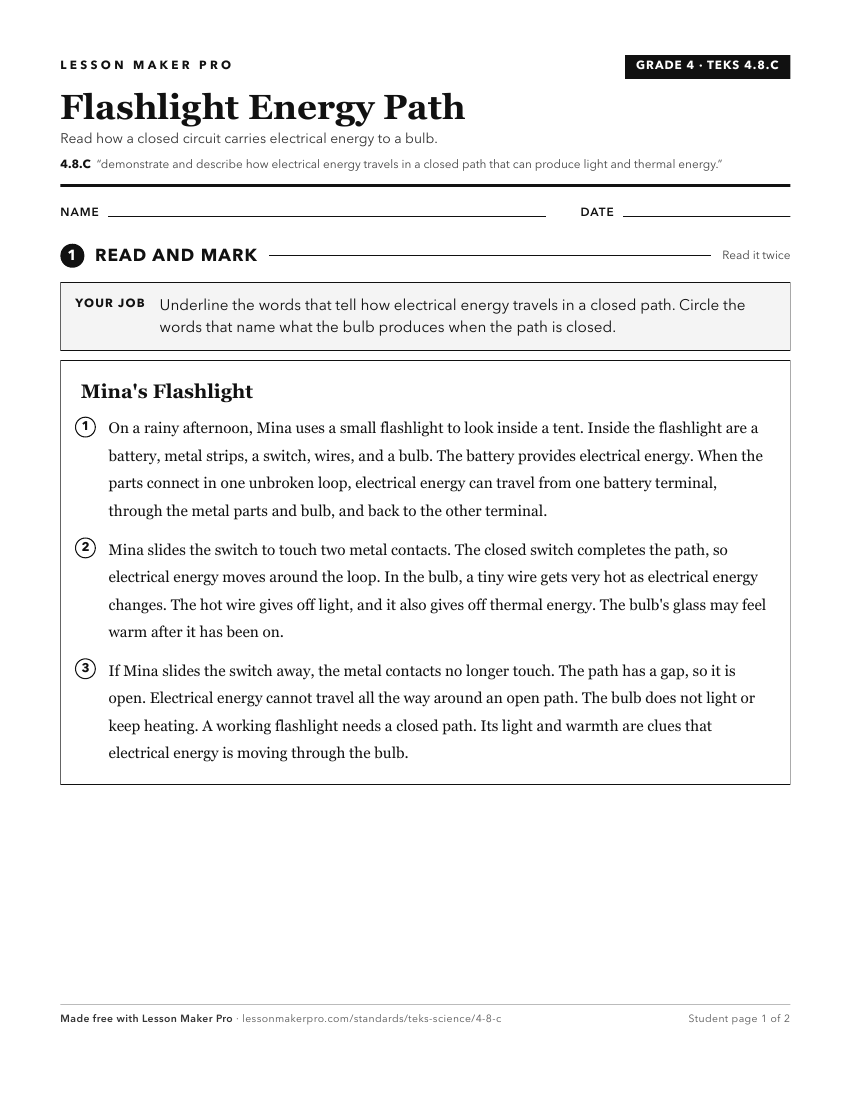
A ready-to-print activity worksheet aligned to 4.8.C, with an answer key for the teacher on its own page. No account needed.
PDF, US Letter, prints cleanly in black and white.
Download the worksheetKeep exploring
Related Standards
- 5.8.A
investigate and describe the transformation of energy in systems such as energy in a flashlight battery that changes from chemical energy to electrical energy t...
- 5.8.B
demonstrate that electrical energy in complete circuits can be transformed into motion, light, sound, or thermal energy and identify the requirements for a func...
- 5.8.C
demonstrate and explain how light travels in a straight line and can be reflected, refracted, or absorbed.
- 3.8.A
identify everyday examples of energy, including light, sound, thermal, and mechanical
Turn this exact standard into a lesson
Grade, subject, topic, and the complete standard are prefilled. Create one free, no account needed.
Also for this standard:Make a WorksheetMake a QuizMake a Sub Lesson