Texas TEKS 5.8.C
The Standard
- 5.8
- Force, motion, and energy. The student knows that energy is everywhere and can be observed in cycles, patterns, and systems. The student is expected to:
demonstrate and explain how light travels in a straight line and can be reflected, refracted, or absorbed.
Texas Essential Knowledge and Skills for Science
Teacher's field guide
What This Standard Means
What Students Need to Do
- Students show that a beam follows a straight path until it meets a new material or surface. They observe mirrors, water, clear plastic, and dark paper, then explain what happens to the light.
What Mastery Looks Like
- A student predicts what a flashlight beam will do at a mirror, water, clear plastic, or black paper. The student draws straight ray segments and correctly labels reflection, refraction, and absorption. Explanations use evidence from observations.
Common Misconceptions
- Students may think light curves around objects or travels from the eye to an object. They often confuse reflection with refraction or think absorbed light disappears without transferring energy to the material.
How to Assess It
- Give students four mini diagrams: a beam in open air, striking a mirror, entering water, and hitting black paper. Ask them to draw each path, label the interaction, and explain one choice.
Lesson moves
Ways to Teach It
At stations, students aim a flashlight through aligned card holes, at a mirror, through water, and onto black paper, then sketch each path.
Show a straw in water and have students write whether the straw bent or the light changed direction, using a ray sketch as evidence.
Teams sort picture cards into straight travel, reflection, refraction, or absorption, then earn a point by explaining one clue.
Students compare car mirrors, eyeglass lenses, and dark shirts, then explain how each light behavior affects seeing or heating.
Free download
Printable 5.8.C Worksheet
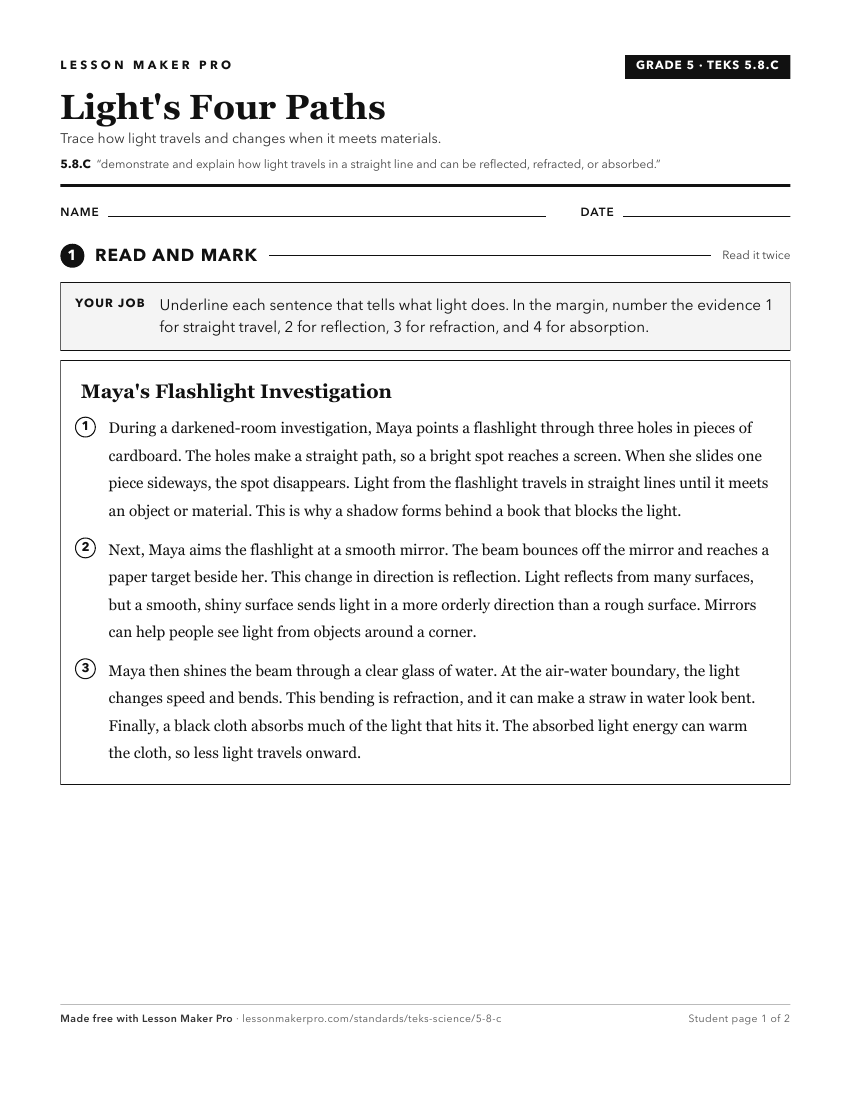
A ready-to-print activity worksheet aligned to 5.8.C, with an answer key for the teacher on its own page. No account needed.
PDF, US Letter, prints cleanly in black and white.
Download the worksheetKeep exploring
Related Standards
- 4.8.C
demonstrate and describe how electrical energy travels in a closed path that can produce light and thermal energy.
- 5.8.B
demonstrate that electrical energy in complete circuits can be transformed into motion, light, sound, or thermal energy and identify the requirements for a func...
- K.8.B
demonstrate and explain that light travels through some objects and is blocked by other objects, creating shadows.
- K.8.A
communicate the idea that objects can only be seen when a light source is present and compare the effects of different amounts of light on the appearance of obj...
Turn this exact standard into a lesson
Grade, subject, topic, and the complete standard are prefilled. Create one free, no account needed.
Also for this standard:Make a WorksheetMake a QuizMake a Sub Lesson