Texas TEKS K.8.A
The Standard
- K.8
- Force, motion, and energy. The student knows that energy is everywhere and can be observed in everyday life. The student is expected to:
communicate the idea that objects can only be seen when a light source is present and compare the effects of different amounts of light on the appearance of objects
Texas Essential Knowledge and Skills for Science
Teacher's field guide
What This Standard Means
What Students Need to Do
- Students observe the same object with no light, dim light, and bright light. They explain how the amount of light changes what details they can see.
What Mastery Looks Like
- Students predict whether an object will be visible under different lighting conditions. They compare observations using words such as hidden, dim, clear, darker, and brighter.
Common Misconceptions
- Students may think eyes make their own light or that familiar objects can be seen in complete darkness. They may also think dim light changes the object rather than its appearance.
How to Assess It
- Show a toy inside a covered box, first without a flashlight and then with one. Ask, “Why can you see more details after the flashlight turns on?”
Lesson moves
Ways to Teach It
Place a toy in a covered box, then observe it with no flashlight, dim light, and bright light.
Ask students to draw the same classroom object in dim and bright light, then label what became easier to see.
Give pairs picture cards showing objects under different lighting, and have them sort the cards into clear, dim, and hidden groups.
Compare how a book page looks near a window, under classroom lights, and beneath a table, then choose the best reading spot.
Free download
Printable K.8.A Worksheet
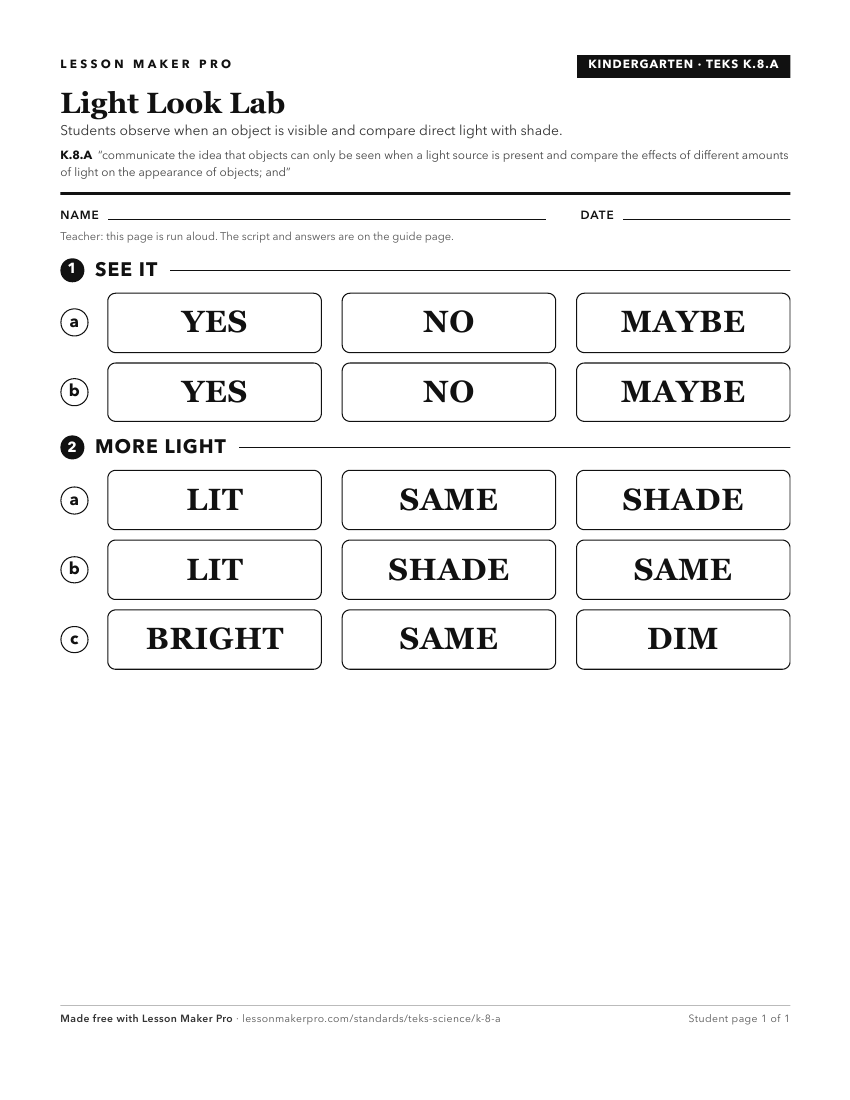
A ready-to-print activity worksheet aligned to K.8.A, with an answer key for the teacher on its own page. No account needed.
PDF, US Letter, prints cleanly in black and white.
Download the worksheetKeep exploring
Related Standards
- 2.9.B
observe objects in the sky using tools such as a telescope and compare how objects in the sky are more visible and can appear different with a tool than with an...
- 5.6.C
compare the properties of substances before and after they are combined into a solution and demonstrate that matter is conserved in solutions
- 5.8.C
demonstrate and explain how light travels in a straight line and can be reflected, refracted, or absorbed.
- K.8.B
demonstrate and explain that light travels through some objects and is blocked by other objects, creating shadows.
Turn this exact standard into a lesson
Grade, subject, topic, and the complete standard are prefilled. Create one free, no account needed.
Also for this standard:Make a WorksheetMake a QuizMake a Sub Lesson