Texas TEKS 5.8.A
The Standard
- 5.8
- Force, motion, and energy. The student knows that energy is everywhere and can be observed in cycles, patterns, and systems. The student is expected to:
investigate and describe the transformation of energy in systems such as energy in a flashlight battery that changes from chemical energy to electrical energy to light energy
Texas Essential Knowledge and Skills for Science
Teacher's field guide
What This Standard Means
What Students Need to Do
- Students observe simple systems and identify the energy forms present before, during, and after operation. They use labeled arrows to show how energy changes from one form to another.
What Mastery Looks Like
- Students can trace an accurate energy chain for a familiar or unfamiliar device. They support each step with evidence, such as a glowing bulb, moving part, sound, or warmth.
Common Misconceptions
- Students may say batteries store electrical energy instead of chemical energy. They may think a bulb changes all energy into light, ignoring heat, or that energy disappears when a device stops.
How to Assess It
- Give students a picture of a working flashlight. Ask them to draw and label the energy changes, then name one observation that supports their diagram.
Lesson moves
Ways to Teach It
Build a circuit with a battery, wires, and a small bulb, then label each energy change and record evidence of light and heat.
Write an energy chain for a flashlight, then explain why the bulb becomes warm even though its main purpose is producing light.
Sort device, input energy, and output energy cards into matching sets, then race to arrange each set as an energy chain.
Choose a household device, such as a toaster or fan, and create a labeled diagram showing its input and output energy forms.
Free download
Printable 5.8.A Worksheet
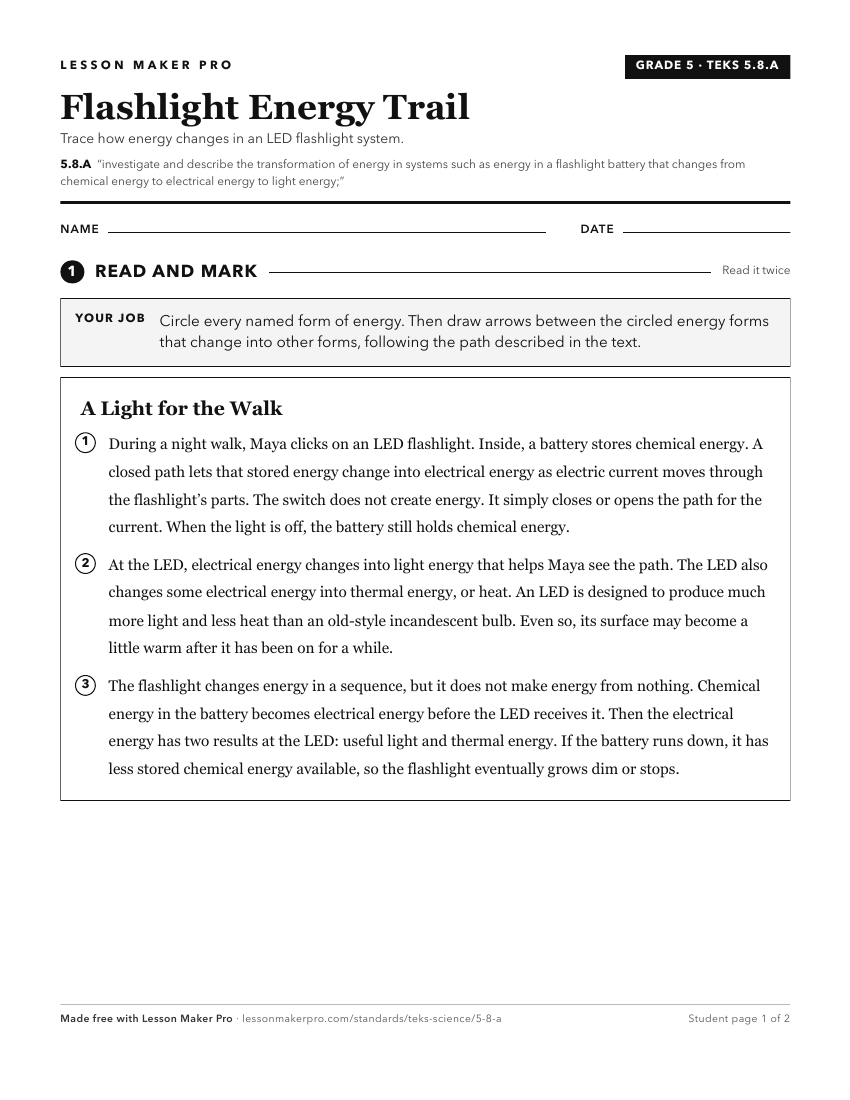
A ready-to-print activity worksheet aligned to 5.8.A, with an answer key for the teacher on its own page. No account needed.
PDF, US Letter, prints cleanly in black and white.
Download the worksheetKeep exploring
Related Standards
- 4.8.C
demonstrate and describe how electrical energy travels in a closed path that can produce light and thermal energy.
- 3.5.E
investigate the flow of energy and cycling of matter through systems
- 5.8.B
demonstrate that electrical energy in complete circuits can be transformed into motion, light, sound, or thermal energy and identify the requirements for a func...
- 4.8.A
investigate and identify the transfer of energy by objects in motion, waves in water, and sound
Turn this exact standard into a lesson
Grade, subject, topic, and the complete standard are prefilled. Create one free, no account needed.
Also for this standard:Make a WorksheetMake a QuizMake a Sub Lesson