Texas TEKS 6.8.A
The Standard
- 6.8
- Force, motion, and energy. The student knows that the total energy in systems is conserved through energy transfers and transformations. The student is expected to:
compare and contrast gravitational, elastic, and chemical potential energies with kinetic energy
Texas Essential Knowledge and Skills for Science
Teacher's field guide
What This Standard Means
What Students Need to Do
- Students identify energy stored by height, stretching, or chemical bonds and distinguish it from energy of motion. They compare where each form comes from and describe how stored energy can become motion.
What Mastery Looks Like
- Students correctly classify a raised ball, stretched rubber band, battery, and rolling cart. They justify each choice using height, shape change, chemical storage, or motion as evidence.
Common Misconceptions
- Students may think potential energy means any object that is not moving. They may overlook chemical energy in food and batteries or think gravitational energy exists only while an object falls.
How to Assess It
- Give students four examples: a book on a shelf, compressed spring, granola bar, and moving skateboard. Ask them to name each energy form and justify one answer.
Lesson moves
Ways to Teach It
Set up stations with a raised ball, stretched rubber band, battery car, and rolling marble, then have students record stored and moving energy.
Ask students to explain how a windup toy can have energy before it moves and after it is released.
Play an energy sort relay using scenario cards labeled raised, stretched, chemical, or moving, with teams defending each placement.
Have students trace energy changes in riding a bicycle, starting with food and ending with the moving bicycle.
Free download
Printable 6.8.A Worksheet
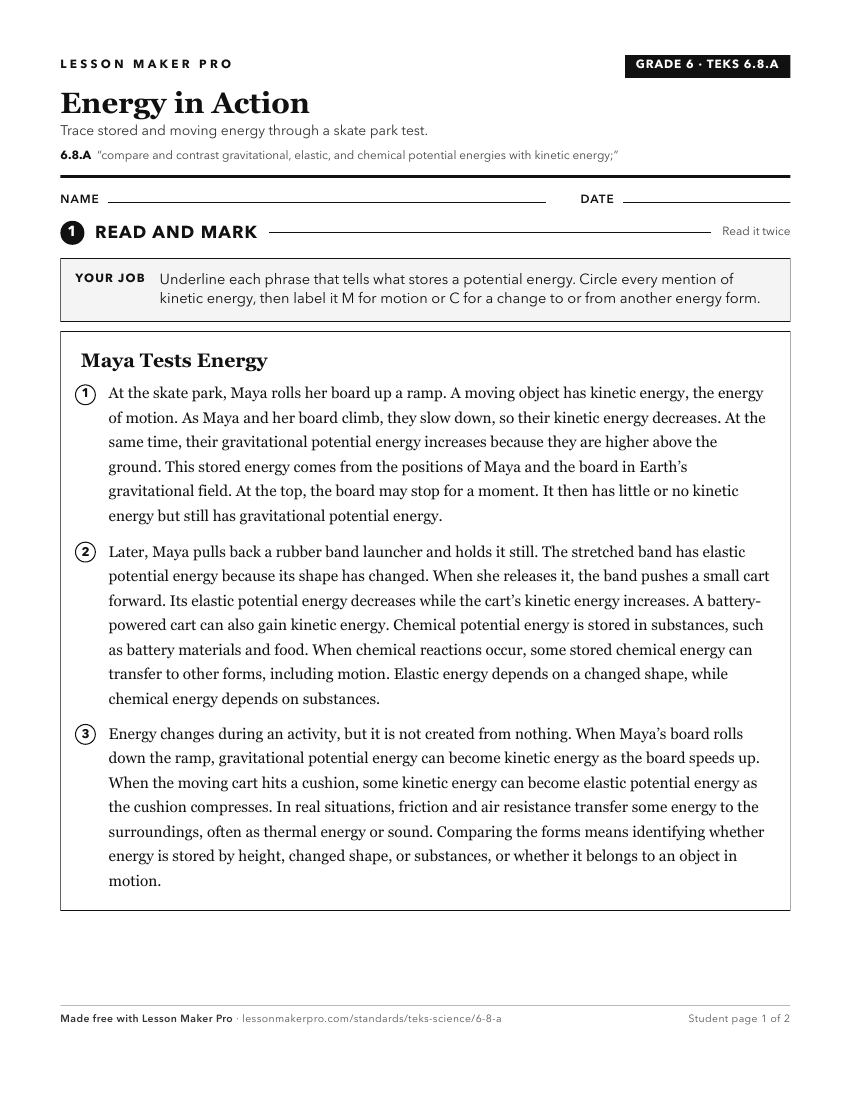
A ready-to-print activity worksheet aligned to 6.8.A, with an answer key for the teacher on its own page. No account needed.
PDF, US Letter, prints cleanly in black and white.
Download the worksheetKeep exploring
Related Standards
Turn this exact standard into a lesson
Grade, subject, topic, and the complete standard are prefilled. Create one free, no account needed.
Also for this standard:Make a WorksheetMake a QuizMake a Sub Lesson