Texas TEKS 6.7
TEKS Knowledge Statement (Expectation Cluster)
Force, motion, and energy. The student knows the nature of forces and their role in systems that experience stability or change. The student is expected to: identify and explain how forces act on objects, including gravity, friction, magnetism, applied forces, and normal forces, using real-world applications; calculate the net force on an object in a horizontal or vertical direction using diagrams and determine if the forces are balanced or unbalanced; and identify simultaneous force pairs that are equal in magnitude and opposite in direction that result from the interactions between objects using Newton's Third Law of Motion.
Texas Essential Knowledge and Skills for Science
Cluster contents
Student Expectations in This Statement
6.7 is a TEKS knowledge and skills statement. These are the student expectations under it.
- 6.7.A
identify and explain how forces act on objects, including gravity, friction, magnetism, applied forces, and normal forces, using real-world applications
- 6.7.B
calculate the net force on an object in a horizontal or vertical direction using diagrams and determine if the forces are balanced or unbalanced
- 6.7.C
identify simultaneous force pairs that are equal in magnitude and opposite in direction that result from the interactions between objects using Newton's Third L...
Teacher's field guide
What This Cluster Means
What Students Need to Do
- Students label gravity, friction, magnetic, applied, and normal forces in everyday situations. They use horizontal or vertical force diagrams to find net force and decide whether forces are balanced. They also identify equal, opposite interaction forces acting on two different objects.
What Mastery Looks Like
- Given a scenario or force diagram, a student labels each force and calculates net force with both size and direction. The student correctly calls zero net force balanced and nonzero net force unbalanced. For an interaction, the student names the force on each object without placing both arrows on one object.
Common Misconceptions
- Students often think balanced forces mean no forces are present. They may pair gravity and normal force as an interaction pair, even though both act on the same object. They may also assume an object moving right must have a net force pointing right.
How to Assess It
- Exit ticket: “A box is pushed right with 18 N, while friction is 11 N left, weight is 30 N down, and floor support is 30 N up. Draw and label the forces, find each net force, classify the forces, and name the partner to Earth’s pull on the box.”
Lesson moves
Ways to Teach It
Rotate through stations with a sliding block, bar magnets, and a book on a table, then label every force acting on each object.
Ask students to explain why a book resting on a table does not move even though gravity pulls downward.
Play force diagram match: teams pair scenario cards with diagrams, calculate net force, and sort each as balanced or unbalanced.
Analyze a swimmer pushing water backward, then identify the equal, opposite forces between the swimmer and water.
Free download
Printable 6.7 Worksheet
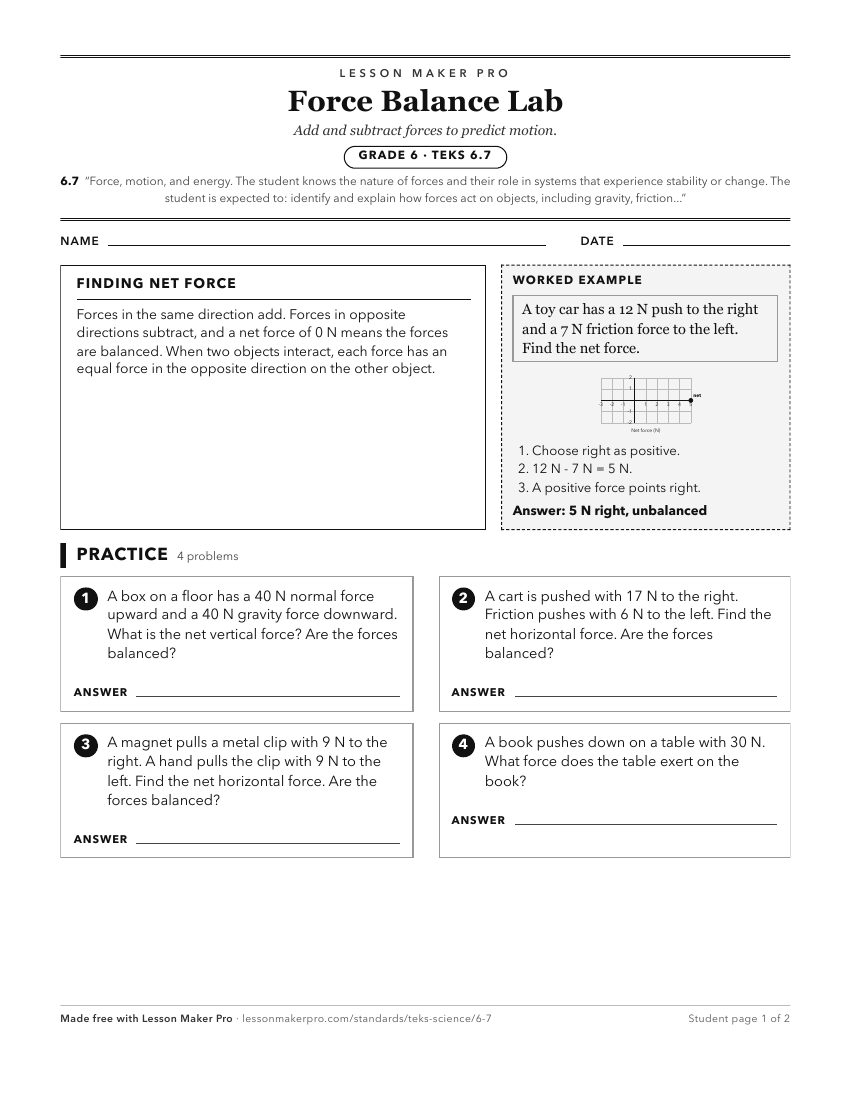
A ready-to-print activity worksheet aligned to 6.7, with an answer key for the teacher on its own page. No account needed.
PDF, US Letter, prints cleanly in black and white.
Download the worksheetKeep exploring
Related Standards
- 1.7
Force, motion, and energy. The student knows that forces cause changes in motion and position in everyday life. The student is expected to:
- 3.7
Force, motion, and energy. The student knows the nature of forces and the patterns of their interactions. The student is expected to:
- 5.7
Force, motion, and energy. The student knows the nature of forces and the patterns of their interactions. The student is expected to:
- 2.7
Force, motion, and energy. The student knows that forces cause changes in motion and position in everyday life. The student is expected to:
Turn this cluster into a lesson
Grade, subject, topic, and the complete cluster are prefilled. Create one free, no account needed.
Also for this cluster:Make a WorksheetMake a QuizMake a Sub Lesson