Texas TEKS 6.7.A
The Standard
- 6.7
- Force, motion, and energy. The student knows the nature of forces and their role in systems that experience stability or change. The student is expected to:
identify and explain how forces act on objects, including gravity, friction, magnetism, applied forces, and normal forces, using real-world applications
Texas Essential Knowledge and Skills for Science
Teacher's field guide
What This Standard Means
What Students Need to Do
- Students identify gravity, friction, magnetism, applied force, and normal force in everyday situations. They explain each force’s direction and how it changes or supports an object’s motion.
What Mastery Looks Like
- Students label forces on an object and use arrows to show their directions. They explain why an object speeds up, slows down, changes direction, or remains supported.
Common Misconceptions
- Students may treat motion as a force or think stationary objects have no forces acting on them. They may confuse normal force with gravity, or assume magnetic forces require contact.
How to Assess It
- Give students a picture of a book being pushed across a table. Ask them to label gravity, normal force, friction, and applied force with arrows and explain the book’s motion.
Lesson moves
Ways to Teach It
Slide blocks across sandpaper, foil, and fabric, then compare how friction changes their motion.
Ask students to explain why a chair supports a seated person even though gravity pulls downward.
Play force-card sorting, matching gravity, friction, magnetism, applied force, and normal force to illustrated situations.
Analyze forces on a bicycle rider braking downhill, including gravity, friction, applied force, and the road’s normal force.
Free download
Printable 6.7.A Worksheet
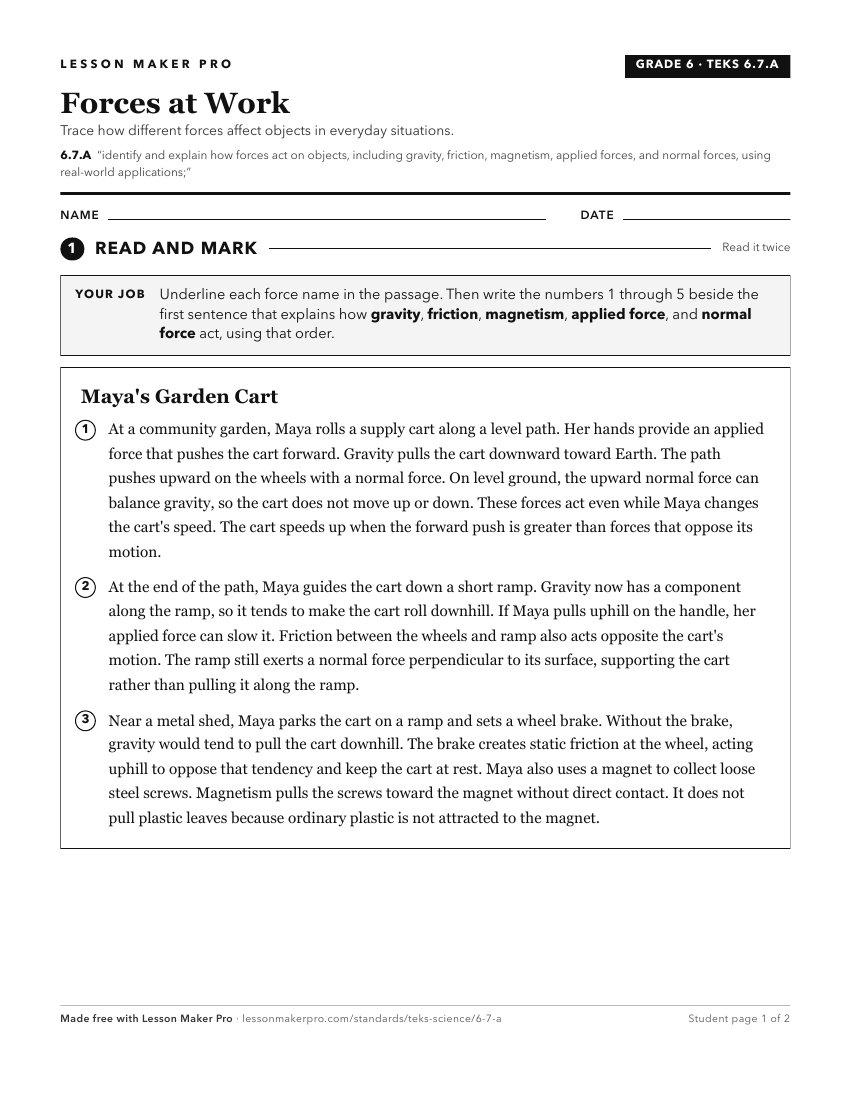
A ready-to-print activity worksheet aligned to 6.7.A, with an answer key for the teacher on its own page. No account needed.
PDF, US Letter, prints cleanly in black and white.
Download the worksheetKeep exploring
Related Standards
- 3.7.A
demonstrate and describe forces acting on an object in contact or at a distance, including magnetism, gravity, and pushes and pulls
- 5.7
Force, motion, and energy. The student knows the nature of forces and the patterns of their interactions. The student is expected to:
- 4.7
The student knows the nature of forces and the patterns of their interactions. The student is expected to plan and conduct descriptive investigations to explore...
- 5.7.A
investigate and explain how equal and unequal forces acting on an object cause patterns of motion and transfer of energy
Turn this exact standard into a lesson
Grade, subject, topic, and the complete standard are prefilled. Create one free, no account needed.
Also for this standard:Make a WorksheetMake a QuizMake a Sub Lesson