Texas TEKS 3.2
TEKS Knowledge Statement (Expectation Cluster)
Scientific and engineering practices. The student analyzes and interprets data to derive meaning, identify features and patterns, and discover relationships or correlations to develop evidence-based arguments or evaluate designs. The student is expected to: identify advantages and limitations of models such as their size, scale, properties, and materials; analyze data by identifying any significant features, patterns, or sources of error; use mathematical calculations to compare patterns and relationships; and evaluate a design or object using criteria.
Texas Essential Knowledge and Skills for Science
Cluster contents
Student Expectations in This Statement
3.2 is a TEKS knowledge and skills statement. These are the student expectations under it.
- 3.2.A
identify advantages and limitations of models such as their size, scale, properties, and materials
- 3.2.B
analyze data by identifying any significant features, patterns, or sources of error
- 3.2.C
use mathematical calculations to compare patterns and relationships
- 3.2.D
evaluate a design or object using criteria.
Teacher's field guide
What This Cluster Means
What Students Need to Do
- Students explain what a model shows well and where its size, scale, materials, or missing details make it less accurate. They inspect data for patterns and unusual results, use simple calculations to compare results, and judge designs against stated criteria.
What Mastery Looks Like
- Given a model, the student names one useful feature and one limit tied to its construction. Given test results, the student calculates totals or differences, describes a pattern, spots a possible measurement error, and uses criteria to choose a design.
Common Misconceptions
- Students may think a model is a perfect copy or that a larger model is always better. They may treat one unusual result as a pattern, ignore inconsistent trials, or choose a favorite design without checking the criteria.
How to Assess It
- Exit ticket: A paper bridge held 8, 9, and 8 cubes, while a foil bridge held 5, 14, and 6. Students total each set, flag a possible error, choose the better bridge for a 7-cube goal, and name one limitation of the test.
Lesson moves
Ways to Teach It
Build two paper bridges, test each with pennies, record three trials, then choose the design that meets a stated load goal.
Compare a globe and a flat map, then write one advantage and one limitation of each model.
Play Data Detective with result cards, awarding points for finding patterns, calculating differences, and spotting measurements that may contain errors.
Score three reusable lunch containers for capacity, leak resistance, and cost, then recommend one using the completed scorecard.
Free download
Printable 3.2 Worksheet
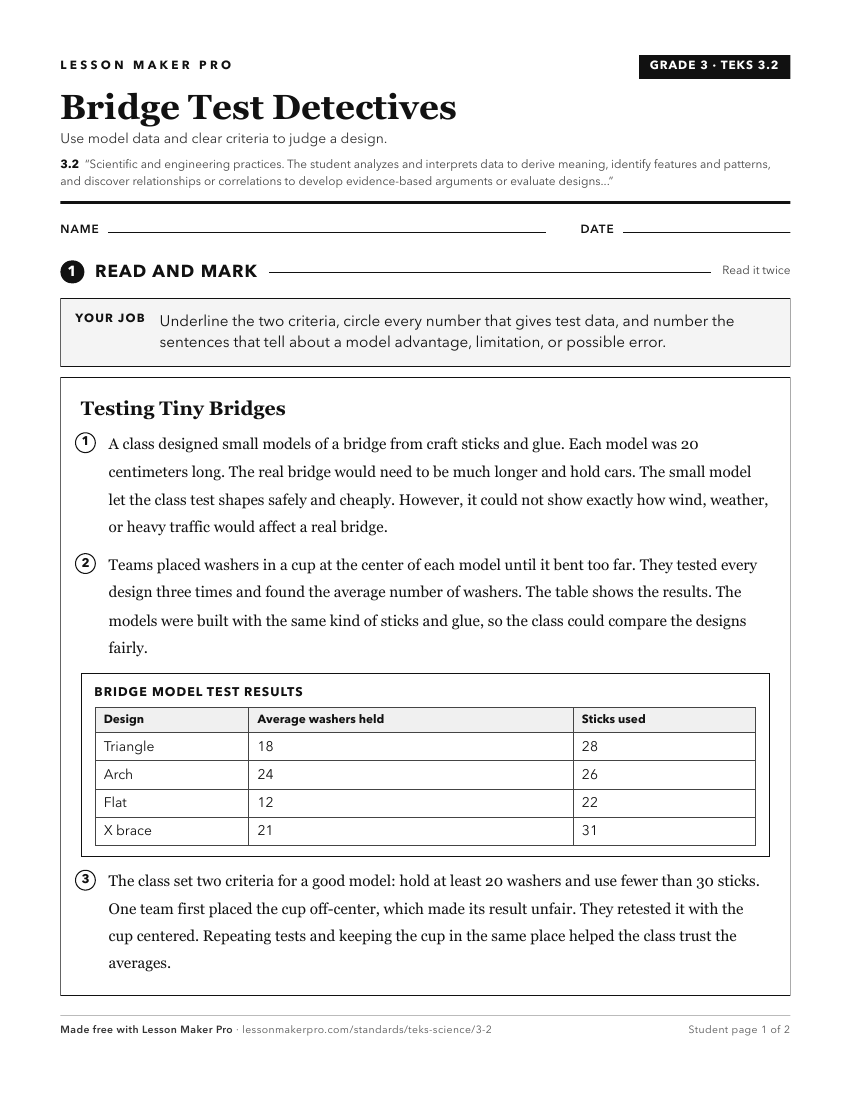
A ready-to-print activity worksheet aligned to 3.2, with an answer key for the teacher on its own page. No account needed.
PDF, US Letter, prints cleanly in black and white.
Download the worksheetKeep exploring
Related Standards
Turn this cluster into a lesson
Grade, subject, topic, and the complete cluster are prefilled. Create one free, no account needed.
Also for this cluster:Make a WorksheetMake a QuizMake a Sub Lesson