Texas TEKS 3.2.C
The Standard
- 3.2
- Scientific and engineering practices. The student analyzes and interprets data to derive meaning, identify features and patterns, and discover relationships or correlations to develop evidence-based arguments or evaluate designs. The student is expected to:
use mathematical calculations to compare patterns and relationships
Texas Essential Knowledge and Skills for Science
Teacher's field guide
What This Standard Means
What Students Need to Do
- Students use numbers from observations or measurements to find totals, differences, or changes. They compare results and explain a pattern or relationship using their calculations.
What Mastery Looks Like
- Students choose the correct operation and show their work. They use the result to make an accurate comparison, such as identifying which plant grew more and by how much.
Common Misconceptions
- Students may compare numbers by looking only at the first digit or assume the largest total shows the greatest change. They may calculate correctly but fail to connect the answer to the observed pattern.
How to Assess It
- Give students a table showing two plants growing from 6 cm to 11 cm and from 8 cm to 12 cm. Ask which grew more and require a calculation and one-sentence explanation.
Lesson moves
Ways to Teach It
Roll a toy car down two ramp heights, measure each distance, then subtract to compare how ramp height affected travel distance.
Give students a plant growth table and ask, “What number pattern do you notice, and which calculation proves it?”
Play Data Match by pairing calculation cards with data tables that show the same difference, total, or change.
Use five days of local temperatures to calculate daily changes and identify when the largest warming or cooling occurred.
Free download
Printable 3.2.C Worksheet
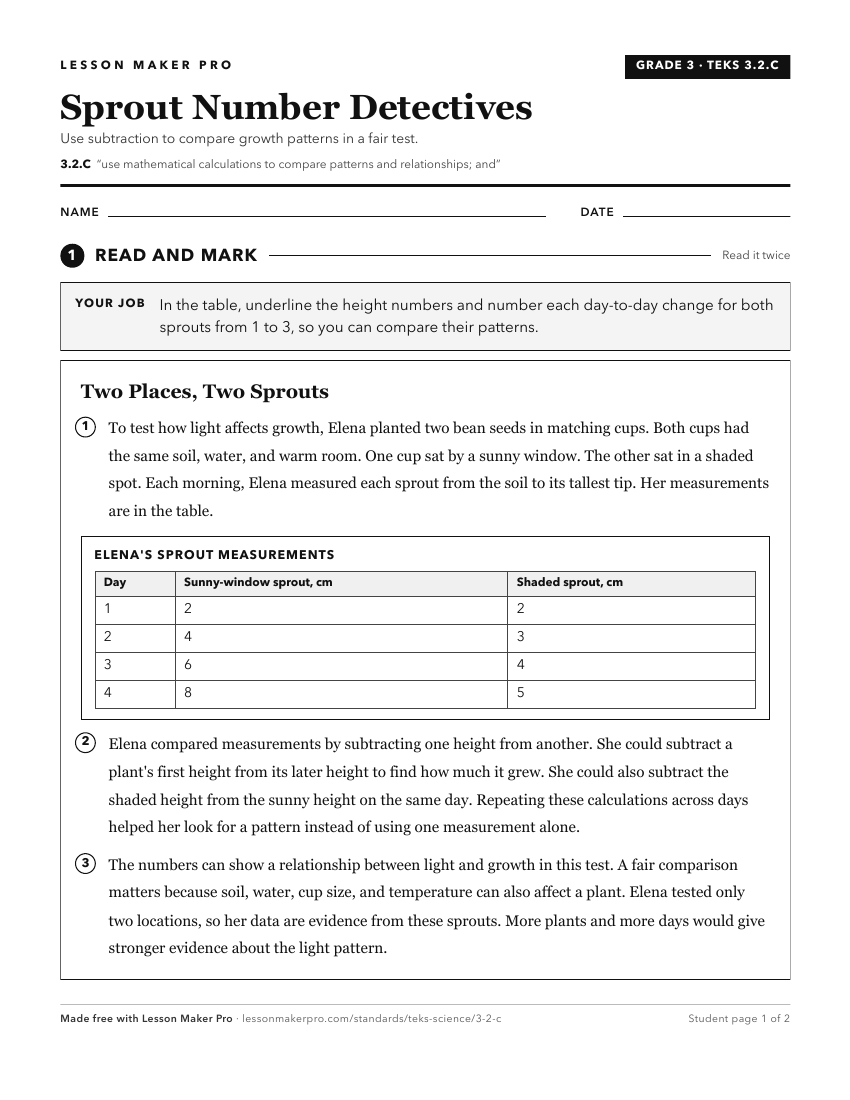
A ready-to-print activity worksheet aligned to 3.2.C, with an answer key for the teacher on its own page. No account needed.
PDF, US Letter, prints cleanly in black and white.
Download the worksheetKeep exploring
Related Standards
Turn this exact standard into a lesson
Grade, subject, topic, and the complete standard are prefilled. Create one free, no account needed.
Also for this standard:Make a WorksheetMake a QuizMake a Sub Lesson