Texas TEKS 7.2.C
The Standard
- 7.2
- Scientific and engineering practices. The student analyzes and interprets data to derive meaning, identify features and patterns, and discover relationships or correlations to develop evidence-based arguments or evaluate designs. The student is expected to:
use mathematical calculations to assess quantitative relationships in data
Texas Essential Knowledge and Skills for Science
Teacher's field guide
What This Standard Means
What Students Need to Do
- Students choose a calculation that fits the data, such as difference, average, ratio, rate, or percent change. They include units and use the result to describe a pattern or relationship.
What Mastery Looks Like
- Students select the correct values from a table or graph and calculate accurately. They show their setup, label units, and explain what the answer means for the investigation.
Common Misconceptions
- Students may reverse ratios, confuse total change with rate of change, or average values incorrectly. They may omit units or report calculator results without connecting them to the data.
How to Assess It
- Use this exit ticket: A plant grew from 8 cm to 14 cm in 3 days. Calculate its average daily growth and explain the result.
Lesson moves
Ways to Teach It
Students time a toy car over measured distances, calculate speed for each trial, and compare the results.
Give pairs a fertilizer and plant growth table, then ask: Which calculation best supports a claim about fertilizer amount and growth?
Run a card match with data sets, calculation setups, answers, and scientific claims that students must connect correctly.
Use two monthly water bills to calculate the change in household water use and identify a possible cause.
Free download
Printable 7.2.C Worksheet
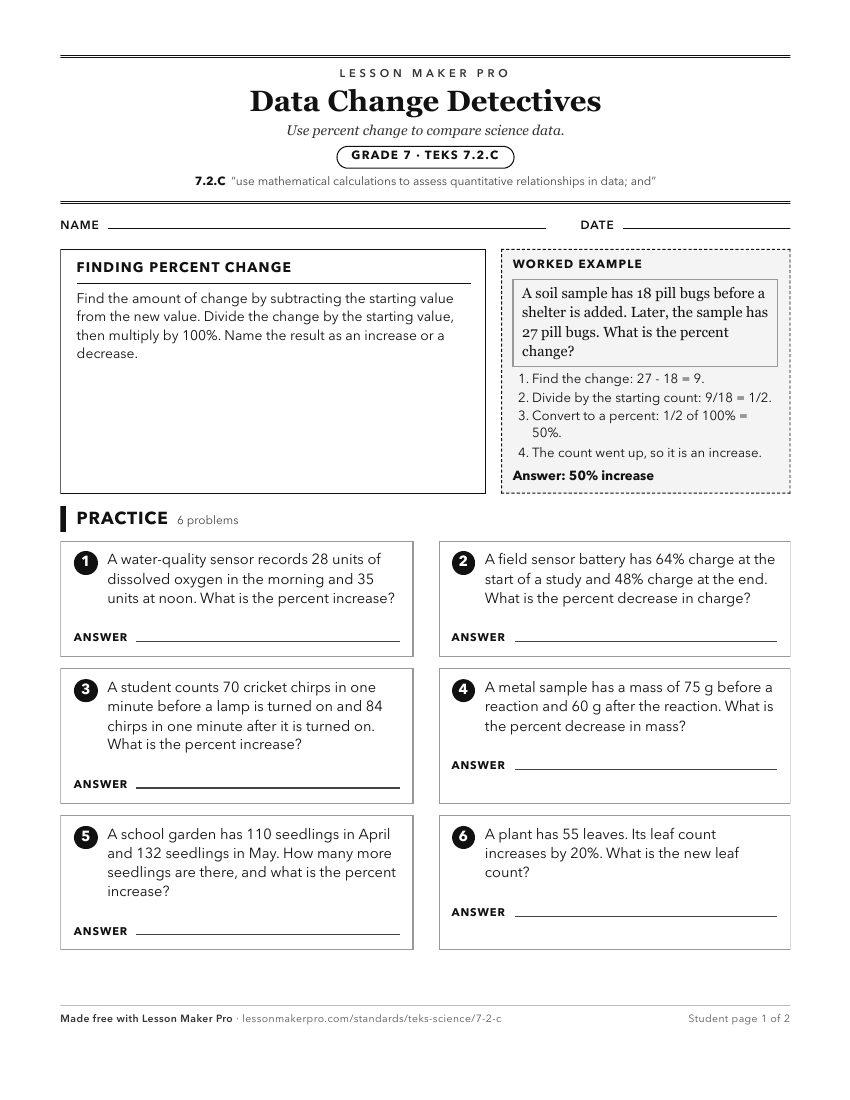
A ready-to-print activity worksheet aligned to 7.2.C, with an answer key for the teacher on its own page. No account needed.
PDF, US Letter, prints cleanly in black and white.
Download the worksheetKeep exploring
Related Standards
Turn this exact standard into a lesson
Grade, subject, topic, and the complete standard are prefilled. Create one free, no account needed.
Also for this standard:Make a WorksheetMake a QuizMake a Sub Lesson