Texas TEKS 2.2
TEKS Knowledge Statement (Expectation Cluster)
Scientific and engineering practices. The student analyzes and interprets data to derive meaning, identify features and patterns, and discover relationships or correlations to develop evidence-based arguments or evaluate designs. The student is expected to: identify basic advantages and limitations of models such as their size, properties, and materials; analyze data by identifying significant features and patterns; use mathematical concepts to compare two objects with common attributes; and evaluate a design or object using criteria to determine if it works as intended.
Texas Essential Knowledge and Skills for Science
Cluster contents
Student Expectations in This Statement
2.2 is a TEKS knowledge and skills statement. These are the student expectations under it.
- 2.2.A
identify basic advantages and limitations of models such as their size, properties, and materials
- 2.2.B
analyze data by identifying significant features and patterns
- 2.2.C
use mathematical concepts to compare two objects with common attributes
- 2.2.D
evaluate a design or object using criteria to determine if it works as intended.
Teacher's field guide
What This Cluster Means
What Students Need to Do
- Students explain what a model represents well and what its size or material cannot show. They find patterns in observations and measurements, then compare two objects using the same measurable feature. They test a design against clear rules and support a conclusion with results.
What Mastery Looks Like
- Given a globe, a student can name one useful feature and one way it differs from Earth. The student can read a simple table, describe a repeated result, and compare lengths or masses with numbers. After testing a paper bridge, the student can use the stated rules to explain whether it succeeded.
Common Misconceptions
- Students may treat a model as an exact copy, missing changes in scale, texture, or material. They may call one unusual result a pattern or compare different features, such as one object's length with another object's mass. They may say a design works because they like it, rather than checking every stated rule.
How to Assess It
- Exit ticket: Give students drawings of two paper bridges and a table listing each bridge's length and three penny-load trials. Ask, "Which bridge meets both rules, what pattern do the numbers show, and what can the drawings not show?"
Lesson moves
Ways to Teach It
Build two foil boats, predict which will hold more counters, test three times, record results, and check whether each meets a ten-counter goal.
Show a toy car and its cardboard model, then ask students to write one useful match and one misleading difference.
Play Pattern Detective with measurement cards, where pairs circle repeated changes and explain the pattern before earning a point.
Test classroom pencil holders against three rules, then recommend one for the supply table using measured height, width, and capacity.
Free download
Printable 2.2 Worksheet
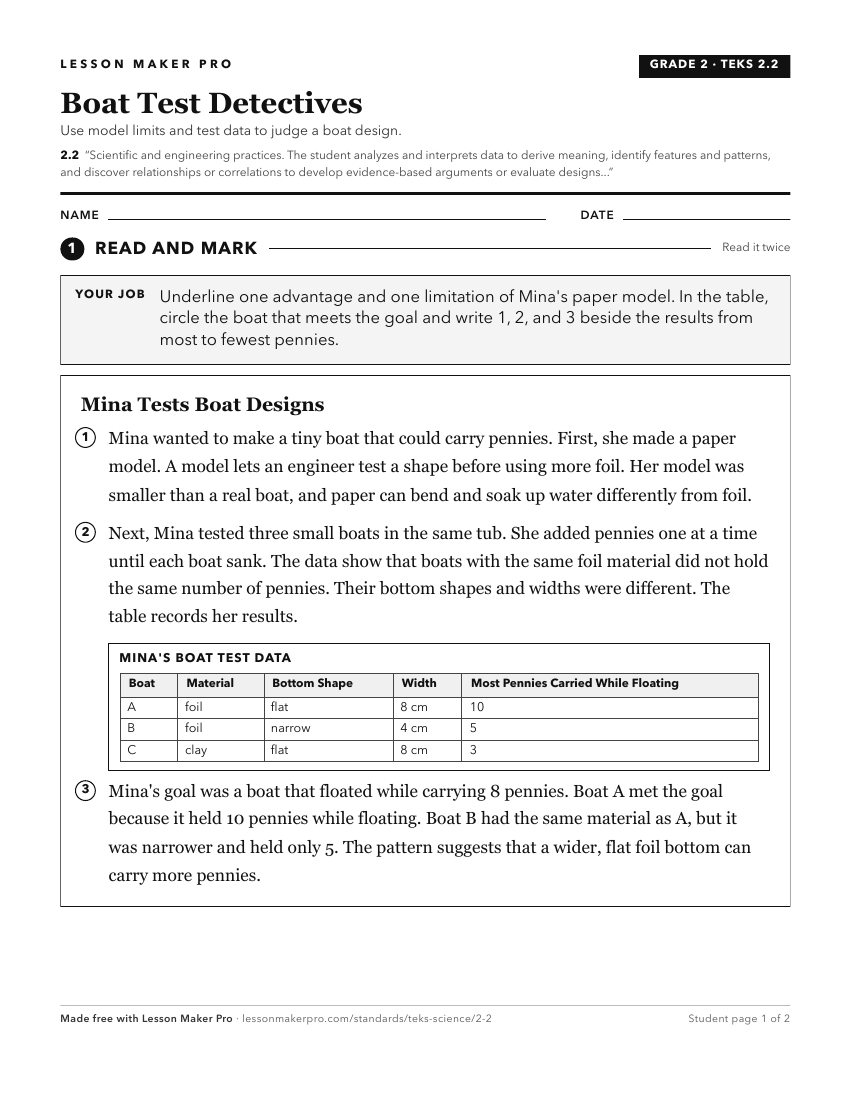
A ready-to-print activity worksheet aligned to 2.2, with an answer key for the teacher on its own page. No account needed.
PDF, US Letter, prints cleanly in black and white.
Download the worksheetKeep exploring
Related Standards
Turn this cluster into a lesson
Grade, subject, topic, and the complete cluster are prefilled. Create one free, no account needed.
Also for this cluster:Make a WorksheetMake a QuizMake a Sub Lesson