Texas TEKS 5.2
TEKS Knowledge Statement (Expectation Cluster)
Scientific and engineering practices. The student analyzes and interprets data to derive meaning, identify features and patterns, and discover relationships or correlations to develop evidence-based arguments or evaluate designs. The student is expected to: identify advantages and limitations of models such as their size, scale, properties, and materials; analyze data by identifying any significant features, patterns, or sources of error; use mathematical calculations to compare patterns and relationships; and evaluate experimental and engineering designs.
Texas Essential Knowledge and Skills for Science
Cluster contents
Student Expectations in This Statement
5.2 is a TEKS knowledge and skills statement. These are the student expectations under it.
- 5.2.A
identify advantages and limitations of models such as their size, scale, properties, and materials
- 5.2.B
analyze data by identifying any significant features, patterns, or sources of error
- 5.2.C
use mathematical calculations to compare patterns and relationships
- 5.2.D
evaluate experimental and engineering designs.
Teacher's field guide
What This Cluster Means
What Students Need to Do
- Students judge what a model represents well and where its size, scale, materials, or properties make it less accurate. They inspect data for patterns, unusual results, and possible errors, then use calculations to compare relationships. They use evidence to explain findings and decide how an experiment or engineered design could improve.
What Mastery Looks Like
- Given a model, the student names a specific advantage and limitation tied to its construction or scale. Given a table or graph, the student identifies a pattern, calculates a comparison, and flags likely error. The student uses those results to choose between designs and justify the choice with evidence.
Common Misconceptions
- Students may treat a model as an exact copy and overlook how material or scale changes its behavior. They may call any increase a pattern, ignore units, or remove an outlier without considering measurement error. They may choose the best-looking design rather than compare test results, controlled variables, and tradeoffs.
How to Assess It
- Give students load data for two paper bridges: A, 8, 9, 10 pennies; B, 11, 5, 11 pennies. Ask them to calculate each average, identify a possible error, choose the more reliable design, and name one model limitation.
Lesson moves
Ways to Teach It
Build two paper bridges with different folds, test each with pennies, graph the loads, and name one testing error and one material limitation.
Show a globe and flat world map, then ask students to write which model better shows distance, shape, and location, with reasons.
Run a data detective game where teams calculate averages from short tables, spot outliers, and earn points for explaining possible errors.
Compare crash-test results for two bicycle helmets, then have students recommend one using impact data, cost, comfort, and test limitations.
Free download
Printable 5.2 Worksheet
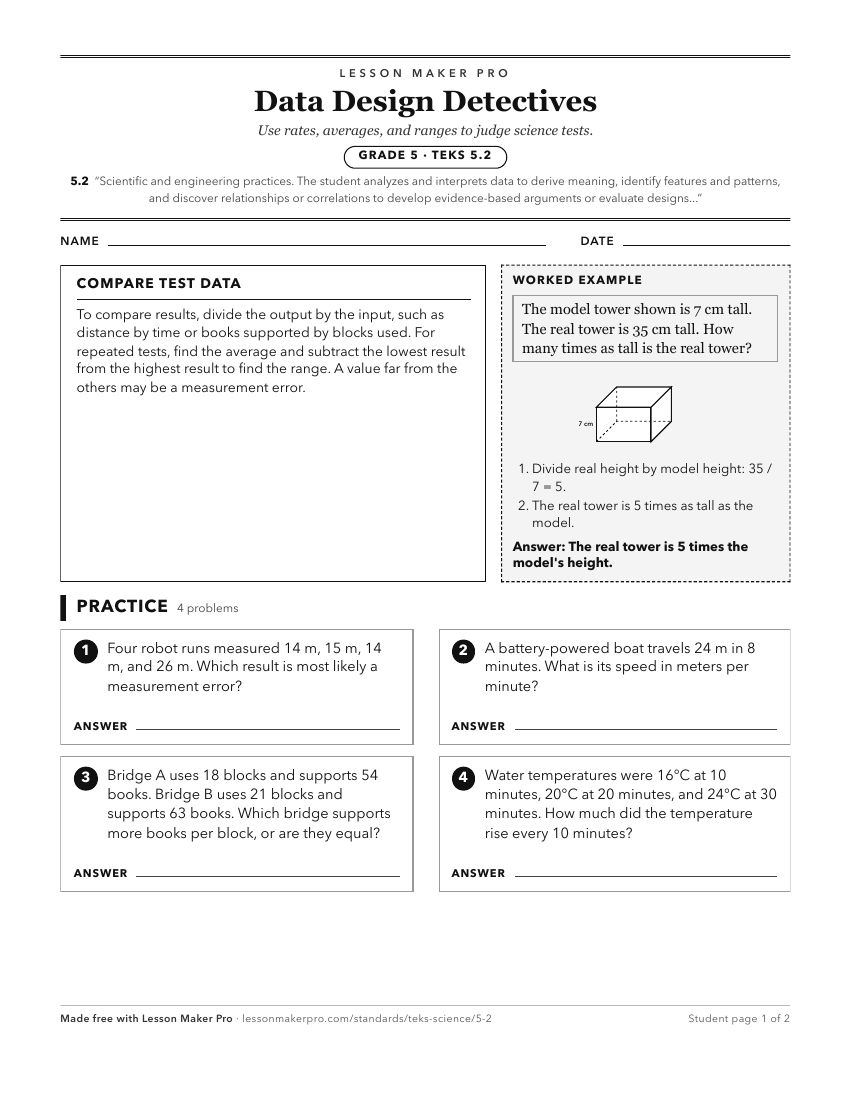
A ready-to-print activity worksheet aligned to 5.2, with an answer key for the teacher on its own page. No account needed.
PDF, US Letter, prints cleanly in black and white.
Download the worksheetKeep exploring
Related Standards
Turn this cluster into a lesson
Grade, subject, topic, and the complete cluster are prefilled. Create one free, no account needed.
Also for this cluster:Make a WorksheetMake a QuizMake a Sub Lesson