Texas TEKS 1.2
TEKS Knowledge Statement (Expectation Cluster)
Scientific and engineering practices. The student analyzes and interprets data to derive meaning, identify features and patterns, and discover relationships or correlations to develop evidence-based arguments or evaluate designs. The student is expected to: identify basic advantages and limitations of models such as their size, properties, and materials; analyze data by identifying significant features and patterns; use mathematical concepts to compare two objects with common attributes; and evaluate a design or object using criteria to determine if it works as intended.
Texas Essential Knowledge and Skills for Science
Cluster contents
Student Expectations in This Statement
1.2 is a TEKS knowledge and skills statement. These are the student expectations under it.
- 1.2.A
identify basic advantages and limitations of models such as their size, properties, and materials
- 1.2.B
analyze data by identifying significant features and patterns
- 1.2.C
use mathematical concepts to compare two objects with common attributes
- 1.2.D
evaluate a design or object using criteria to determine if it works as intended.
Teacher's field guide
What This Cluster Means
What Students Need to Do
- Students examine simple models and name what each model shows well or leaves out. They find patterns in data and use numbers to compare two objects with the same attribute. They test a design against clear criteria and decide whether it works.
What Mastery Looks Like
- A student can identify a model’s useful feature and one limit, such as its size or material. The student can describe a data pattern, compare measurements, and use test results to judge a design.
Common Misconceptions
- Students may think a model must look exactly like the real object or that a larger model is always better. They may compare different attributes, focus on one data point instead of a pattern, or say a design works without checking the criteria.
How to Assess It
- Give students a chart showing how many blocks two paper bridges held. Ask them to compare the results, name a pattern, decide which bridge met a 10-block goal, and state one limit of the model.
Lesson moves
Ways to Teach It
Pairs build two foil boats, count how many pennies each holds, record the results, and decide which boat meets a 10-penny goal.
Show a toy animal and a real animal photo, then ask, “What does the model show well, and what does it leave out?”
Students match data cards to pattern statements, such as “the plant grew each day” or “the temperature stayed the same.”
Test two classroom storage boxes, compare how many books they hold, and choose the one that meets a stated storage goal.
Free download
Printable 1.2 Worksheet
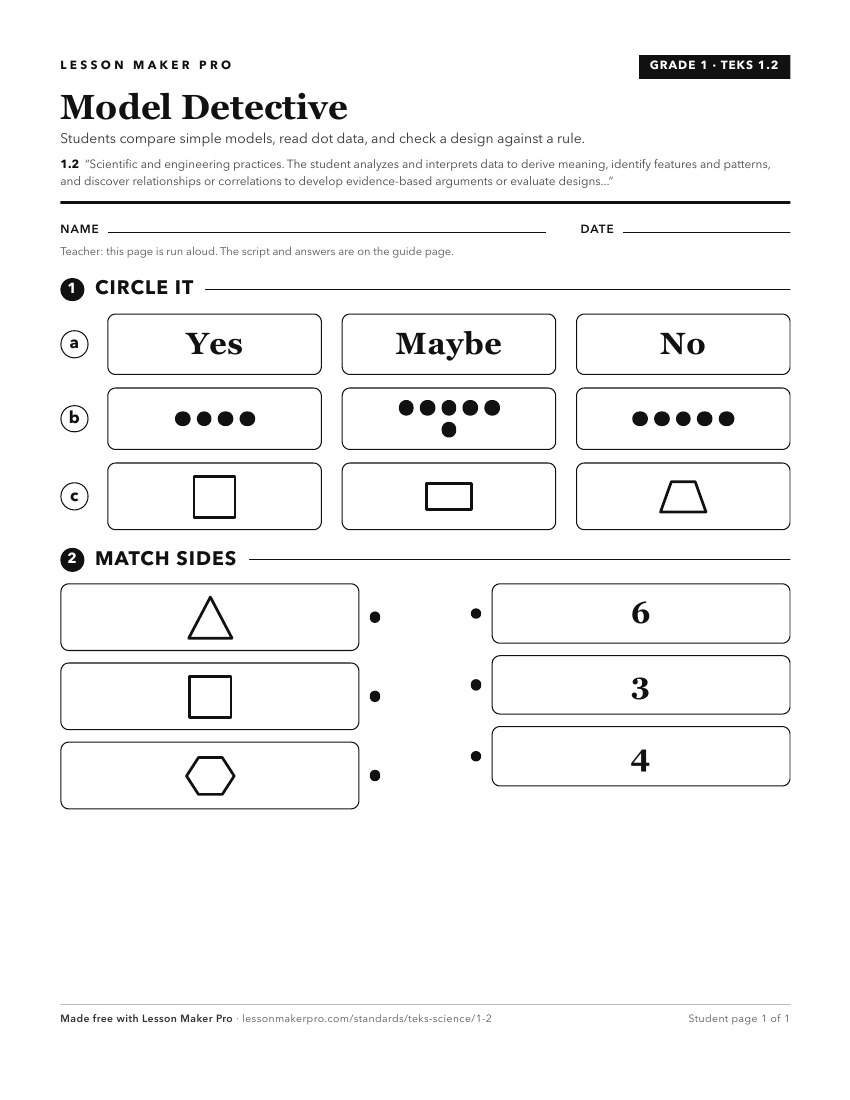
A ready-to-print activity worksheet aligned to 1.2, with an answer key for the teacher on its own page. No account needed.
PDF, US Letter, prints cleanly in black and white.
Download the worksheetKeep exploring
Related Standards
Turn this cluster into a lesson
Grade, subject, topic, and the complete cluster are prefilled. Create one free, no account needed.
Also for this cluster:Make a WorksheetMake a QuizMake a Sub Lesson