Texas TEKS 1.2.D
The Standard
- 1.2
- Scientific and engineering practices. The student analyzes and interprets data to derive meaning, identify features and patterns, and discover relationships or correlations to develop evidence-based arguments or evaluate designs. The student is expected to:
evaluate a design or object using criteria to determine if it works as intended.
Texas Essential Knowledge and Skills for Science
Teacher's field guide
What This Standard Means
What Students Need to Do
- Students name what an object should do and the rules it must meet. They test it, observe what happens, and use those results to decide whether it succeeds.
What Mastery Looks Like
- A student can test an object fairly against clear criteria. The student gives a decision and points to an observation that supports it.
Common Misconceptions
- Students may decide based on color, size, or personal preference instead of the criteria. They may also call an object successful after one partial success or change the rules after testing.
How to Assess It
- Exit ticket: A holder must keep three crayons upright for 10 seconds. Demonstrate a test, then have students circle works or not yet and record one observation.
Lesson moves
Ways to Teach It
Build paper bridges, then test whether each bridge holds 10 counters across a 20-centimeter gap without collapsing.
Show two cup towers and ask, “Which one better holds a book, and what observation supports your choice?”
Play Criteria Match by pairing object cards with test cards, then labeling each demonstrated object pass or not yet.
Inspect classroom pencil boxes using three criteria: closes fully, holds five pencils, and can be carried without spilling.
Free download
Printable 1.2.D Worksheet
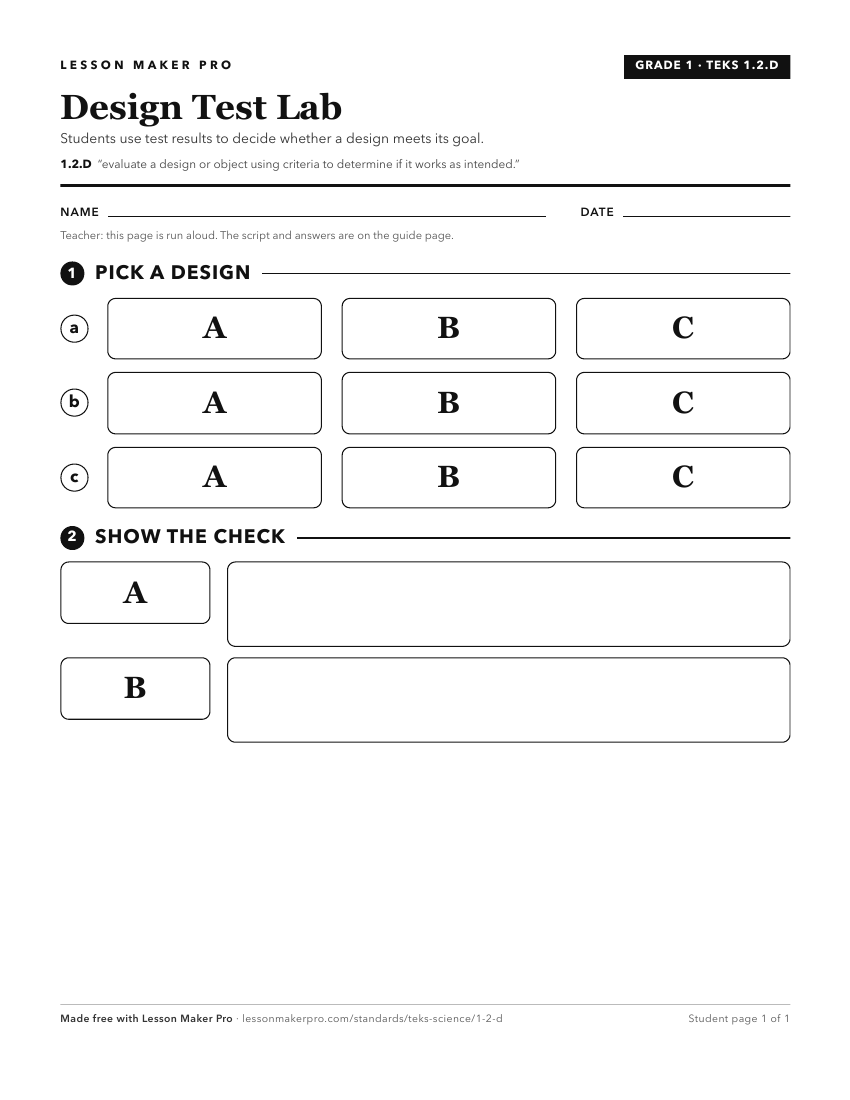
A ready-to-print activity worksheet aligned to 1.2.D, with an answer key for the teacher on its own page. No account needed.
PDF, US Letter, prints cleanly in black and white.
Download the worksheetKeep exploring
Related Standards
Turn this exact standard into a lesson
Grade, subject, topic, and the complete standard are prefilled. Create one free, no account needed.
Also for this standard:Make a WorksheetMake a QuizMake a Sub Lesson