Texas TEKS 1.2.C
The Standard
- 1.2
- Scientific and engineering practices. The student analyzes and interprets data to derive meaning, identify features and patterns, and discover relationships or correlations to develop evidence-based arguments or evaluate designs. The student is expected to:
use mathematical concepts to compare two objects with common attributes
Texas Essential Knowledge and Skills for Science
Teacher's field guide
What This Standard Means
What Students Need to Do
- Students choose one shared feature, such as length, height, mass, or number of parts. They compare the objects using numbers and words such as longer, shorter, heavier, lighter, more, less, or equal.
What Mastery Looks Like
- A student measures or counts the same feature on both objects using the same method. The student states which object has more, less, or an equal amount and supports the comparison with results.
Common Misconceptions
- Students may compare different features, such as one object’s height with another object’s width. They may use different units, misalign starting points, or assume the longer object is always heavier.
How to Assess It
- Give each student a pencil, a crayon, and connecting cubes. Ask the student to measure both lengths and write one comparison sentence using the results.
Lesson moves
Ways to Teach It
Pairs measure two classroom objects with connecting cubes, record each length, and write which is longer or whether they are equal.
Show a tall empty cup and a short full cup, then ask, “Which comparisons can we make fairly, and what must we measure?”
Play Comparison Match by pairing object cards with measurement cards, then stating a correct longer, shorter, more, less, or equal sentence.
Students compare two classroom books by height, width, and page count, then choose which book fits a given shelf space.
Free download
Printable 1.2.C Worksheet
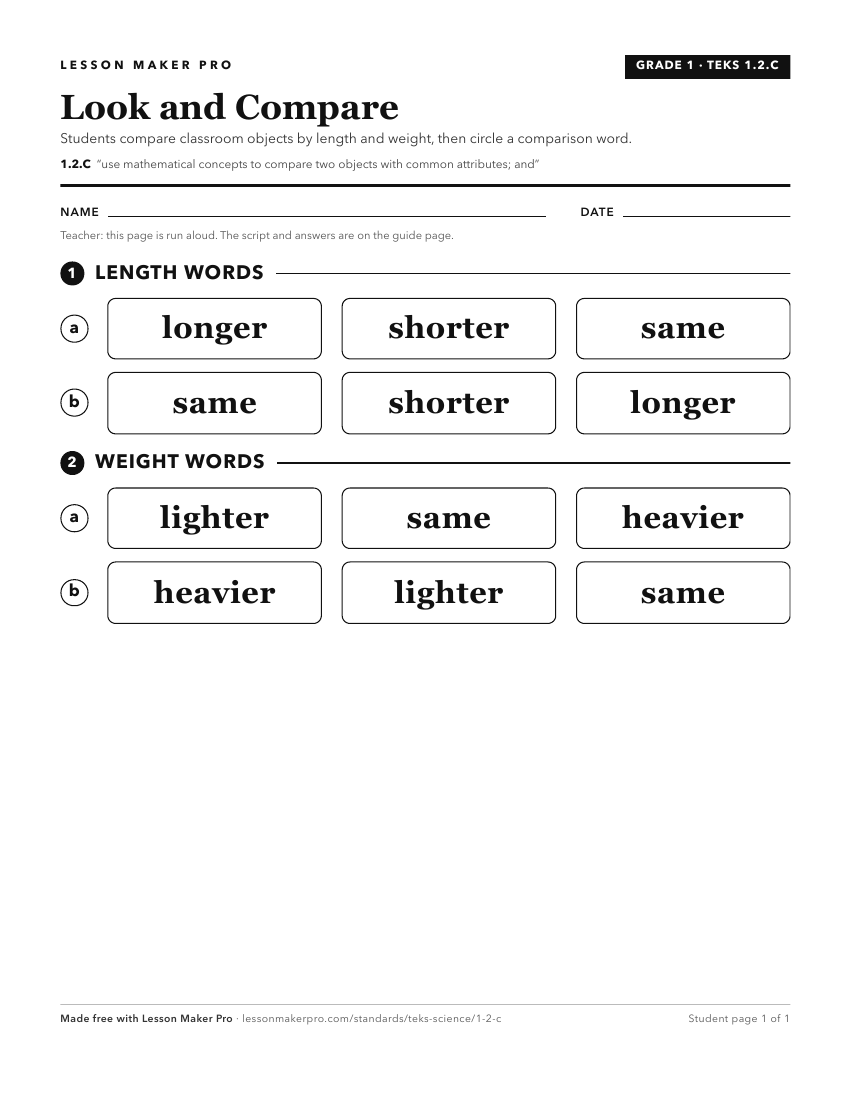
A ready-to-print activity worksheet aligned to 1.2.C, with an answer key for the teacher on its own page. No account needed.
PDF, US Letter, prints cleanly in black and white.
Download the worksheetKeep exploring
Related Standards
Turn this exact standard into a lesson
Grade, subject, topic, and the complete standard are prefilled. Create one free, no account needed.
Also for this standard:Make a WorksheetMake a QuizMake a Sub Lesson