Texas TEKS 1.12
TEKS Knowledge Statement (Expectation Cluster)
Organisms and environments. The student knows that the environment is composed of relationships between living organisms and nonliving components. The student is expected to: classify living and nonliving things based upon whether they have basic needs and produce young; describe and record examples of interactions and dependence between living and nonliving components in terrariums or aquariums; and identify and illustrate how living organisms depend on each other through food chains.
Texas Essential Knowledge and Skills for Science
Cluster contents
Student Expectations in This Statement
1.12 is a TEKS knowledge and skills statement. These are the student expectations under it.
- 1.12.A
classify living and nonliving things based upon whether they have basic needs and produce young
- 1.12.B
describe and record examples of interactions and dependence between living and nonliving components in terrariums or aquariums
- 1.12.C
identify and illustrate how living organisms depend on each other through food chains.
Teacher's field guide
What This Cluster Means
What Students Need to Do
- Students decide whether something is living by checking whether it needs resources to survive and can make more of its kind. They observe a terrarium or aquarium and record how organisms use water, light, air, soil, or shelter. They arrange organisms in simple food chains to show who eats what.
What Mastery Looks Like
- Given picture cards, a student correctly sorts living and nonliving things and explains the sorting rule. The student records two clear examples of dependence in a terrarium or aquarium. The student orders a plant, grasshopper, and frog into a food chain and explains each link.
Common Misconceptions
- Students may call plants nonliving because plants do not walk or talk. They may call water or sunlight living because organisms need them. They may reverse a food chain or think every animal eats plants directly.
How to Assess It
- Give students pictures of grass, a rabbit, a hawk, water, sunlight, and a rock. Ask them to circle living things, name two clues, draw a food chain, and tell how the rabbit depends on one nonliving thing.
Lesson moves
Ways to Teach It
Build a clear-cup terrarium with soil, a plant, water, and a pill bug, then draw what each living thing uses.
Ask how the terrarium would change without water, light, plants, or animals, then have students defend one answer with an observation.
Play a card sort relay with organisms and objects, then have teams arrange grass, grasshopper, frog, and hawk cards into a food chain.
Inspect the schoolyard for plants, insects, rocks, water, and sunlight, then sketch one way a living thing depends on its surroundings.
Free download
Printable 1.12 Worksheet
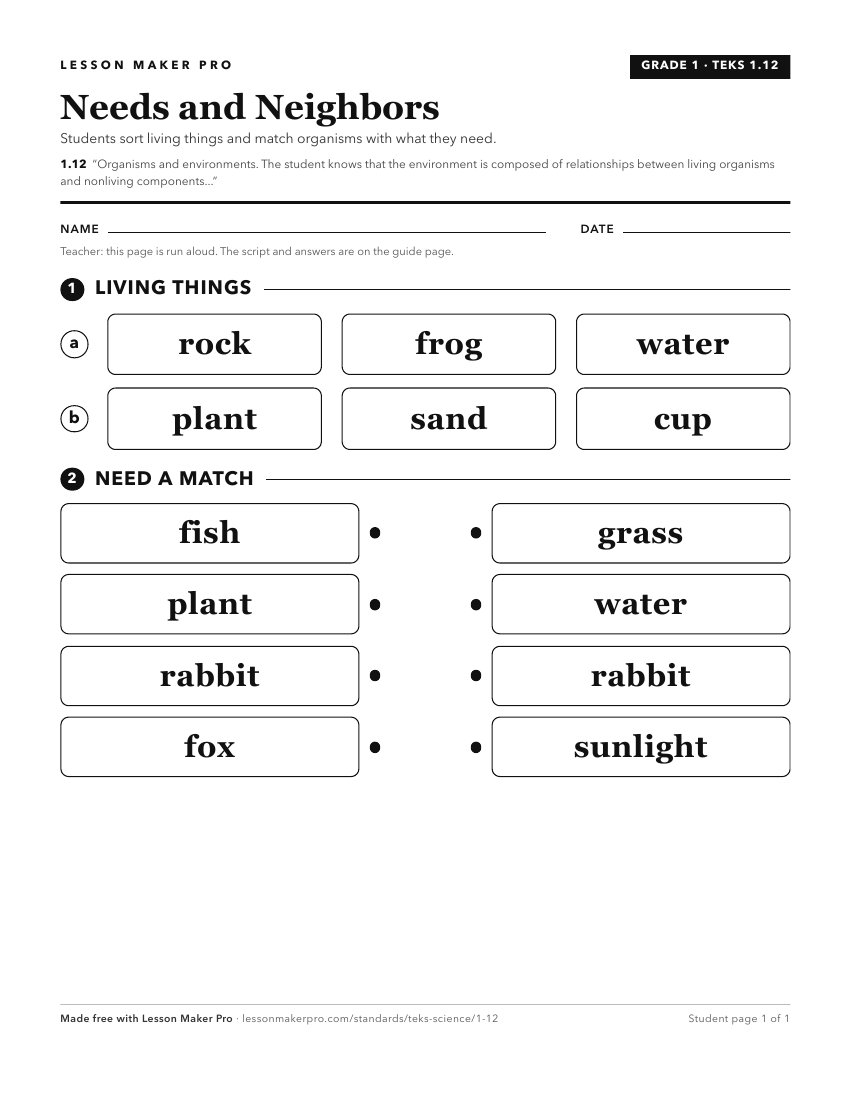
A ready-to-print activity worksheet aligned to 1.12, with an answer key for the teacher on its own page. No account needed.
PDF, US Letter, prints cleanly in black and white.
Download the worksheetKeep exploring
Related Standards
- 6.12
Organisms and environments. The student knows that interdependence occurs between living systems and the environment. The student is expected to:
- 2.13
Organisms and environments. The student knows that organisms have structures and undergo processes that help them interact and survive within their environments...
- 5.12
Organisms and environments. The student describes patterns, cycles, systems, and relationships within environments. The student is expected to:
- 2.12
Organisms and environments. The student knows that living organisms have basic needs that must be met through interactions within their environment. The student...
Turn this cluster into a lesson
Grade, subject, topic, and the complete cluster are prefilled. Create one free, no account needed.
Also for this cluster:Make a WorksheetMake a QuizMake a Sub Lesson