Texas TEKS 1.12.A
The Standard
- 1.12
- Organisms and environments. The student knows that the environment is composed of relationships between living organisms and nonliving components. The student is expected to:
classify living and nonliving things based upon whether they have basic needs and produce young
Texas Essential Knowledge and Skills for Science
Teacher's field guide
What This Standard Means
What Students Need to Do
- Students sort familiar plants, animals, and objects into living and nonliving groups. They use evidence about needs and making more of the same kind to explain each choice.
What Mastery Looks Like
- A student correctly sorts familiar plants, animals, and objects. For each living example, the student names a need and explains that its kind can make new organisms. The student explains that nonliving things cannot do these things.
Common Misconceptions
- Students may think anything that moves is alive, so they group cars and robots with animals. They may call plants nonliving because plants do not walk. They may also call fire living because it grows and uses fuel.
How to Assess It
- Show pictures of a puppy, oak tree, bird, rock, toy car, and spoon. Students circle the living things, then explain one choice by naming a need and whether it makes more of its kind.
Lesson moves
Ways to Teach It
Sort a potted plant, rock, toy car, spoon, dog card, and bird card into two groups using evidence about needs, babies, and seeds.
Ask: Is a bean plant alive even though it cannot walk? Students write a claim using water, light, and seeds as evidence.
Play Living or Nonliving Relay: teams place picture cards under two headings, then earn a point only after giving evidence.
Walk around the schoolyard and record three living and three nonliving examples, including the evidence used to classify each one.
Free download
Printable 1.12.A Worksheet
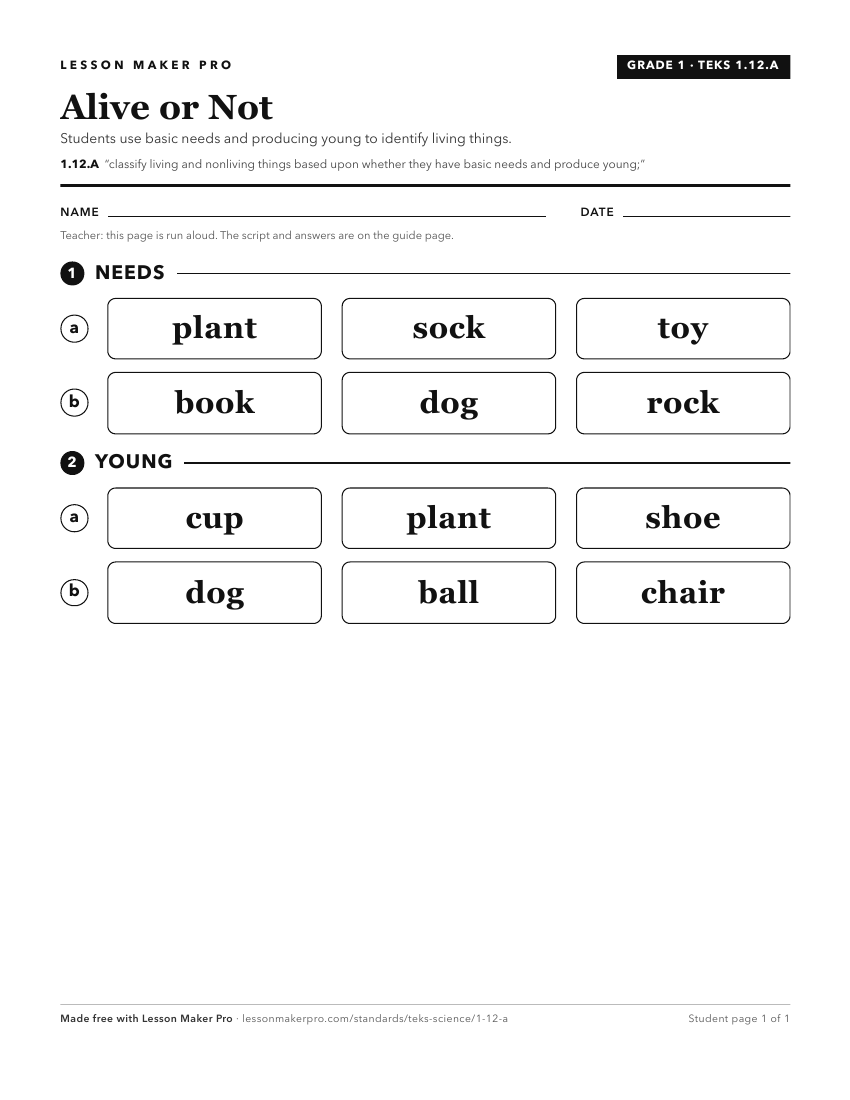
A ready-to-print activity worksheet aligned to 1.12.A, with an answer key for the teacher on its own page. No account needed.
PDF, US Letter, prints cleanly in black and white.
Download the worksheetKeep exploring
Related Standards
- 1.13.A
identify the external structures of different animals and compare how those structures help different animals live, move, and meet basic needs for survival
- 6.13.B
identify and compare the basic characteristics of organisms, including prokaryotic and eukaryotic, unicellular and multicellular, and autotrophic and heterotrop...
- 2.12.B
create and describe food chains identifying producers and consumers to demonstrate how animals depend on other living things
- 2.13.D
investigate and describe some of the unique life cycles of animals where young animals do not resemble their parents, including butterflies and frogs.
Turn this exact standard into a lesson
Grade, subject, topic, and the complete standard are prefilled. Create one free, no account needed.
Also for this standard:Make a WorksheetMake a QuizMake a Sub Lesson