Texas TEKS 2.13.D
The Standard
- 2.13
- Organisms and environments. The student knows that organisms have structures and undergo processes that help them interact and survive within their environments. The student is expected to:
investigate and describe some of the unique life cycles of animals where young animals do not resemble their parents, including butterflies and frogs.
Texas Essential Knowledge and Skills for Science
Teacher's field guide
What This Standard Means
What Students Need to Do
- Students examine pictures, models, or live observations of butterfly and frog development. They put each life cycle in order and describe how body shape, movement, and habitat change.
What Mastery Looks Like
- Given mixed pictures, a student correctly sequences the stages of both animals. The student explains how a caterpillar becomes a butterfly and how a tadpole develops legs and loses its tail.
Common Misconceptions
- Students may expect all young animals to look like smaller adults, or think caterpillars and butterflies are different animals. They may confuse a chrysalis with an egg, call tadpoles fish, or place the froglet before the tadpole.
How to Assess It
- Exit ticket: Put four butterfly pictures and four frog pictures in order. Circle one young stage that looks unlike the adult, then write one visible change.
Lesson moves
Ways to Teach It
Give pairs butterfly and frog photo cards to sequence, then have them build each cycle with clay and label every stage.
Ask, “How does a tadpole differ from an adult frog, and which changes help it live in a new place?”
Play Life Cycle Relay: teams race to place mixed stage cards in order and explain one body change before earning a point.
Use photos from a local pond or garden to predict which frog or butterfly stages people might observe there this month.
Free download
Printable 2.13.D Worksheet
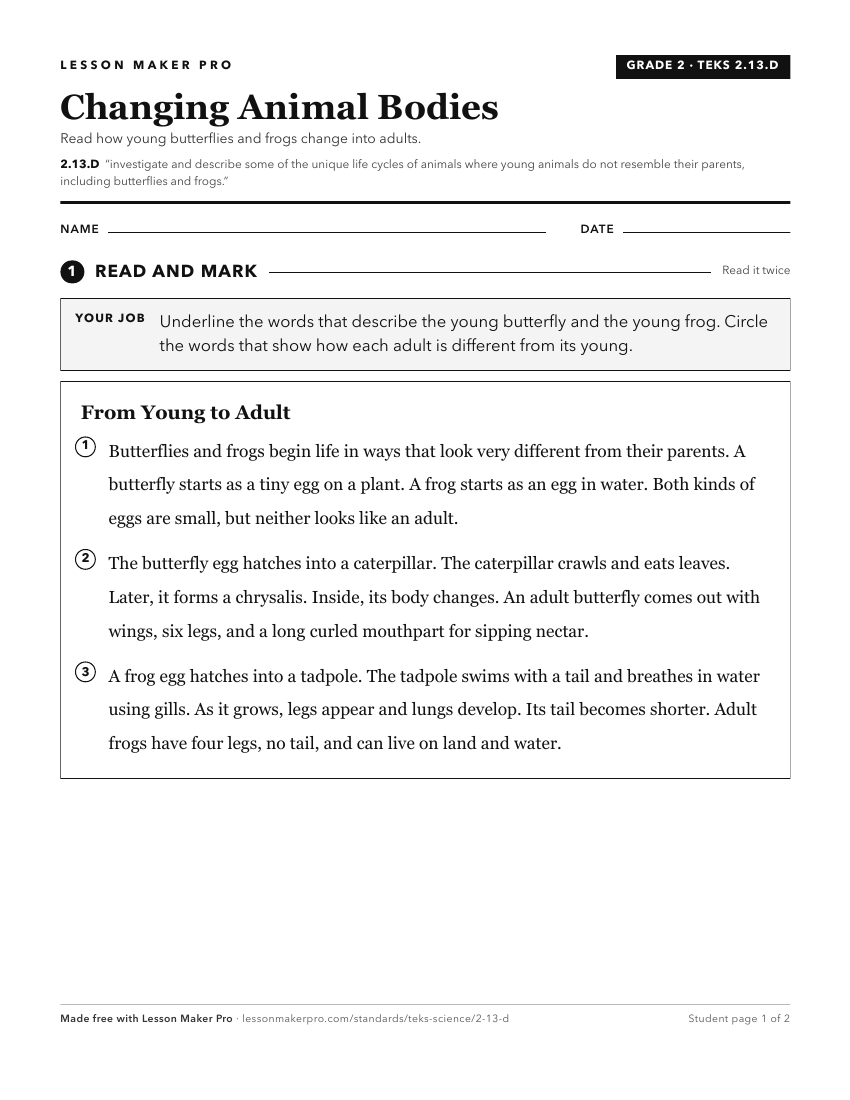
A ready-to-print activity worksheet aligned to 2.13.D, with an answer key for the teacher on its own page. No account needed.
PDF, US Letter, prints cleanly in black and white.
Download the worksheetKeep exploring
Related Standards
- 1.13.B
record observations of and describe basic life cycles of animals, including a bird, a mammal, and a fish
- 1.13.C
compare ways that young animals resemble their parents.
- 3.13.B
explore, illustrate, and compare life cycles in organisms such as beetles, crickets, radishes, or lima beans.
- 1.12.A
classify living and nonliving things based upon whether they have basic needs and produce young
Turn this exact standard into a lesson
Grade, subject, topic, and the complete standard are prefilled. Create one free, no account needed.
Also for this standard:Make a WorksheetMake a QuizMake a Sub Lesson