Texas TEKS 3.13.B
The Standard
- 3.13
- Organisms and environments. The student knows that organisms undergo similar life processes and have structures that function to help them survive within their environments. The student is expected to:
explore, illustrate, and compare life cycles in organisms such as beetles, crickets, radishes, or lima beans.
Texas Essential Knowledge and Skills for Science
Teacher's field guide
What This Standard Means
What Students Need to Do
- Students sequence the stages of animal and plant life cycles using pictures, observations, and labels. They compare stages and explain how each organism grows, reproduces, and begins a new cycle.
What Mastery Looks Like
- Students can create an accurate life cycle diagram with arrows showing the correct order. They can name similarities and differences between a beetle, cricket, radish, and lima bean life cycle.
Common Misconceptions
- Students may think all young animals look like smaller adults or that every insect has a pupa stage. They may also think a plant's cycle ends when it is fully grown, overlooking flowers, fruits, and seeds.
How to Assess It
- Give students mixed stage cards for a beetle and a lima bean. Have them sequence each cycle, then write one similarity and one difference.
Lesson moves
Ways to Teach It
Place soaked lima beans in clear bags with damp paper towels, then have students sketch and date changes each day.
Ask, “How is a beetle’s life cycle like and unlike a radish’s?” Require one similarity and two differences.
Run a card relay where teams arrange beetle, cricket, radish, and lima bean stages in the correct order.
Examine a seed packet and have students connect planting, flowering, harvest, and seed collection to stages in the plant life cycle.
Free download
Printable 3.13.B Worksheet
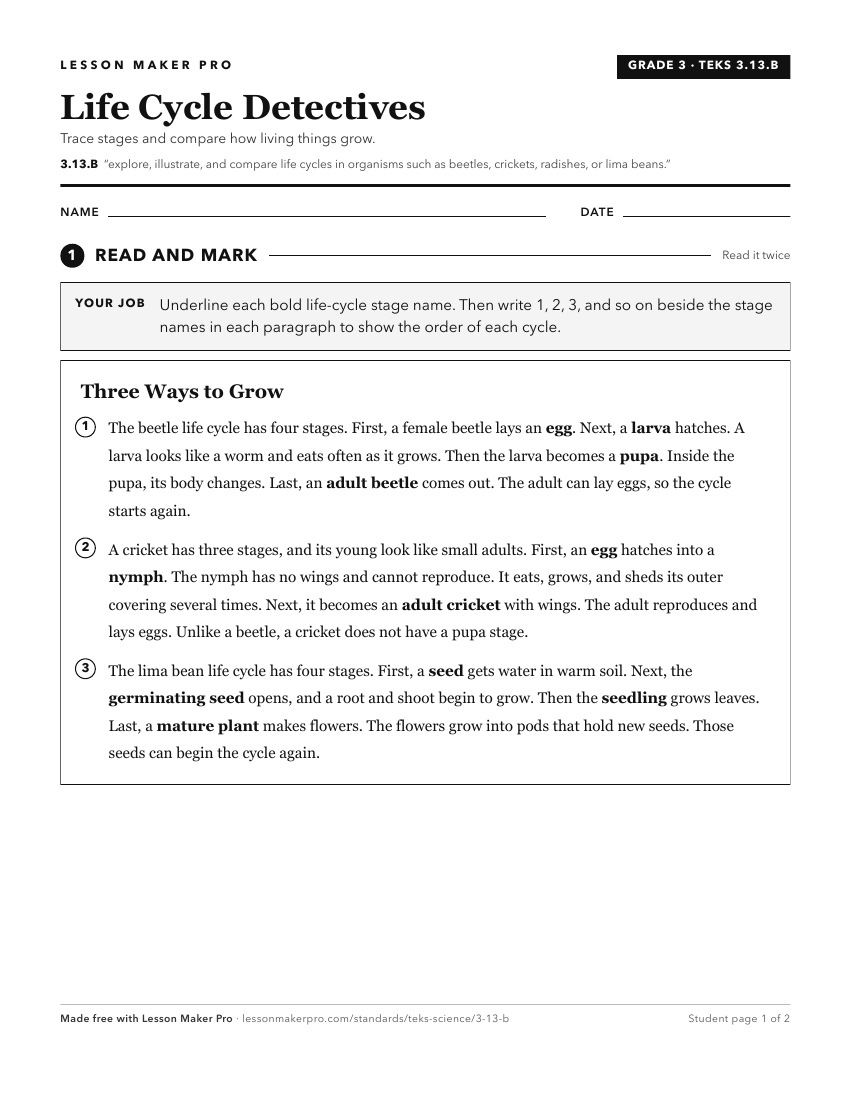
A ready-to-print activity worksheet aligned to 3.13.B, with an answer key for the teacher on its own page. No account needed.
PDF, US Letter, prints cleanly in black and white.
Download the worksheetKeep exploring
Related Standards
- 2.13.A
identify the roots, stems, leaves, flowers, fruits, and seeds of plants and compare how those structures help different plants meet their basic needs for surviv...
- 1.13.B
record observations of and describe basic life cycles of animals, including a bird, a mammal, and a fish
- 2.13.D
investigate and describe some of the unique life cycles of animals where young animals do not resemble their parents, including butterflies and frogs.
- K.13.C
identify and record the changes from seed, seedling, plant, flower, and fruit in a simple plant life cycle
Turn this exact standard into a lesson
Grade, subject, topic, and the complete standard are prefilled. Create one free, no account needed.
Also for this standard:Make a WorksheetMake a QuizMake a Sub Lesson