Texas TEKS 2.13.A
The Standard
- 2.13
- Organisms and environments. The student knows that organisms have structures and undergo processes that help them interact and survive within their environments. The student is expected to:
identify the roots, stems, leaves, flowers, fruits, and seeds of plants and compare how those structures help different plants meet their basic needs for survival
Texas Essential Knowledge and Skills for Science
Teacher's field guide
What This Standard Means
What Students Need to Do
- Students point out six main plant parts on real plants, photos, or diagrams. They explain each part's job and compare how the same part can look or work differently in two plants.
What Mastery Looks Like
- A student accurately labels roots, stems, leaves, flowers, fruits, and seeds, even when plants look different. The student uses evidence to explain how each structure helps a plant get resources, reproduce, or stay protected.
Common Misconceptions
- Students may say roots take in food, rather than water and minerals, or that leaves take in water from soil. They may confuse fruits with seeds and think fruits must be sweet. They may assume every plant has visible flowers and that all roots, stems, and leaves look alike.
How to Assess It
- On an exit ticket, show a bean plant and a strawberry plant. Ask students to label six parts, then compare one structure on the two plants.
Lesson moves
Ways to Teach It
Set out a potted flowering plant, carrot tops with roots, and sliced peppers; students find each structure and match it to a job card.
Ask, "How do cactus stems and bean stems help each plant survive?" Students cite one observation from photographs in a two-sentence response.
Play Plant Part Match with picture cards, structure name cards, and job cards; teams earn a point only after explaining each completed set.
Examine carrots, asparagus, spinach, broccoli, tomatoes, and dried beans; students sort each food by the plant structure people eat.
Free download
Printable 2.13.A Worksheet
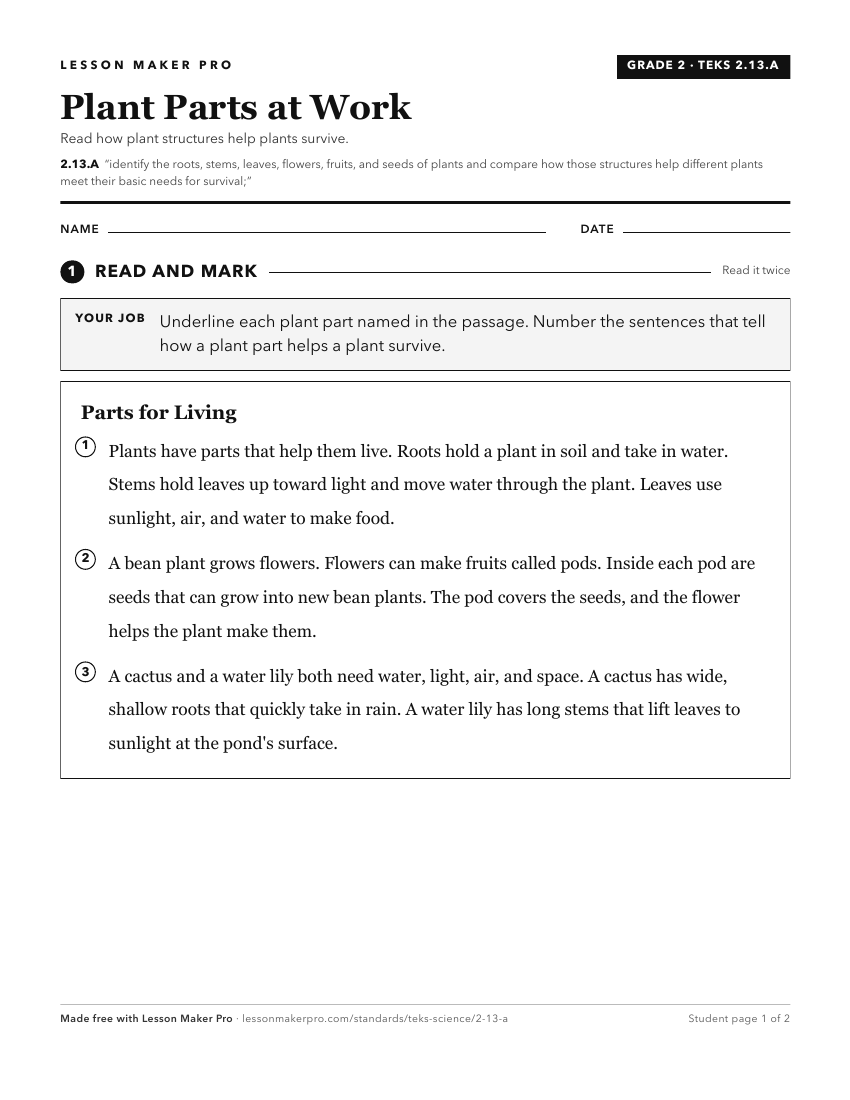
A ready-to-print activity worksheet aligned to 2.13.A, with an answer key for the teacher on its own page. No account needed.
PDF, US Letter, prints cleanly in black and white.
Download the worksheetKeep exploring
Related Standards
- K.12.A
observe and identify the dependence of plants on air, sunlight, water, nutrients in the soil, and space to grow
- 1.13.A
identify the external structures of different animals and compare how those structures help different animals live, move, and meet basic needs for survival
- K.13.A
identify the structures of plants, including roots, stems, leaves, flowers, and fruits
- 4.13.A
explore and explain how structures and functions of plants such as waxy leaves and deep roots enable them to survive in their environment
Turn this exact standard into a lesson
Grade, subject, topic, and the complete standard are prefilled. Create one free, no account needed.
Also for this standard:Make a WorksheetMake a QuizMake a Sub Lesson