Texas TEKS K.12.A
The Standard
- K.12
- Organisms and environments. The student knows that plants and animals depend on the environment to meet their basic needs for survival. The student is expected to:
observe and identify the dependence of plants on air, sunlight, water, nutrients in the soil, and space to grow
Texas Essential Knowledge and Skills for Science
Teacher's field guide
What This Standard Means
What Students Need to Do
- Students observe plants and name what helps them stay alive and grow. They use simple observations to explain what may happen when a plant lacks one need.
What Mastery Looks Like
- Students can identify air, light, water, nutrient-rich soil, and growing room as plant needs. Given a plant problem, they can name the missing need and predict the result.
Common Misconceptions
- Students may think plants eat soil or that sunlight is only for warmth. They may believe more water is always better. They may overlook air and space because neither can be held.
How to Assess It
- Exit ticket: Circle everything a plant needs from picture cards showing air, sunlight, water, nutrient-rich soil, space, milk, and a toy.
Lesson moves
Ways to Teach It
Grow matched seedlings with different amounts of light or water, then have students draw and compare changes over several days.
Show a wilted, crowded plant and ask, "What might this plant be missing, and what evidence do you see?"
Play Plant Needs Relay by having students sort picture cards into "helps plants grow" and "does not help plants grow" hoops.
Walk through the school garden and identify where each plant gets light, water, air, soil nutrients, and room to grow.
Free download
Printable K.12.A Worksheet
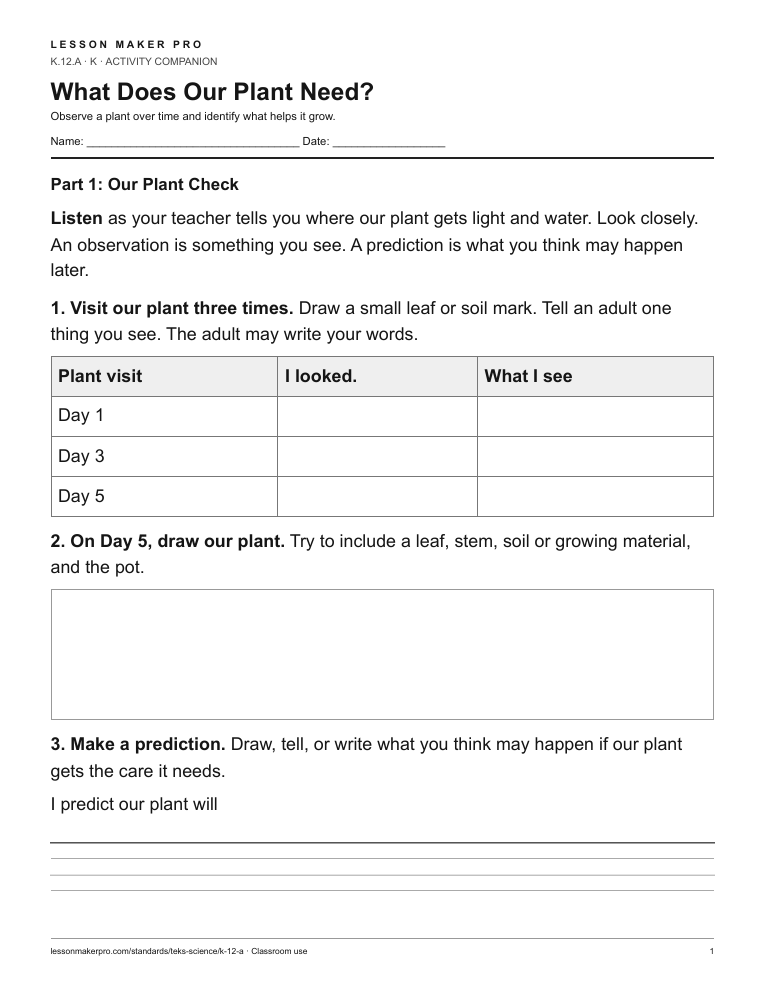
A ready-to-print activity worksheet aligned to K.12.A, with an answer key for the teacher on its own page. No account needed.
PDF, US Letter, prints cleanly in black and white.
Download the worksheetKeep exploring
Related Standards
- K.12.B
observe and identify the dependence of animals on air, water, food, space, and shelter.
- 2.13.A
identify the roots, stems, leaves, flowers, fruits, and seeds of plants and compare how those structures help different plants meet their basic needs for surviv...
- K.12
Organisms and environments. The student knows that plants and animals depend on the environment to meet their basic needs for survival. The student is expected ...
- 5.12.A
observe and describe how a variety of organisms survive by interacting with biotic and abiotic factors in a healthy ecosystem
Turn this exact standard into a lesson
Grade, subject, topic, and the complete standard are prefilled. Create one free, no account needed.
Also for this standard:Make a WorksheetMake a QuizMake a Sub Lesson