Texas TEKS K.13.A
The Standard
- K.13
- Organisms and environments. The student knows that organisms resemble their parents and have structures and undergo processes that help them interact and survive within their environments. The student is expected to:
identify the structures of plants, including roots, stems, leaves, flowers, and fruits
Texas Essential Knowledge and Skills for Science
Teacher's field guide
What This Standard Means
What Students Need to Do
- Students point to and name roots, stems, leaves, flowers, and fruits on real plants and pictures. They match each name to the correct plant part.
What Mastery Looks Like
- Given an unfamiliar flowering plant or clear diagram, a student labels all five parts correctly. The student can distinguish a fruit from a flower and a stem from a root.
Common Misconceptions
- Students may call every green part a leaf or confuse a stem with a root. They may think only sweet foods are fruits. They may expect every plant to show flowers and fruits at the same time.
How to Assess It
- Give students an unlabeled tomato plant picture and ask them to draw lines from five word cards to the matching parts.
Lesson moves
Ways to Teach It
Give pairs a potted flowering plant and sticky labels, then have them mark each visible part and locate roots through a clear cup.
Show a strawberry and ask, “Which plant part is this, and what clues support your answer?”
Play Plant Part Match with picture cards and word cards, asking students to pair each image with its name.
Walk through the school garden or grounds, photograph visible plant parts, and make a class chart of what students found.
Free download
Printable K.13.A Worksheet
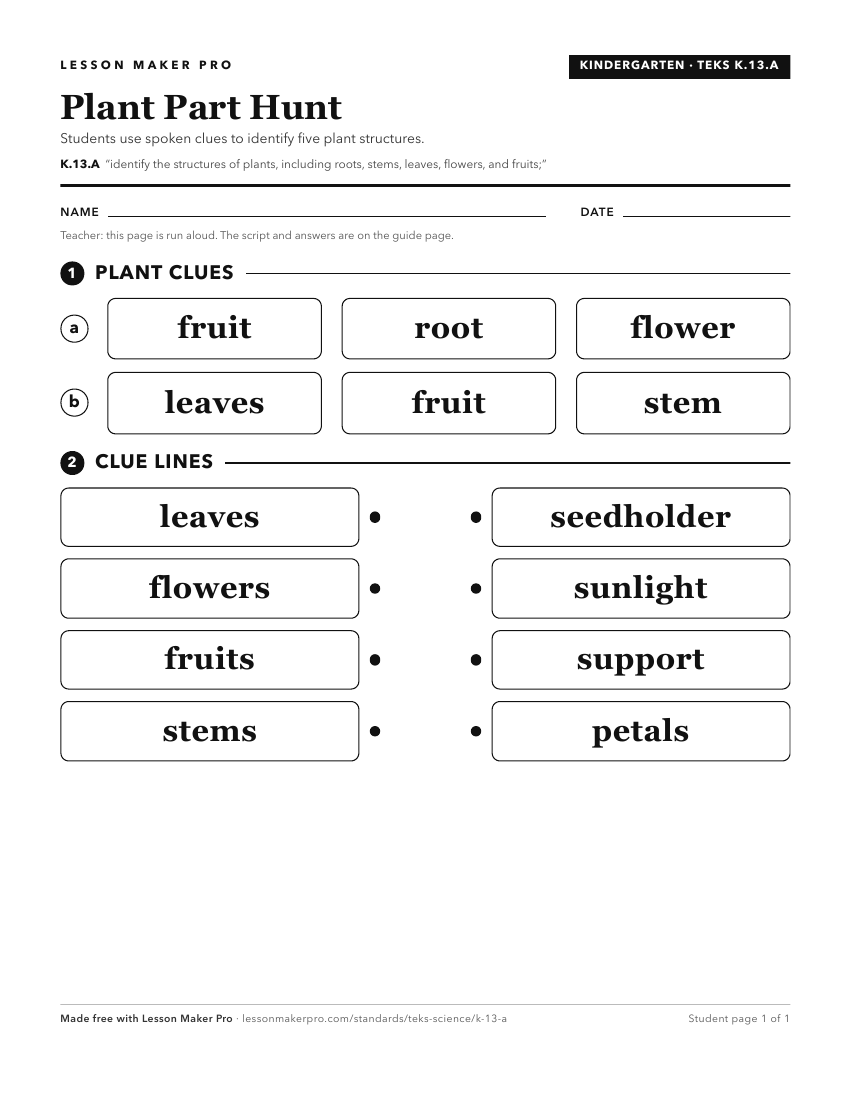
A ready-to-print activity worksheet aligned to K.13.A, with an answer key for the teacher on its own page. No account needed.
PDF, US Letter, prints cleanly in black and white.
Download the worksheetKeep exploring
Related Standards
- 2.13.A
identify the roots, stems, leaves, flowers, fruits, and seeds of plants and compare how those structures help different plants meet their basic needs for surviv...
- 4.13.A
explore and explain how structures and functions of plants such as waxy leaves and deep roots enable them to survive in their environment
- K.13.B
identify the different structures that animals have that allow them to interact with their environment such as seeing, hearing, moving, and grasping objects
- K.13.C
identify and record the changes from seed, seedling, plant, flower, and fruit in a simple plant life cycle
Turn this exact standard into a lesson
Grade, subject, topic, and the complete standard are prefilled. Create one free, no account needed.
Also for this standard:Make a WorksheetMake a QuizMake a Sub Lesson