Texas TEKS 1.13.B
The Standard
- 1.13
- Organisms and environments. The student knows that organisms resemble their parents and have structures and undergo processes that help them interact and survive within their environments. The student is expected to:
record observations of and describe basic life cycles of animals, including a bird, a mammal, and a fish
Texas Essential Knowledge and Skills for Science
Teacher's field guide
What This Standard Means
What Students Need to Do
- Students observe how a bird, mammal, and fish change as they grow. They record what they see with labeled drawings, words, or simple charts, then put life stages in order.
What Mastery Looks Like
- Students can sequence the life stages of a chicken, dog, and goldfish from young to adult. They can describe visible changes and use observations as evidence.
Common Misconceptions
- Students may think every animal hatches from an egg or that young animals look exactly like adults. They may also treat growth as a straight line and forget that adults produce young.
How to Assess It
- Give students shuffled picture cards for a chicken, dog, and goldfish. Ask them to order each set and write one change the animal shows.
Lesson moves
Ways to Teach It
Use clay to build young and adult models of a chicken, dog, and goldfish, then label the changes.
Show two life stage photos and ask, “What changed, and what stayed the same?” Students write or draw two observations.
Play a sequencing relay where teams arrange animal life cycle cards and explain one placement before earning a point.
Examine pet care records or aquarium photos to track how an animal’s size, body features, and needs change over time.
Free download
Printable 1.13.B Worksheet
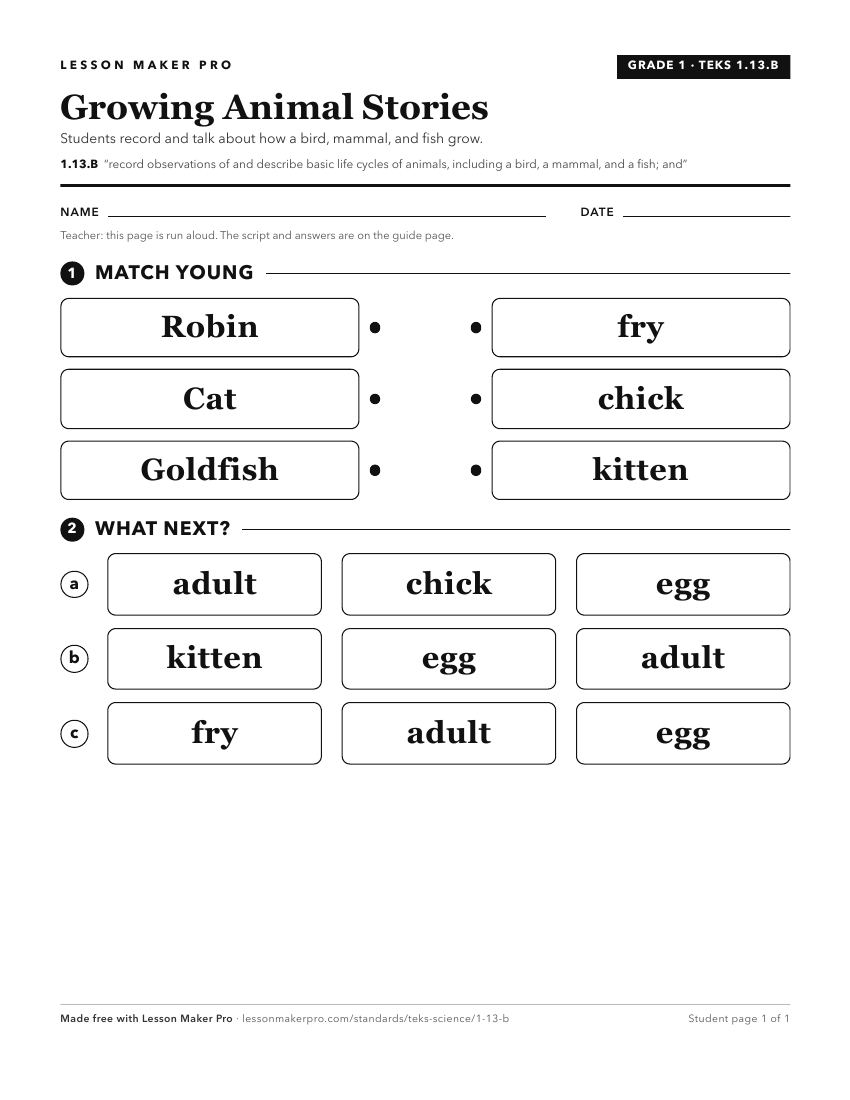
A ready-to-print activity worksheet aligned to 1.13.B, with an answer key for the teacher on its own page. No account needed.
PDF, US Letter, prints cleanly in black and white.
Download the worksheetKeep exploring
Related Standards
- 2.13.B
record and compare how the structures and behaviors of animals help them find and take in food, water, and air
- 2.13.D
investigate and describe some of the unique life cycles of animals where young animals do not resemble their parents, including butterflies and frogs.
- 2.13.C
record and compare how being part of a group helps animals obtain food, defend themselves, and cope with changes
- K.13.C
identify and record the changes from seed, seedling, plant, flower, and fruit in a simple plant life cycle
Turn this exact standard into a lesson
Grade, subject, topic, and the complete standard are prefilled. Create one free, no account needed.
Also for this standard:Make a WorksheetMake a QuizMake a Sub Lesson