Texas TEKS 2.13.B
The Standard
- 2.13
- Organisms and environments. The student knows that organisms have structures and undergo processes that help them interact and survive within their environments. The student is expected to:
record and compare how the structures and behaviors of animals help them find and take in food, water, and air
Texas Essential Knowledge and Skills for Science
Teacher's field guide
What This Standard Means
What Students Need to Do
- Students identify body parts and actions animals use to get food, water, and oxygen. They record observations and compare how two animals meet the same need differently.
What Mastery Looks Like
- A student can name a relevant structure or behavior and explain its job using evidence. The student can organize observations in a table and state a clear similarity or difference.
Common Misconceptions
- Students may confuse a body structure, such as a beak, with a behavior, such as pecking. They may think all animals drink water or breathe air in the same way.
How to Assess It
- Show pictures of a duck and a fish. Ask students to name one structure or behavior each uses to get food, water, or oxygen, then compare them.
Lesson moves
Ways to Teach It
Use spoons, tweezers, and clothespins as beaks to collect different foods, then record which tool works best for each food.
Show a hummingbird and frog, then ask students to write how each animal's body and actions help it get food.
Play a card match game pairing animals with structures, behaviors, and needs, such as a fish, gills, swimming, and oxygen.
Observe birds at a feeder or watch a short feeder video, then record how beaks and movements help different birds eat.
Free download
Printable 2.13.B Worksheet
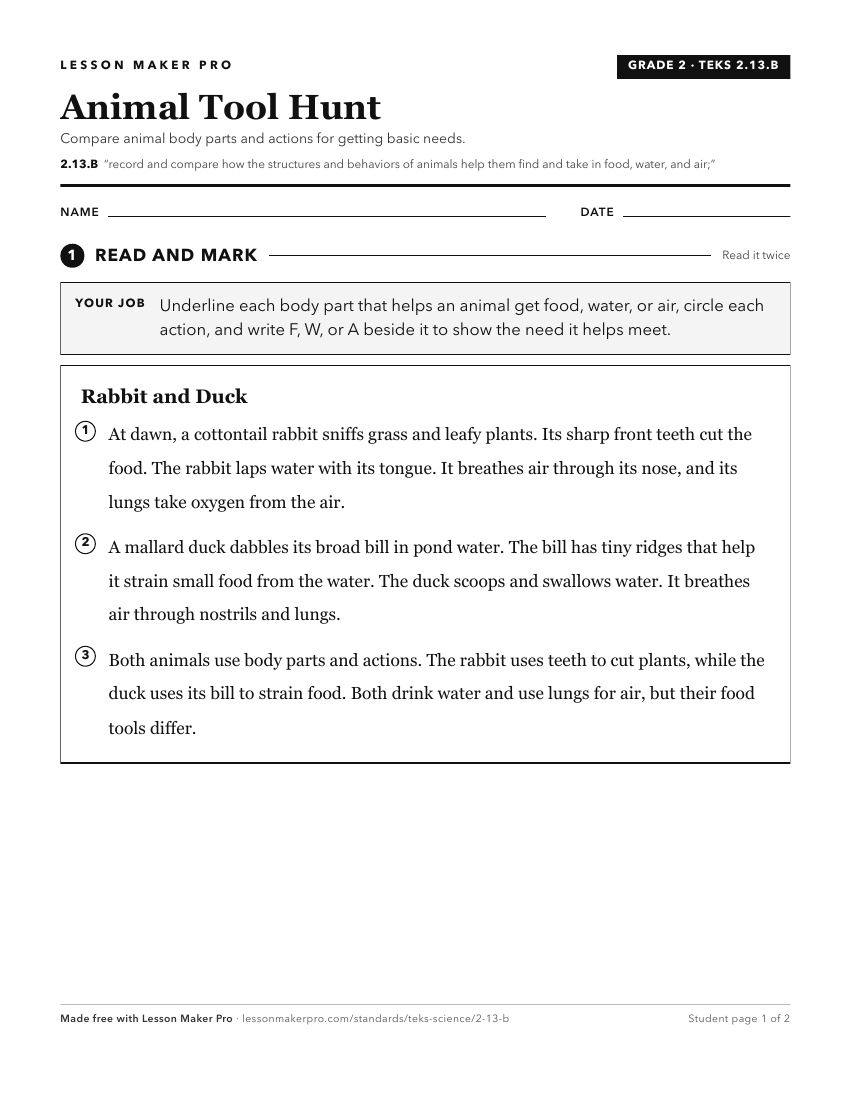
A ready-to-print activity worksheet aligned to 2.13.B, with an answer key for the teacher on its own page. No account needed.
PDF, US Letter, prints cleanly in black and white.
Download the worksheetKeep exploring
Related Standards
- K.12.B
observe and identify the dependence of animals on air, water, food, space, and shelter.
- 1.13.A
identify the external structures of different animals and compare how those structures help different animals live, move, and meet basic needs for survival
- 2.13.C
record and compare how being part of a group helps animals obtain food, defend themselves, and cope with changes
- K.13.B
identify the different structures that animals have that allow them to interact with their environment such as seeing, hearing, moving, and grasping objects
Turn this exact standard into a lesson
Grade, subject, topic, and the complete standard are prefilled. Create one free, no account needed.
Also for this standard:Make a WorksheetMake a QuizMake a Sub Lesson