Texas TEKS 6.13.B
The Standard
- 6.13
- Organisms and environments. The student knows that organisms have an organizational structure and variations can influence survival of populations. The student is expected to:
identify and compare the basic characteristics of organisms, including prokaryotic and eukaryotic, unicellular and multicellular, and autotrophic and heterotrophic
Texas Essential Knowledge and Skills for Science
Teacher's field guide
What This Standard Means
What Students Need to Do
- Students sort organisms by cell type, number of cells, and how they obtain energy. They compare examples and use observable or described traits as evidence.
What Mastery Looks Like
- Students can classify bacteria, protists, fungi, plants, and animals using all three trait pairs. They can explain each choice without treating the pairs as one category.
Common Misconceptions
- Students may think every unicellular organism is prokaryotic or every autotroph is a plant. They may assume all bacteria are harmful. They also confuse heterotrophs with animals only.
How to Assess It
- Give students descriptions of a bacterium, amoeba, mushroom, and oak tree. Ask them to label each by cell type, cell number, and energy source.
Lesson moves
Ways to Teach It
Have groups sort organism cards into overlapping hoops labeled by cell type, cell number, and energy source, then defend two placements.
Ask students to explain why an amoeba and a bacterium are both unicellular but belong in different cell type groups.
Play Trait Match, where students pair organism cards with three correct trait cards and earn a point for each accurate explanation.
Compare yeast, lettuce, and yogurt bacteria found in foods, then classify each organism by its cells and energy source.
Free download
Printable 6.13.B Worksheet
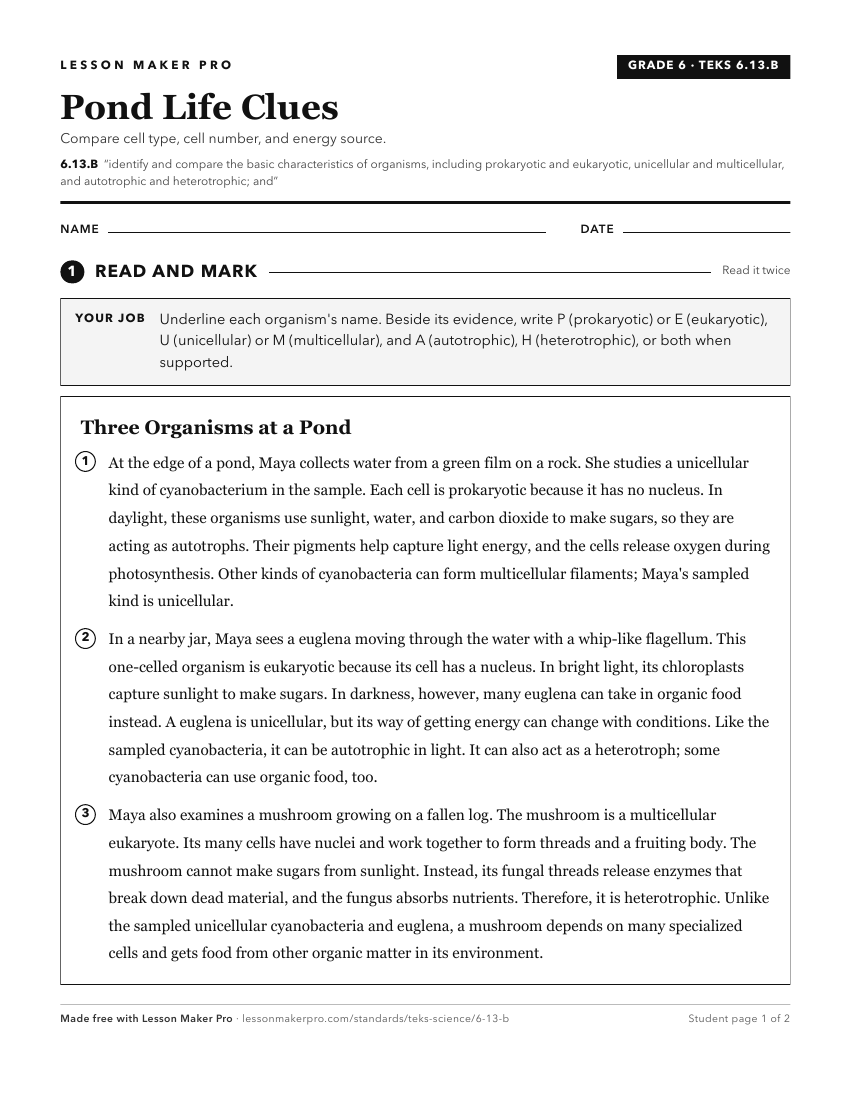
A ready-to-print activity worksheet aligned to 6.13.B, with an answer key for the teacher on its own page. No account needed.
PDF, US Letter, prints cleanly in black and white.
Download the worksheetKeep exploring
Related Standards
- 1.13.A
identify the external structures of different animals and compare how those structures help different animals live, move, and meet basic needs for survival
- 2.13.A
identify the roots, stems, leaves, flowers, fruits, and seeds of plants and compare how those structures help different plants meet their basic needs for surviv...
- 5.13.A
analyze the structures and functions of different species to identify how organisms survive in the same environment
- 1.12.A
classify living and nonliving things based upon whether they have basic needs and produce young
Turn this exact standard into a lesson
Grade, subject, topic, and the complete standard are prefilled. Create one free, no account needed.
Also for this standard:Make a WorksheetMake a QuizMake a Sub Lesson