Texas TEKS 5.12
TEKS Knowledge Statement (Expectation Cluster)
Organisms and environments. The student describes patterns, cycles, systems, and relationships within environments. The student is expected to: observe and describe how a variety of organisms survive by interacting with biotic and abiotic factors in a healthy ecosystem; predict how changes in the ecosystem affect the cycling of matter and flow of energy in a food web; and describe a healthy ecosystem and how human activities can be beneficial or harmful to an ecosystem.
Texas Essential Knowledge and Skills for Science
Cluster contents
Student Expectations in This Statement
5.12 is a TEKS knowledge and skills statement. These are the student expectations under it.
- 5.12.A
observe and describe how a variety of organisms survive by interacting with biotic and abiotic factors in a healthy ecosystem
- 5.12.B
predict how changes in the ecosystem affect the cycling of matter and flow of energy in a food web
- 5.12.C
describe a healthy ecosystem and how human activities can be beneficial or harmful to an ecosystem.
Teacher's field guide
What This Cluster Means
What Students Need to Do
- Students identify how living things use other organisms and nonliving resources such as water, light, air, soil, and temperature. They trace matter and energy through food webs, predict the effects of environmental changes, and judge how people help or harm ecosystem health.
What Mastery Looks Like
- Given an ecosystem model, students can explain several organism interactions and connect each organism to needed resources. They can predict a chain of effects after one factor changes and support the prediction with food web evidence. They can also name signs of ecosystem health and explain helpful and harmful human actions.
Common Misconceptions
- Students may think energy cycles like matter, or that plants get food from soil instead of making sugars with light. They may treat every predator as harmful, overlook decomposers, or assume one population change affects only one species. They may also label every human action as harmful without considering evidence or scale.
How to Assess It
- Give students a pond food web and ask: A drought lowers the water level and kills many water plants. Predict two effects on organisms, explain what happens to energy and matter, and name one human action that could help.
Lesson moves
Ways to Teach It
Build a bottle ecosystem with soil, plants, pill bugs, water, and light, then record daily evidence of biotic and abiotic interactions.
Ask students which pond organism a drought would affect first, then have them defend their choice in writing and with a partner.
Give groups food web cards and event cards; teams rearrange connections and earn a point for each evidence-based prediction.
Compare photos of a local creek before and after cleanup, then list human actions that improved or damaged ecosystem health.
Free download
Printable 5.12 Worksheet
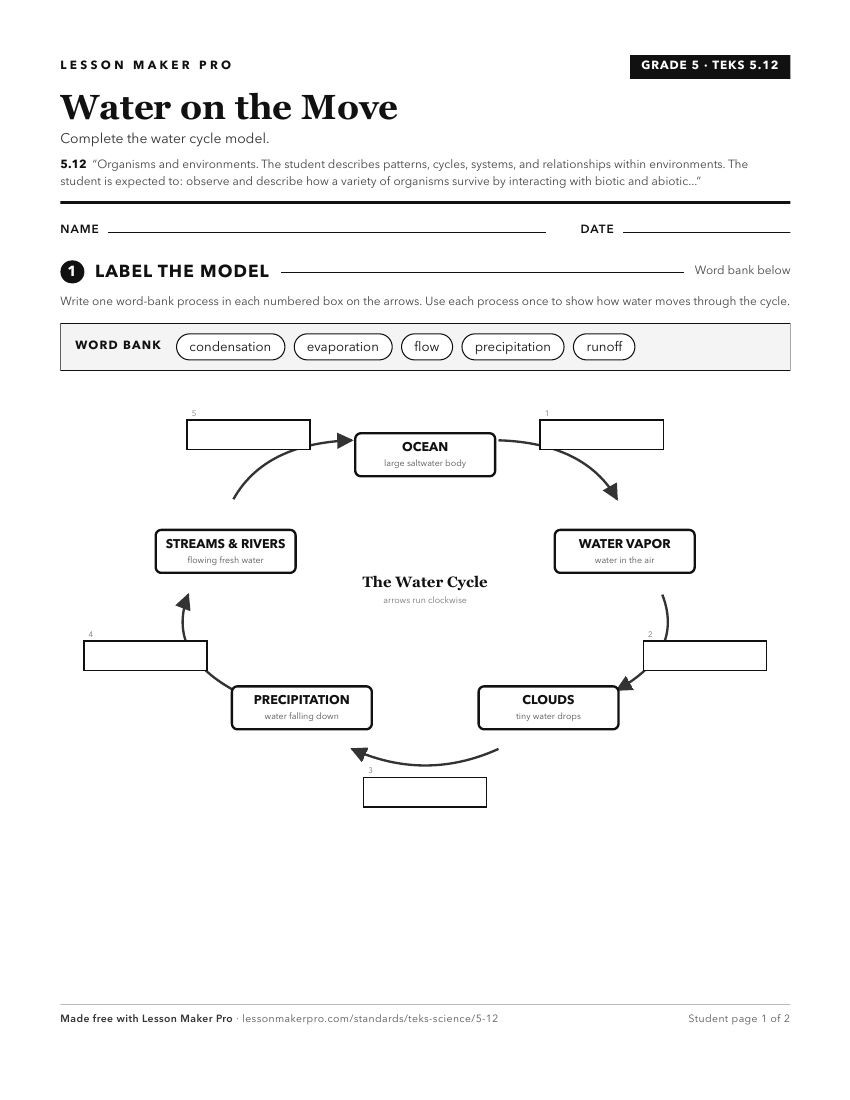
A ready-to-print activity worksheet aligned to 5.12, with an answer key for the teacher on its own page. No account needed.
PDF, US Letter, prints cleanly in black and white.
Download the worksheetKeep exploring
Related Standards
- 3.12
The 3rd Grade version of this standard.
- 1.12
Organisms and environments. The student knows that the environment is composed of relationships between living organisms and nonliving components. The student i...
- 2.13
Organisms and environments. The student knows that organisms have structures and undergo processes that help them interact and survive within their environments...
- 4.12
The 4th Grade version of this standard.
Turn this cluster into a lesson
Grade, subject, topic, and the complete cluster are prefilled. Create one free, no account needed.
Also for this cluster:Make a WorksheetMake a QuizMake a Sub Lesson