Texas TEKS 4.12
TEKS Knowledge Statement (Expectation Cluster)
Organisms and environments. The student describes patterns, cycles, systems, and relationships within environments. The student is expected to: investigate and explain how most producers can make their own food using sunlight, water, and carbon dioxide through the cycling of matter; describe the cycling of matter and flow of energy through food webs, including the roles of the Sun, producers, consumers, and decomposers; and identify and describe past environments based on fossil evidence, including common Texas fossils.
Texas Essential Knowledge and Skills for Science
Cluster contents
Student Expectations in This Statement
4.12 is a TEKS knowledge and skills statement. These are the student expectations under it.
- 4.12.A
investigate and explain how most producers can make their own food using sunlight, water, and carbon dioxide through the cycling of matter
- 4.12.B
describe the cycling of matter and flow of energy through food webs, including the roles of the Sun, producers, consumers, and decomposers
- 4.12.C
identify and describe past environments based on fossil evidence, including common Texas fossils.
Teacher's field guide
What This Cluster Means
What Students Need to Do
- Students explain how most producers use sunlight, water, and carbon dioxide to make food. They trace matter and energy through food webs and identify the roles of producers, consumers, and decomposers. They use fossils to make claims about past environments in Texas.
What Mastery Looks Like
- A student can label a food web and explain each arrow as energy moving from food to eater. They can explain that matter cycles while energy moves from the Sun through organisms. They can use an ammonite, shell fossil, or petrified wood as evidence for a past environment.
Common Misconceptions
- Students often say plants get food from soil instead of making it with sunlight, water, and carbon dioxide. They may reverse food web arrows or say energy cycles like matter. They may treat one fossil as proof of an exact environment instead of evidence supporting a reasonable claim.
How to Assess It
- Give students a grass, rabbit, hawk, and fungi food web plus an ammonite photo. Ask them to label roles, draw energy arrows, describe matter cycling, and infer a past environment.
Lesson moves
Ways to Teach It
Use cups labeled air, soil, plant, rabbit, hawk, and decomposer; move matter beads in a loop and energy tokens from the Sun onward.
Ask students to write: Why does a plant need sunlight, water, and carbon dioxide if its roots are in rich soil?
Give students organism cards and yarn; they build a food web, pass an energy token, and repair any backward arrows.
Compare photos of Texas ammonites and petrified wood with modern organisms, then write what each fossil suggests about the past environment.
Free download
Printable 4.12 Worksheet
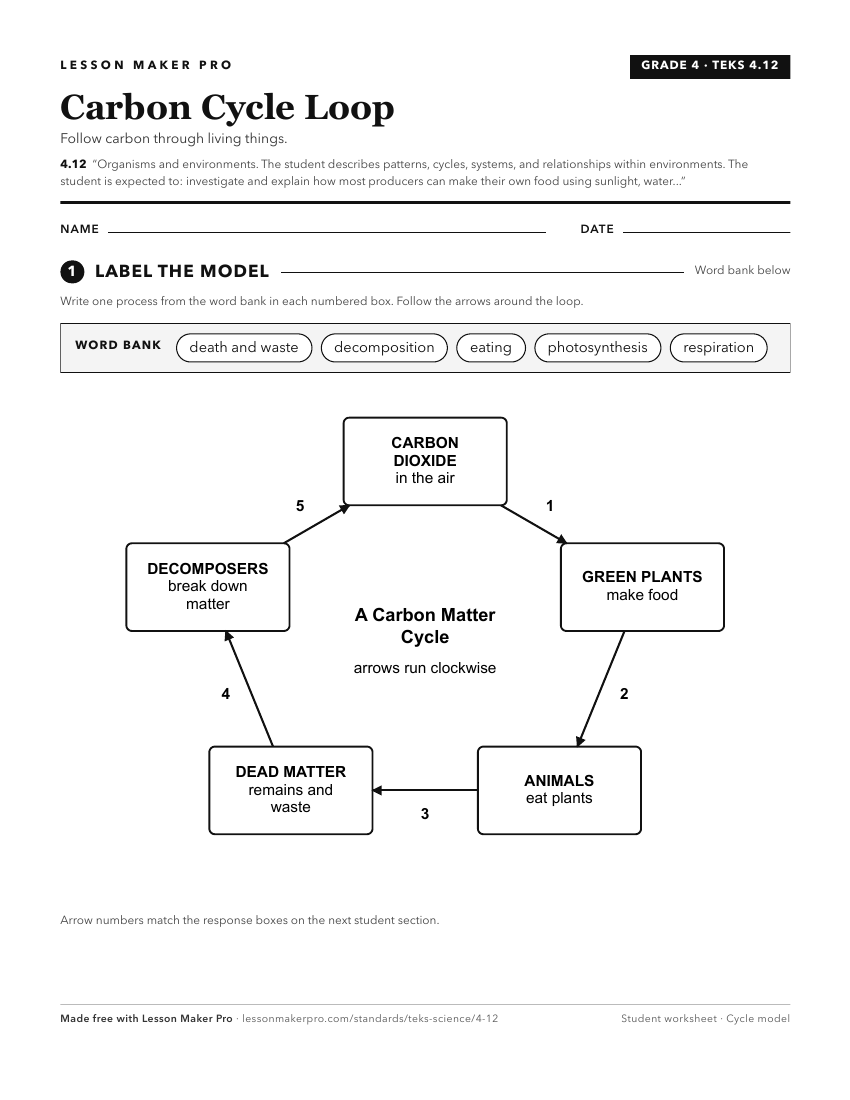
A ready-to-print activity worksheet aligned to 4.12, with an answer key for the teacher on its own page. No account needed.
PDF, US Letter, prints cleanly in black and white.
Download the worksheetKeep exploring
Related Standards
- 3.12
The 3rd Grade version of this standard.
- 1.12
Organisms and environments. The student knows that the environment is composed of relationships between living organisms and nonliving components. The student i...
- 2.13
Organisms and environments. The student knows that organisms have structures and undergo processes that help them interact and survive within their environments...
- 5.12
The 5th Grade version of this standard.
Turn this cluster into a lesson
Grade, subject, topic, and the complete cluster are prefilled. Create one free, no account needed.
Also for this cluster:Make a WorksheetMake a QuizMake a Sub Lesson