Texas TEKS 3.12
TEKS Knowledge Statement (Expectation Cluster)
Organisms and environments. The student describes patterns, cycles, systems, and relationships within environments. The student is expected to: explain how temperature and precipitation affect animal growth and behavior through migration and hibernation and plant responses through dormancy; identify and describe the flow of energy in a food chain and predict how changes in a food chain such as removal of frogs from a pond or bees from a field affect the ecosystem; describe how natural changes to the environment such as floods and droughts cause some organisms to thrive and others to perish or move to new locations; and identify fossils as evidence of past living organisms and environments, including common Texas fossils.
Texas Essential Knowledge and Skills for Science
Cluster contents
Student Expectations in This Statement
3.12 is a TEKS knowledge and skills statement. These are the student expectations under it.
- 3.12.A
explain how temperature and precipitation affect animal growth and behavior through migration and hibernation and plant responses through dormancy
- 3.12.B
identify and describe the flow of energy in a food chain and predict how changes in a food chain such as removal of frogs from a pond or bees from a field affec...
- 3.12.C
describe how natural changes to the environment such as floods and droughts cause some organisms to thrive and others to perish or move to new locations
- 3.12.D
identify fossils as evidence of past living organisms and environments, including common Texas fossils.
Teacher's field guide
What This Cluster Means
What Students Need to Do
- Students connect seasonal weather patterns to migration, hibernation, and plant dormancy. They trace energy through food chains and predict effects when an organism disappears. They explain responses to floods and droughts and use fossils to infer past life and habitats.
What Mastery Looks Like
- Students can match changes in temperature or rainfall with a likely plant or animal response. They use arrows correctly in a food chain and predict multiple effects of removing one organism. They use fossil features and location as evidence about a past environment.
Common Misconceptions
- Students may point food chain arrows toward what is eaten rather than toward the energy receiver. They may treat dormancy as death or assume every animal migrates or hibernates. They may predict only one effect from a removed species and think fossils are only dinosaur bones.
How to Assess It
- Use a four-box exit ticket. Ask students to explain one seasonal response, complete a food chain, predict a drought effect, and infer an environment from a fossil picture.
Lesson moves
Ways to Teach It
Build a pond food chain with organism cards and yarn, then remove the frog card and record two predicted effects.
Write a claim explaining whether a drought would cause a chosen Texas organism to thrive, perish, become dormant, or move.
Play a sorting game matching temperature, rainfall, flood, and drought cards with likely plant and animal responses.
Examine photos of common Texas fossils and write what each fossil suggests about the area's past environment.
Free download
Printable 3.12 Worksheet
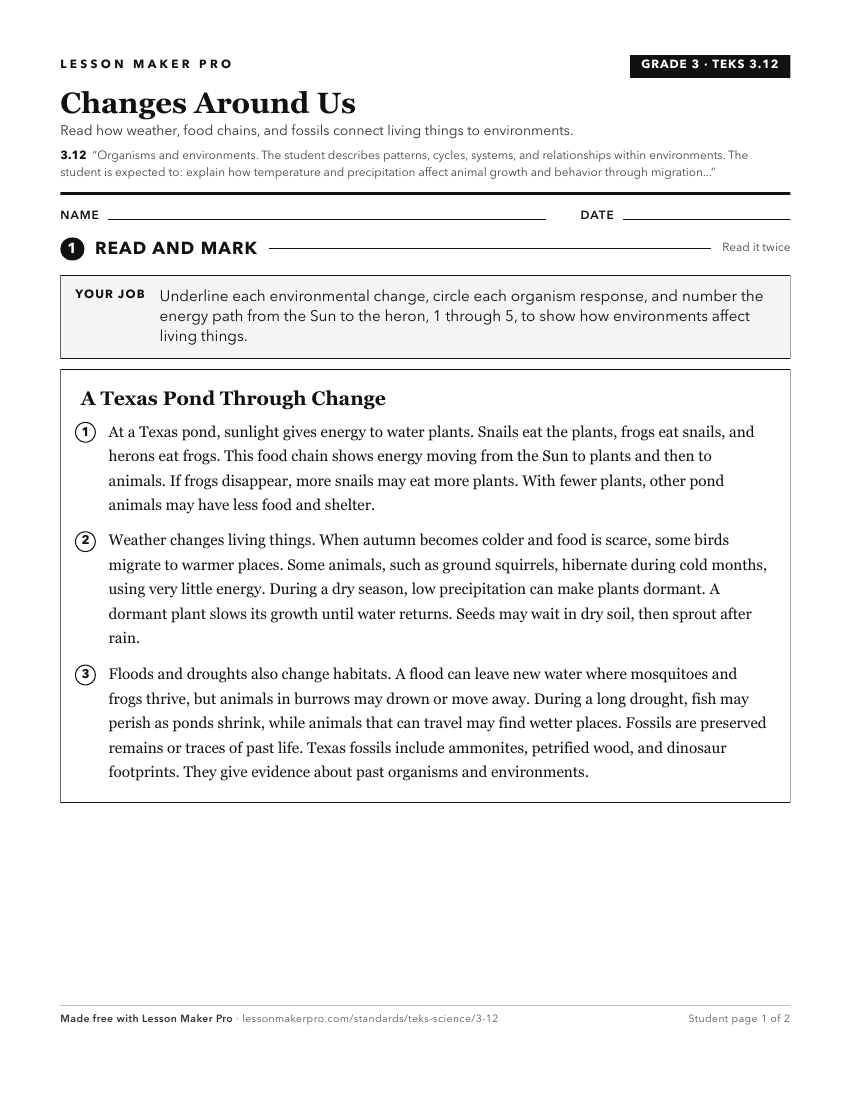
A ready-to-print activity worksheet aligned to 3.12, with an answer key for the teacher on its own page. No account needed.
PDF, US Letter, prints cleanly in black and white.
Download the worksheetKeep exploring
Related Standards
- 1.12
Organisms and environments. The student knows that the environment is composed of relationships between living organisms and nonliving components. The student i...
- 2.13
Organisms and environments. The student knows that organisms have structures and undergo processes that help them interact and survive within their environments...
- 5.12
The 5th Grade version of this standard.
- 4.12
The 4th Grade version of this standard.
Turn this cluster into a lesson
Grade, subject, topic, and the complete cluster are prefilled. Create one free, no account needed.
Also for this cluster:Make a WorksheetMake a QuizMake a Sub Lesson