Texas TEKS 2.13
TEKS Knowledge Statement (Expectation Cluster)
Organisms and environments. The student knows that organisms have structures and undergo processes that help them interact and survive within their environments. The student is expected to: identify the roots, stems, leaves, flowers, fruits, and seeds of plants and compare how those structures help different plants meet their basic needs for survival; record and compare how the structures and behaviors of animals help them find and take in food, water, and air; record and compare how being part of a group helps animals obtain food, defend themselves, and cope with changes; and investigate and describe some of the unique life cycles of animals where young animals do not resemble their parents, including butterflies and frogs.
Texas Essential Knowledge and Skills for Science
Cluster contents
Student Expectations in This Statement
2.13 is a TEKS knowledge and skills statement. These are the student expectations under it.
- 2.13.A
identify the roots, stems, leaves, flowers, fruits, and seeds of plants and compare how those structures help different plants meet their basic needs for surviv...
- 2.13.B
record and compare how the structures and behaviors of animals help them find and take in food, water, and air
- 2.13.C
record and compare how being part of a group helps animals obtain food, defend themselves, and cope with changes
- 2.13.D
investigate and describe some of the unique life cycles of animals where young animals do not resemble their parents, including butterflies and frogs.
Teacher's field guide
What This Cluster Means
What Students Need to Do
- Students identify roots, stems, leaves, flowers, fruits, and seeds, then explain the job each does for a plant. They observe and record how animal body parts, actions, and group living help with food, water, breathing, and safety. They sequence butterfly and frog life cycles and explain why the young look different from adults.
What Mastery Looks Like
- Given a plant or diagram, a student labels six major parts and links each part to a specific job. The student compares two animals using observed evidence about feeding, drinking, breathing, and group behavior. The student correctly orders butterfly and frog stages and describes how each animal changes.
Common Misconceptions
- Students may say roots eat soil, stems only hold plants up, or fruits are not plant structures. They may confuse a body structure with a behavior or assume groups help animals only by fighting predators. They often think every young animal is a smaller adult or place chrysalis and tadpole stages in the wrong order.
How to Assess It
- Use a four-box exit ticket: label six plant parts and explain two jobs; match one animal structure to a need; name one group benefit; order four frog stages.
Lesson moves
Ways to Teach It
Set out a rooted bean seedling, celery, spinach, a flower, an apple, and dry beans; students label each plant part and match its job.
Show photos of a duck and pelican feeding, then ask students to write how each beak helps the bird take in food.
Teams race to sequence mixed butterfly and frog life cycle cards, then earn a point by describing one change between stages.
Observe ants or birds outside for ten minutes; students tally solo and group behaviors, then connect one behavior to food, safety, or weather.
Free download
Printable 2.13 Worksheet
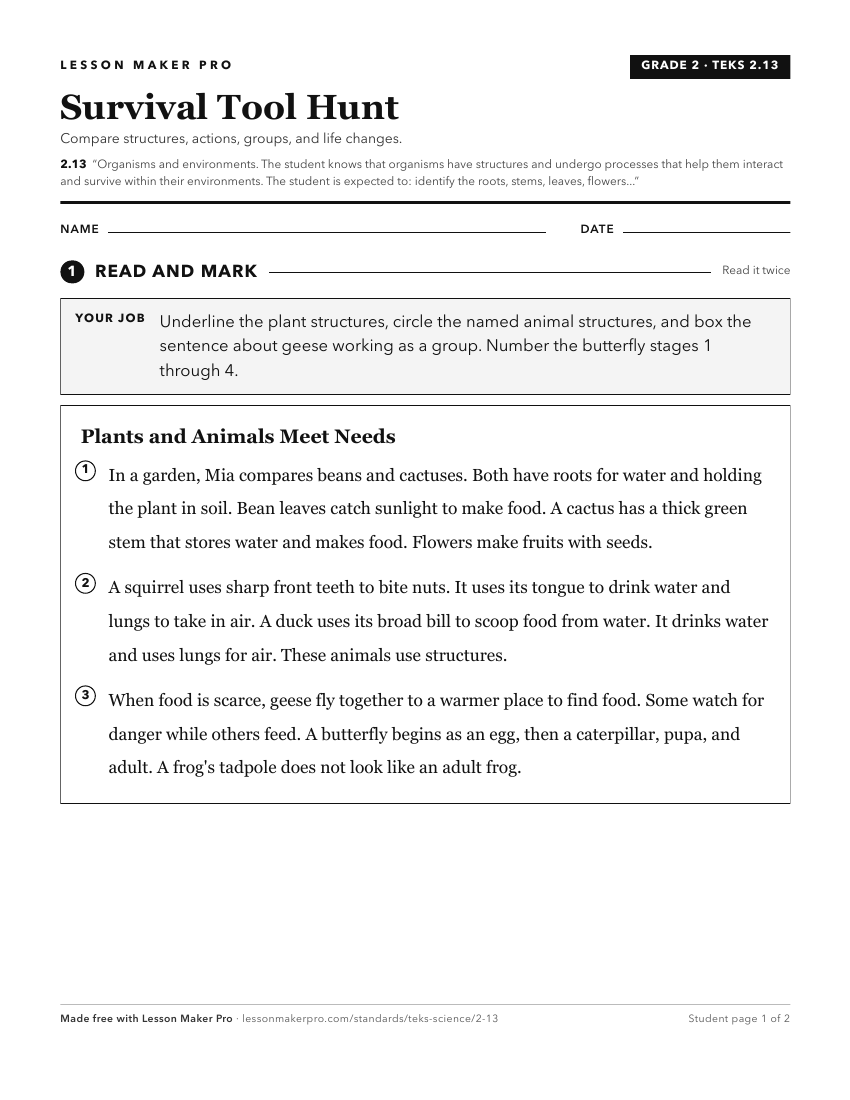
A ready-to-print activity worksheet aligned to 2.13, with an answer key for the teacher on its own page. No account needed.
PDF, US Letter, prints cleanly in black and white.
Download the worksheetKeep exploring
Related Standards
- 1.13
Organisms and environments. The student knows that organisms resemble their parents and have structures and undergo processes that help them interact and surviv...
- 5.13
Organisms and environments. The student knows that organisms undergo similar life processes and have structures and behaviors that help them survive within thei...
- 3.13
Organisms and environments. The student knows that organisms undergo similar life processes and have structures that function to help them survive within their ...
- 4.13
Organisms and environments. The student knows that organisms undergo similar life processes and have structures that function to help them survive within their ...
Turn this cluster into a lesson
Grade, subject, topic, and the complete cluster are prefilled. Create one free, no account needed.
Also for this cluster:Make a WorksheetMake a QuizMake a Sub Lesson