Texas TEKS 3.12.A
The Standard
- 3.12
- Organisms and environments. The student describes patterns, cycles, systems, and relationships within environments. The student is expected to:
explain how temperature and precipitation affect animal growth and behavior through migration and hibernation and plant responses through dormancy
Texas Essential Knowledge and Skills for Science
Teacher's field guide
What This Standard Means
What Students Need to Do
- Students connect changes in temperature and rainfall to food, water, and growing conditions. They explain how these changes affect animal growth, migration, hibernation, and plant dormancy.
What Mastery Looks Like
- Students use weather information to predict how an animal or plant may respond. They support the prediction with a clear cause and effect explanation.
Common Misconceptions
- Students may think hibernation is ordinary sleep, migration is random travel, or dormant plants are dead. They may also assume every organism responds to weather changes in the same way.
How to Assess It
- Show a forecast with colder temperatures and little rainfall. Ask students to predict one animal response and one plant response, then explain each prediction.
Lesson moves
Ways to Teach It
Give groups weather, animal, and plant cards to arrange into cause and effect chains, then have them explain each chain.
Ask students to write: How might a cold, dry season change a bear's behavior and a tree's growth?
Play response match, where students pair condition cards with migration, hibernation, dormancy, or continued growth and defend each match.
Compare local monthly rainfall and temperature charts with observations of bird movement, insect activity, or changes in nearby plants.
Free download
Printable 3.12.A Worksheet
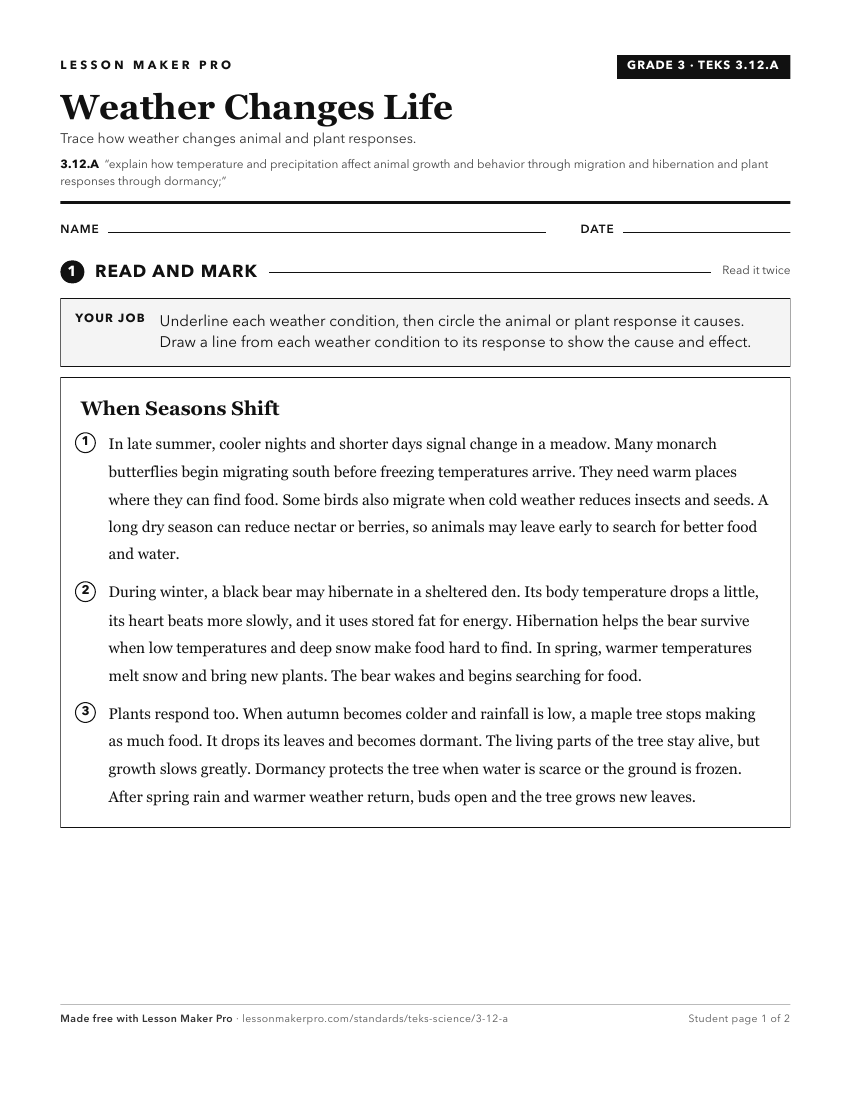
A ready-to-print activity worksheet aligned to 3.12.A, with an answer key for the teacher on its own page. No account needed.
PDF, US Letter, prints cleanly in black and white.
Download the worksheetKeep exploring
Related Standards
- 2.12.A
describe how the physical characteristics of environments, including the amount of rainfall, support plants and animals within an ecosystem
- 4.9.A
collect and analyze data to identify sequences and predict patterns of change in seasons such as change in temperature and length of daylight
- 3.12.C
describe how natural changes to the environment such as floods and droughts cause some organisms to thrive and others to perish or move to new locations
- 4.13.A
explore and explain how structures and functions of plants such as waxy leaves and deep roots enable them to survive in their environment
Turn this exact standard into a lesson
Grade, subject, topic, and the complete standard are prefilled. Create one free, no account needed.
Also for this standard:Make a WorksheetMake a QuizMake a Sub Lesson