Texas TEKS 1.12.B
The Standard
- 1.12
- Organisms and environments. The student knows that the environment is composed of relationships between living organisms and nonliving components. The student is expected to:
describe and record examples of interactions and dependence between living and nonliving components in terrariums or aquariums
Texas Essential Knowledge and Skills for Science
Teacher's field guide
What This Standard Means
What Students Need to Do
- Students identify living and nonliving parts of a terrarium or aquarium. They describe and record how plants and animals use water, air, light, soil, rocks, and shelter.
What Mastery Looks Like
- Students can observe a small habitat and name accurate examples of dependence. They can draw, label, or write how one part helps another survive.
Common Misconceptions
- Students may think plants are nonliving or that water and sunlight are living. They may name two nearby parts without explaining how one depends on the other.
How to Assess It
- Show a picture of an aquarium. Ask students to circle one living thing, box one nonliving thing, and draw an arrow showing dependence.
Lesson moves
Ways to Teach It
Observe a classroom terrarium with hand lenses, then draw and label two ways an organism uses a nonliving part.
Ask, "What would happen to the fish if the aquarium had no water?" Students draw and explain their answer.
Play a matching game using organism cards and cards showing water, light, air, soil, rocks, food, and shelter.
Study a schoolyard plant and record how it uses sunlight, air, water, and soil to live.
Free download
Printable 1.12.B Worksheet
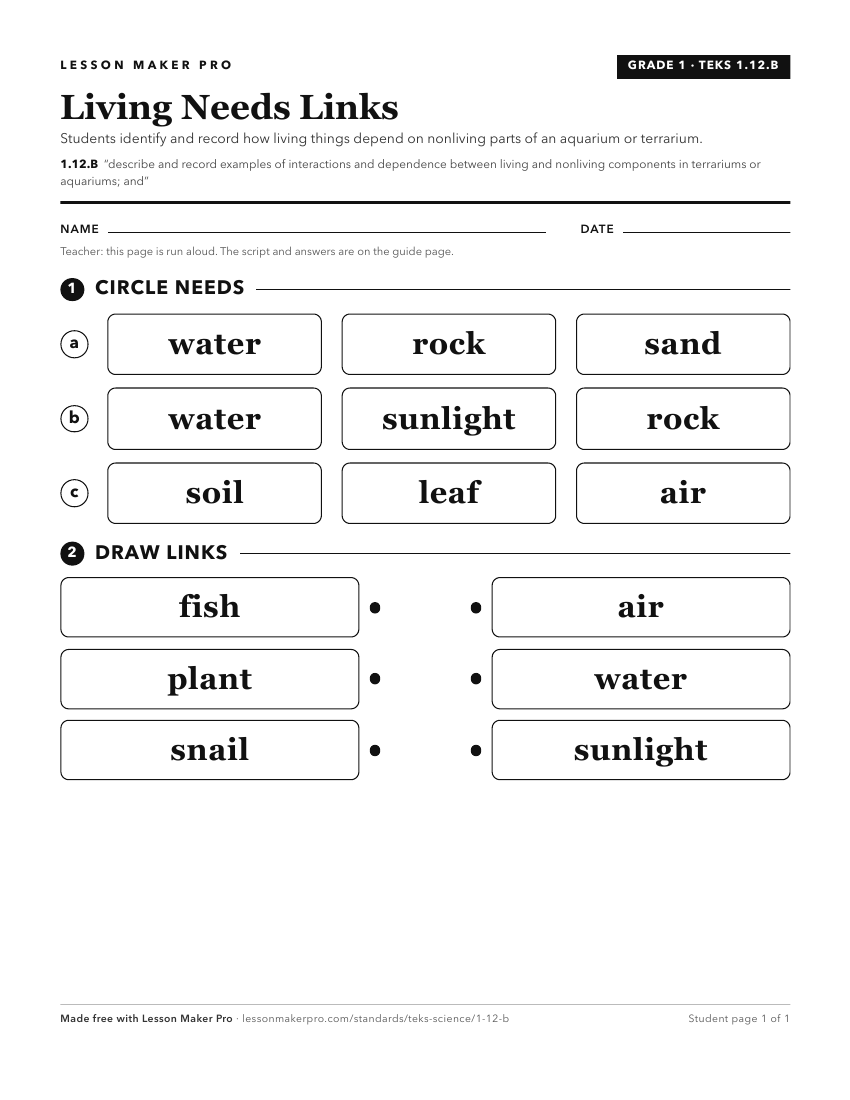
A ready-to-print activity worksheet aligned to 1.12.B, with an answer key for the teacher on its own page. No account needed.
PDF, US Letter, prints cleanly in black and white.
Download the worksheetKeep exploring
Related Standards
- K.12.B
observe and identify the dependence of animals on air, water, food, space, and shelter.
- 1.13.B
record observations of and describe basic life cycles of animals, including a bird, a mammal, and a fish
- 5.12.A
observe and describe how a variety of organisms survive by interacting with biotic and abiotic factors in a healthy ecosystem
- 6.12.B
describe and give examples of predatory, competitive, and symbiotic relationships between organisms, including mutualism, parasitism, and commensalism
Turn this exact standard into a lesson
Grade, subject, topic, and the complete standard are prefilled. Create one free, no account needed.
Also for this standard:Make a WorksheetMake a QuizMake a Sub Lesson