Texas TEKS 6.12.B
The Standard
- 6.12
- Organisms and environments. The student knows that interdependence occurs between living systems and the environment. The student is expected to:
describe and give examples of predatory, competitive, and symbiotic relationships between organisms, including mutualism, parasitism, and commensalism
Texas Essential Knowledge and Skills for Science
Teacher's field guide
What This Standard Means
What Students Need to Do
- Students identify how two organisms interact and describe the effect on each organism. They classify examples as predation, competition, mutualism, parasitism, or commensalism.
What Mastery Looks Like
- Given an unfamiliar scenario, students name the relationship and explain which organism benefits, is harmed, or is unaffected. They can provide an accurate example of each relationship.
Common Misconceptions
- Students may think all symbiotic relationships benefit both organisms or that commensalism helps both. They may confuse parasitism with predation or assume competition always involves direct fighting.
How to Assess It
- Give five short organism scenarios, one for each relationship. Students label each scenario and mark each organism with +, -, or 0.
Lesson moves
Ways to Teach It
Give pairs organism cards and +, -, and 0 tokens; students model each relationship and explain what each token means.
Discuss this prompt: How is a tick feeding on a deer different from a hawk eating a mouse?
Play Relationship Sort, with teams racing to place scenario cards under predation, competition, mutualism, parasitism, or commensalism.
Students find local examples, such as bees and flowers or weeds and crops, then explain each organism's outcome.
Free download
Printable 6.12.B Worksheet
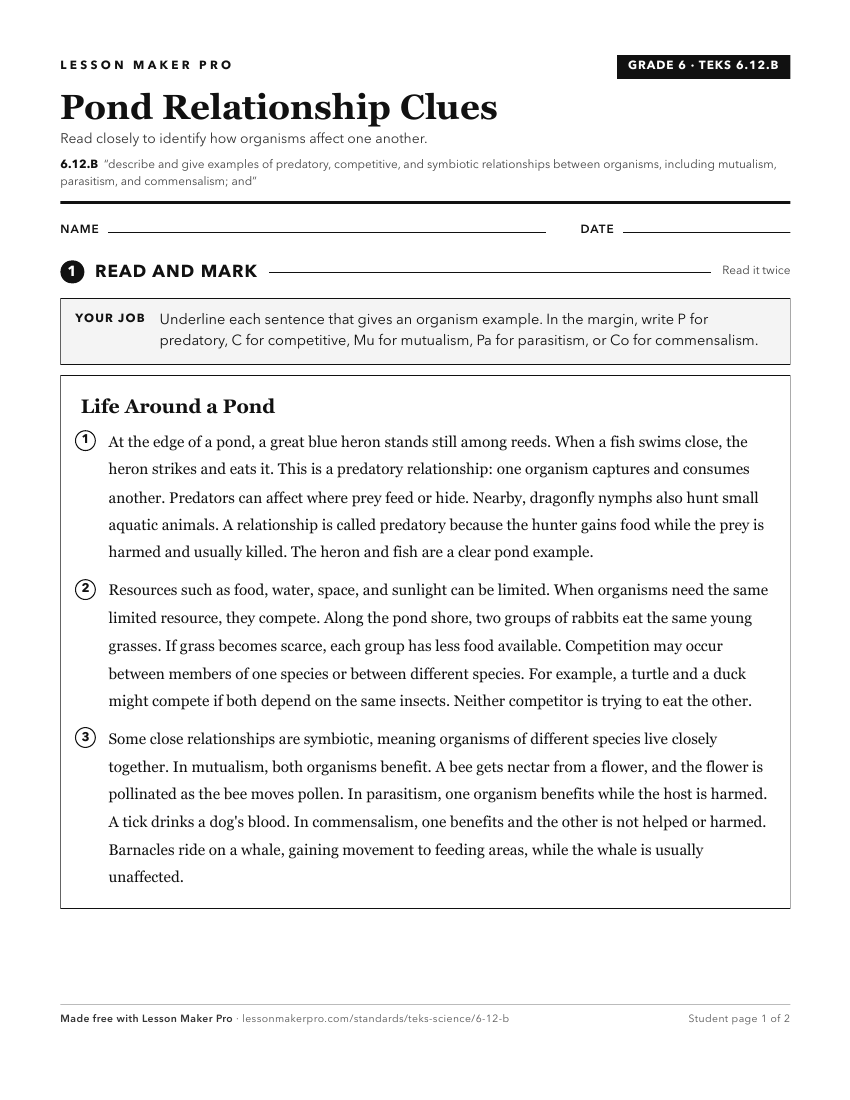
A ready-to-print activity worksheet aligned to 6.12.B, with an answer key for the teacher on its own page. No account needed.
PDF, US Letter, prints cleanly in black and white.
Download the worksheetKeep exploring
Related Standards
- 1.12.C
identify and illustrate how living organisms depend on each other through food chains.
- 1.12.B
describe and record examples of interactions and dependence between living and nonliving components in terrariums or aquariums
- 2.12.B
create and describe food chains identifying producers and consumers to demonstrate how animals depend on other living things
- 5.12.A
observe and describe how a variety of organisms survive by interacting with biotic and abiotic factors in a healthy ecosystem
Turn this exact standard into a lesson
Grade, subject, topic, and the complete standard are prefilled. Create one free, no account needed.
Also for this standard:Make a WorksheetMake a QuizMake a Sub Lesson