Texas TEKS 2.12
TEKS Knowledge Statement (Expectation Cluster)
Organisms and environments. The student knows that living organisms have basic needs that must be met through interactions within their environment. The student is expected to: describe how the physical characteristics of environments, including the amount of rainfall, support plants and animals within an ecosystem; create and describe food chains identifying producers and consumers to demonstrate how animals depend on other living things; and explain and demonstrate how some plants depend on other living things, wind, or water for pollination and to move their seeds around.
Texas Essential Knowledge and Skills for Science
Cluster contents
Student Expectations in This Statement
2.12 is a TEKS knowledge and skills statement. These are the student expectations under it.
- 2.12.A
describe how the physical characteristics of environments, including the amount of rainfall, support plants and animals within an ecosystem
- 2.12.B
create and describe food chains identifying producers and consumers to demonstrate how animals depend on other living things
- 2.12.C
explain and demonstrate how some plants depend on other living things, wind, or water for pollination and to move their seeds around.
Teacher's field guide
What This Cluster Means
What Students Need to Do
- Students explain how rainfall and other habitat features affect which plants and animals can live there. They build food chains and identify producers and consumers. They also show how pollen and seeds move by animals, wind, or water.
What Mastery Looks Like
- A student can compare two habitats and explain how rainfall supports different organisms. The student can arrange food chain cards, label producers and consumers, and describe each feeding link. The student can model pollination and seed movement, then explain what caused each movement.
Common Misconceptions
- Students may think more rain always helps every organism. They may call every animal a consumer but miss that producers make their own food. They often confuse pollination with seed dispersal or assume all pollen and seeds travel by wind.
How to Assess It
- Give students a three-part exit ticket: explain one effect of rainfall, label a three-organism food chain, and draw one way pollen or seeds move.
Lesson moves
Ways to Teach It
Use cotton swabs to move colored chalk dust between paper flowers, then explain how the model represents animal pollination.
Show a dry grassland and rainy forest, then ask, "How does rainfall change what can live in each place?"
Give pairs plant and animal cards to arrange into food chains, label, and check against an answer card.
Walk around the schoolyard and map where burrs, winged seeds, and berries might travel by animals, wind, or water.
Free download
Printable 2.12 Worksheet
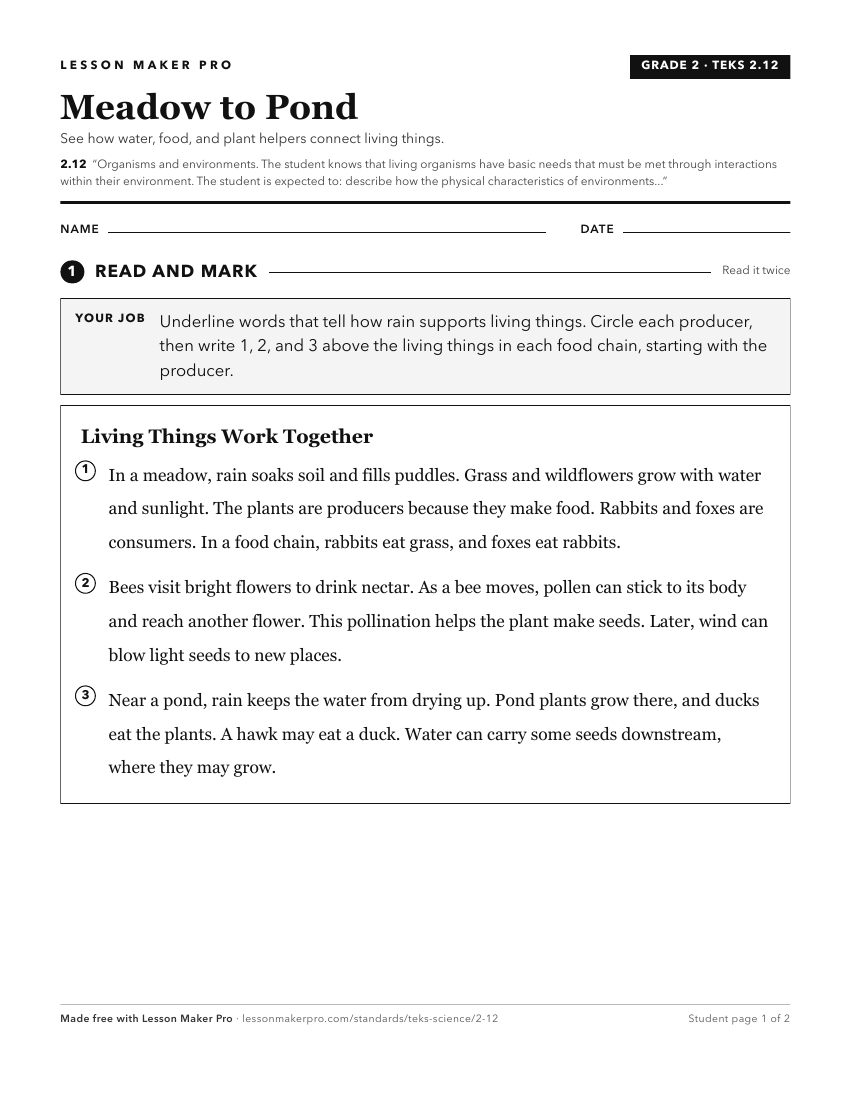
A ready-to-print activity worksheet aligned to 2.12, with an answer key for the teacher on its own page. No account needed.
PDF, US Letter, prints cleanly in black and white.
Download the worksheetKeep exploring
Related Standards
- 6.12
Organisms and environments. The student knows that interdependence occurs between living systems and the environment. The student is expected to:
- 1.12
Organisms and environments. The student knows that the environment is composed of relationships between living organisms and nonliving components. The student i...
- K.12
Organisms and environments. The student knows that plants and animals depend on the environment to meet their basic needs for survival. The student is expected ...
- 2.13
Organisms and environments. The student knows that organisms have structures and undergo processes that help them interact and survive within their environments...
Turn this cluster into a lesson
Grade, subject, topic, and the complete cluster are prefilled. Create one free, no account needed.
Also for this cluster:Make a WorksheetMake a QuizMake a Sub Lesson