Texas TEKS 2.12.C
The Standard
- 2.12
- Organisms and environments. The student knows that living organisms have basic needs that must be met through interactions within their environment. The student is expected to:
explain and demonstrate how some plants depend on other living things, wind, or water for pollination and to move their seeds around.
Texas Essential Knowledge and Skills for Science
Teacher's field guide
What This Standard Means
What Students Need to Do
- Students explain how pollen gets from one flower to another and how seeds leave the parent plant. They use simple models to show how animals, wind, and water help.
What Mastery Looks Like
- Students match examples such as bees, burrs, dandelion seeds, and coconuts with the correct helper. They explain that pollination happens before seeds form, while seed dispersal happens after.
Common Misconceptions
- Students may think pollination and seed dispersal are the same process. They may also think bees carry seeds between flowers or that every plant relies on the same helper.
How to Assess It
- Show a picture of a bee visiting a flower and a burr stuck to a dog. Ask students to name what is moving and explain how the animal helps.
Lesson moves
Ways to Teach It
Move colored chalk dust between paper flowers with cotton swabs, then use a fan and water tray to test model seeds.
Show a bee on a flower and a burr on a dog, then ask, "What is each animal moving, and why?"
Play a card sort matching milkweed, coconut, burr, and flower pictures to wind, water, or animal helpers.
Inspect seeds found near the schoolyard, then use hooks, fluff, or floating ability to predict how each travels.
Free download
Printable 2.12.C Worksheet
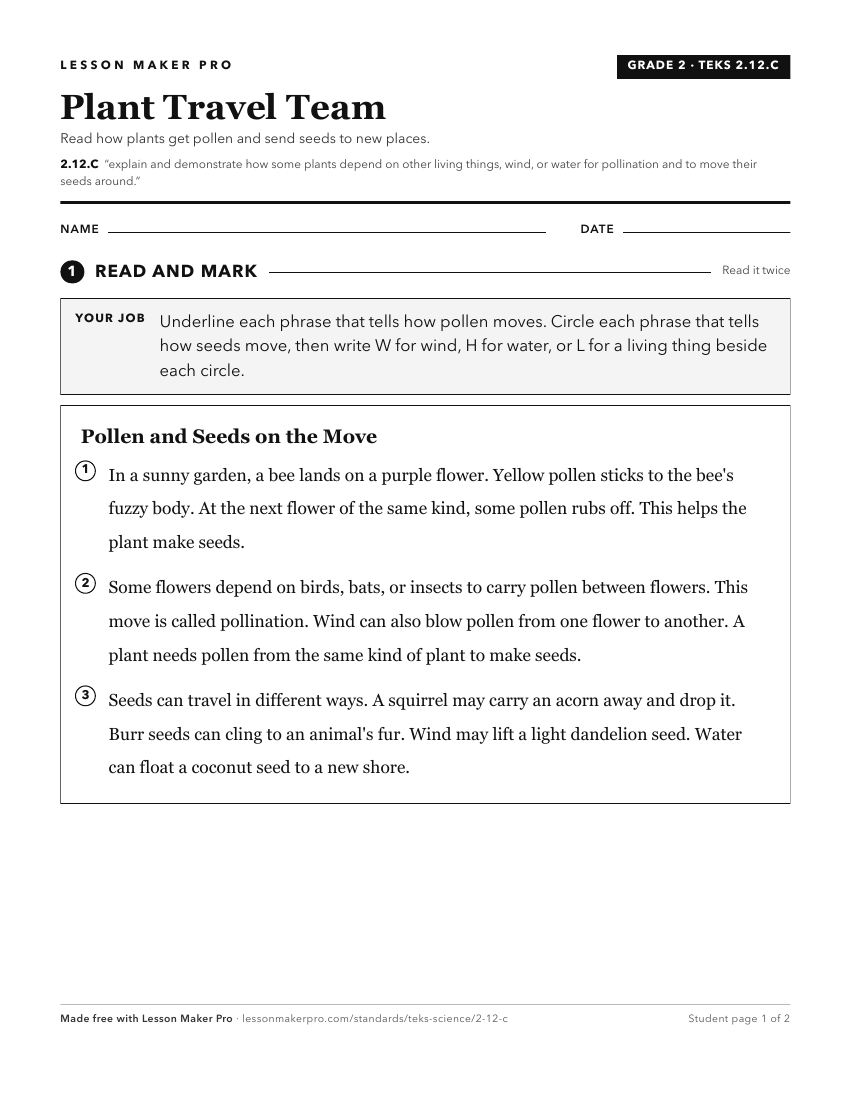
A ready-to-print activity worksheet aligned to 2.12.C, with an answer key for the teacher on its own page. No account needed.
PDF, US Letter, prints cleanly in black and white.
Download the worksheetKeep exploring
Related Standards
- K.12.A
observe and identify the dependence of plants on air, sunlight, water, nutrients in the soil, and space to grow
- 1.12.C
identify and illustrate how living organisms depend on each other through food chains.
- 2.13.A
identify the roots, stems, leaves, flowers, fruits, and seeds of plants and compare how those structures help different plants meet their basic needs for surviv...
- 4.13.A
explore and explain how structures and functions of plants such as waxy leaves and deep roots enable them to survive in their environment
Turn this exact standard into a lesson
Grade, subject, topic, and the complete standard are prefilled. Create one free, no account needed.
Also for this standard:Make a WorksheetMake a QuizMake a Sub Lesson