Texas TEKS 6.12
TEKS Knowledge Statement (Expectation Cluster)
Organisms and environments. The student knows that interdependence occurs between living systems and the environment. The student is expected to: investigate how organisms and populations in an ecosystem depend on and may compete for biotic factors such as food and abiotic factors such as availability of light and water, range of temperatures, or soil composition; describe and give examples of predatory, competitive, and symbiotic relationships between organisms, including mutualism, parasitism, and commensalism; and describe the hierarchical organization of organism, population, and community within an ecosystem.
Texas Essential Knowledge and Skills for Science
Cluster contents
Student Expectations in This Statement
6.12 is a TEKS knowledge and skills statement. These are the student expectations under it.
- 6.12.A
investigate how organisms and populations in an ecosystem depend on and may compete for biotic factors such as food and abiotic factors such as availability of ...
- 6.12.B
describe and give examples of predatory, competitive, and symbiotic relationships between organisms, including mutualism, parasitism, and commensalism
- 6.12.C
describe the hierarchical organization of organism, population, and community within an ecosystem.
Teacher's field guide
What This Cluster Means
What Students Need to Do
- Students identify how organisms depend on food, light, water, temperature, and soil. They explain competition, predation, mutualism, parasitism, and commensalism using examples. They organize living things as organisms, populations, and communities within ecosystems.
What Mastery Looks Like
- Students can analyze an ecosystem scenario and identify the resources organisms need or compete for. They can classify relationships, support each choice with evidence, and correctly place examples in the ecological hierarchy.
Common Misconceptions
- Students may call every close relationship mutualism or assume both organisms benefit in commensalism. They may confuse a population with a community or treat water, soil, and temperature as biotic factors.
How to Assess It
- Give students a pond diagram with fish, algae, herons, insects, water, and sunlight. Ask them to label two factors, classify one relationship, and identify an organism, population, and community.
Lesson moves
Ways to Teach It
Plant radish seeds in cups with different light or water levels, then compare growth and connect the results to resource availability.
Ask students to explain whether a tick on a dog, a bee on a flower, and a barnacle on a whale differ.
Play a relationship card sort where teams match organism pairs to predation, competition, mutualism, parasitism, or commensalism and defend each match.
Survey the schoolyard for organisms, group repeated species into populations, and combine those populations into a community map.
Free download
Printable 6.12 Worksheet
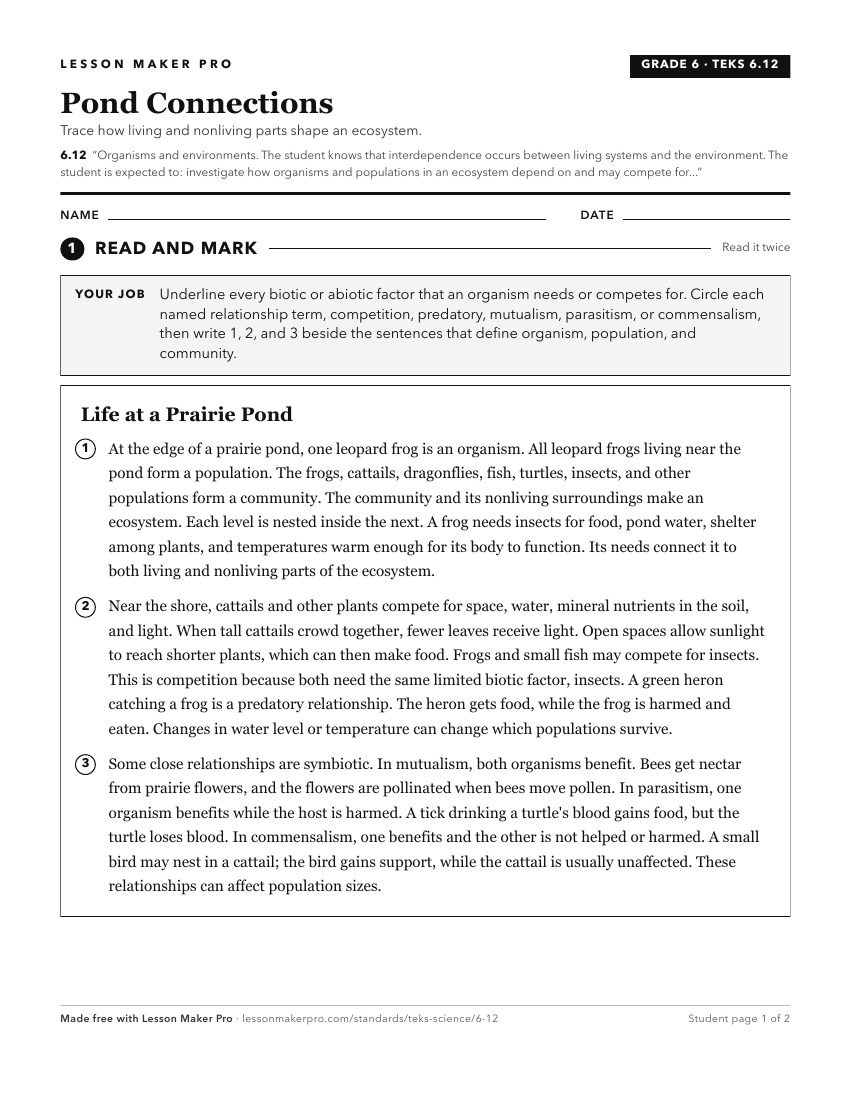
A ready-to-print activity worksheet aligned to 6.12, with an answer key for the teacher on its own page. No account needed.
PDF, US Letter, prints cleanly in black and white.
Download the worksheetKeep exploring
Related Standards
- 1.12
Organisms and environments. The student knows that the environment is composed of relationships between living organisms and nonliving components. The student i...
- K.12
Organisms and environments. The student knows that plants and animals depend on the environment to meet their basic needs for survival. The student is expected ...
- 2.13
Organisms and environments. The student knows that organisms have structures and undergo processes that help them interact and survive within their environments...
- 2.12
Organisms and environments. The student knows that living organisms have basic needs that must be met through interactions within their environment. The student...
Turn this cluster into a lesson
Grade, subject, topic, and the complete cluster are prefilled. Create one free, no account needed.
Also for this cluster:Make a WorksheetMake a QuizMake a Sub Lesson