Texas TEKS 6.12.C
The Standard
- 6.12
- Organisms and environments. The student knows that interdependence occurs between living systems and the environment. The student is expected to:
describe the hierarchical organization of organism, population, and community within an ecosystem.
Texas Essential Knowledge and Skills for Science
Teacher's field guide
What This Standard Means
What Students Need to Do
- Students arrange living systems from one individual to all living populations in an area. They explain how each level fits inside the next and how an ecosystem also includes nonliving surroundings.
What Mastery Looks Like
- A student can label an example such as one frog, all frogs in a pond, and all pond populations. The student can explain why water and rocks belong to the ecosystem but not the community.
Common Misconceptions
- Students may confuse a population with a community or call any group of animals a population. They may also include soil, sunlight, and water in a community instead of only in the ecosystem.
How to Assess It
- Give students four cards labeled one oak tree, all oak trees, all living things, and forest with soil and water. Ask them to order and name the levels.
Lesson moves
Ways to Teach It
Give groups organism and habitat picture cards, then have them build nested circles for organism, population, community, and ecosystem.
Ask students to explain in writing how removing one fish differs from removing an entire fish population.
Play a sorting relay where teams place example cards under organism, population, community, or ecosystem and justify one choice.
Study the schoolyard by recording one organism, its population, the larger community, and two nonliving ecosystem parts.
Free download
Printable 6.12.C Worksheet
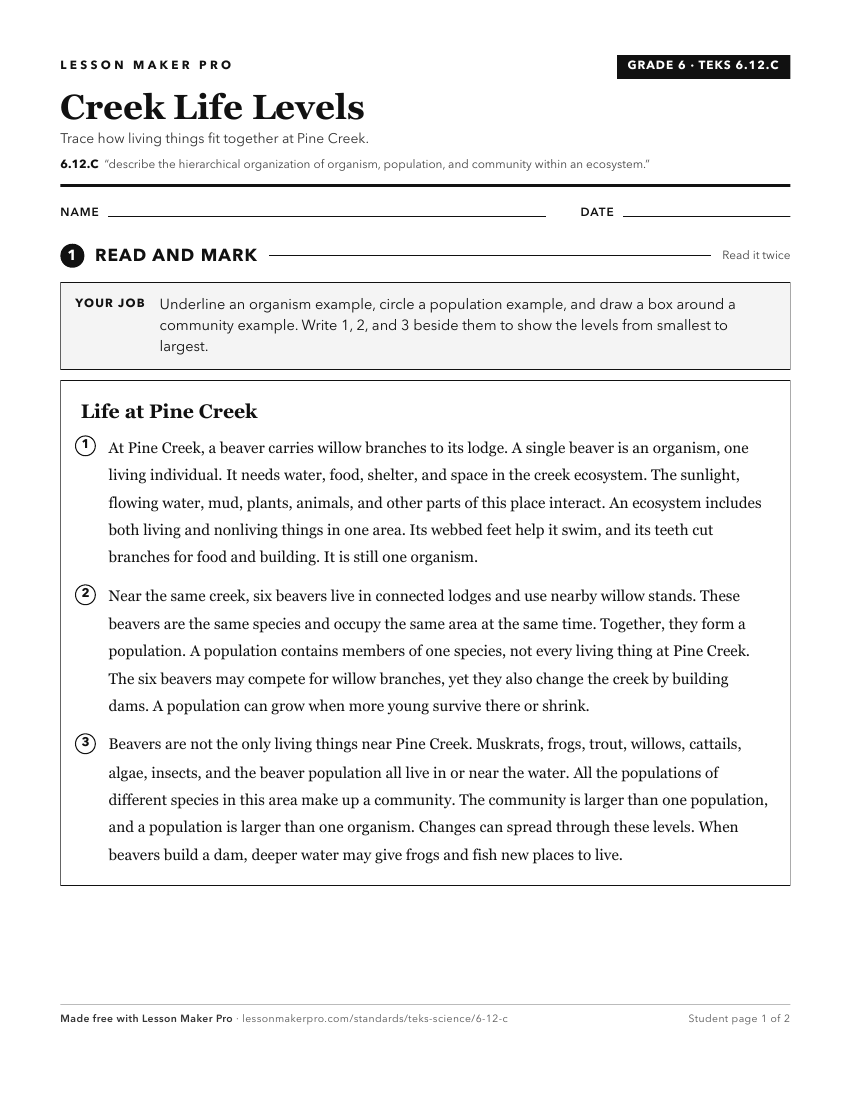
A ready-to-print activity worksheet aligned to 6.12.C, with an answer key for the teacher on its own page. No account needed.
PDF, US Letter, prints cleanly in black and white.
Download the worksheetKeep exploring
Related Standards
- 7.13.B
describe the hierarchical organization of cells, tissues, organs, and organ systems within plants and animals
- 5.12.A
observe and describe how a variety of organisms survive by interacting with biotic and abiotic factors in a healthy ecosystem
- 6.10.A
differentiate between the biosphere, hydrosphere, atmosphere, and geosphere and identify components of each system
- 6.12.B
describe and give examples of predatory, competitive, and symbiotic relationships between organisms, including mutualism, parasitism, and commensalism
Turn this exact standard into a lesson
Grade, subject, topic, and the complete standard are prefilled. Create one free, no account needed.
Also for this standard:Make a WorksheetMake a QuizMake a Sub Lesson