TEKS Math K.1
Knowledge and Skills Statement (Standard Cluster)
The student uses mathematical processes to acquire and demonstrate mathematical understanding
Texas Essential Knowledge and Skills for Mathematics
Cluster contents
Student Expectations in This Statement
K.1 is a knowledge and skills statement. These are the student expectations under it.
- K.1.A
apply mathematics to problems arising in everyday life, society, and the workplace
- K.1.B
use a problem-solving model that incorporates analyzing given information, formulating a plan or strategy, determining a solution, justifying the solution, and ...
- K.1.C
select tools, including real objects, manipulatives, paper and pencil, and technology as appropriate, and techniques, including mental math, estimation, and num...
- K.1.D
communicate mathematical ideas, reasoning, and their implications using multiple representations, including symbols, diagrams, graphs, and language as appropria...
- K.1.E
create and use representations to organize, record, and communicate mathematical ideas
- K.1.F
analyze mathematical relationships to connect and communicate mathematical ideas
- K.1.G
display, explain, and justify mathematical ideas and arguments using precise mathematical language in written or oral communication
Teacher's field guide
What This Cluster Means
What Students Need to Do
- Students solve simple everyday problems by identifying what they know and what they need to find. They choose objects, drawings, words, numbers, or technology to show their thinking. They explain and check their answers.
What Mastery Looks Like
- A student identifies the question, chooses a useful tool or strategy, and finds a reasonable answer. The student shows the work with objects, pictures, words, or numbers and explains the choice.
Common Misconceptions
- Students may use every number they see without deciding what the problem asks. They may choose a tool without knowing how it helps. Some give an answer but cannot show or explain their thinking.
How to Assess It
- Give this exit ticket: “Mia has 3 red blocks and 2 blue blocks. How many blocks does she have altogether?” Students draw or use counters, answer, and explain how they checked.
Lesson moves
Ways to Teach It
Give pairs 7 counters and two cups, then ask them to show, draw, and explain two ways to separate the counters.
Ask, “How do you know your answer makes sense?” Students share a picture, tool, or counting strategy with a partner.
Play Strategy Match by pairing simple story problem cards with matching counters, drawings, or number sentences.
Count how many plates each lunch table needs, record the totals with pictures or numbers, and explain how to check the count.
Free download
Printable K.1 Worksheet
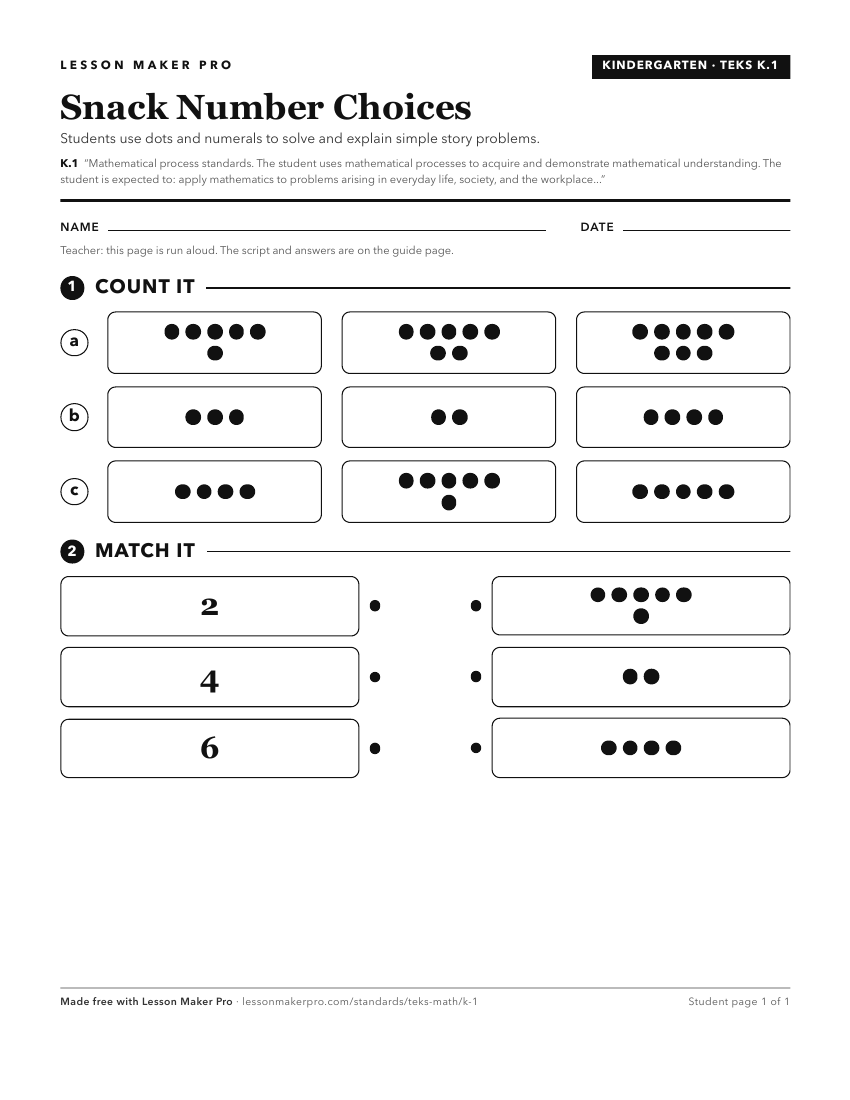
A ready-to-print activity worksheet aligned to K.1, with an answer key for the teacher on its own page. No account needed.
PDF, US Letter, prints cleanly in black and white.
Download the worksheetKeep exploring
Related Standards
Turn this cluster into a lesson
Grade, subject, topic, and the complete cluster are prefilled. Create one free, no account needed.
Also for this cluster:Make a WorksheetMake a QuizMake a Sub Lesson