TEKS Math 6.1
Knowledge and Skills Statement (Standard Cluster)
The student uses mathematical processes to acquire and demonstrate mathematical understanding
Texas Essential Knowledge and Skills for Mathematics
Cluster contents
Student Expectations in This Statement
6.1 is a knowledge and skills statement. These are the student expectations under it.
- 6.1.A
apply mathematics to problems arising in everyday life, society, and the workplace
- 6.1.B
use a problem-solving model that incorporates analyzing given information, formulating a plan or strategy, determining a solution, justifying the solution, and ...
- 6.1.C
select tools, including real objects, manipulatives, paper and pencil, and technology as appropriate, and techniques, including mental math, estimation, and num...
- 6.1.D
communicate mathematical ideas, reasoning, and their implications using multiple representations, including symbols, diagrams, graphs, and language as appropria...
- 6.1.E
create and use representations to organize, record, and communicate mathematical ideas
- 6.1.F
analyze mathematical relationships to connect and communicate mathematical ideas
- 6.1.G
display, explain, and justify mathematical ideas and arguments using precise mathematical language in written or oral communication
Teacher's field guide
What This Cluster Means
What Students Need to Do
- Students solve real-life and mathematical problems by identifying facts, choosing a strategy and tool, and checking whether the answer makes sense. They show their thinking with words, numbers, tables, diagrams, or graphs and explain why their method works.
What Mastery Looks Like
- A student can sort relevant information, choose an efficient method, and calculate accurately. The student uses clear labels and representations, justifies each step, and revises an answer when a check reveals an error.
Common Misconceptions
- Students may calculate immediately without identifying the question, or assume every number given must be used. They may trust calculator output without checking it, omit labels, or give an answer without explaining why it makes sense.
How to Assess It
- Exit ticket: A class has $180 to buy 24 notebooks at $6.75 each. Find the money remaining, then show a plan, calculations, one representation, and a reasonableness check.
Lesson moves
Ways to Teach It
Give pairs grocery ads and $50 in play money, then have them build a meal plan, calculate costs, and justify each choice.
Post two solutions to the same ratio problem and ask students to write which is clearer, more efficient, and better justified.
Play Strategy Match: students pair problem cards with tool, representation, and checking method cards, then defend each match to a partner.
Use a cell phone plan comparison chart and ask students to choose the cheapest plan for three usage levels, using graphs and written evidence.
Free download
Printable 6.1 Worksheet
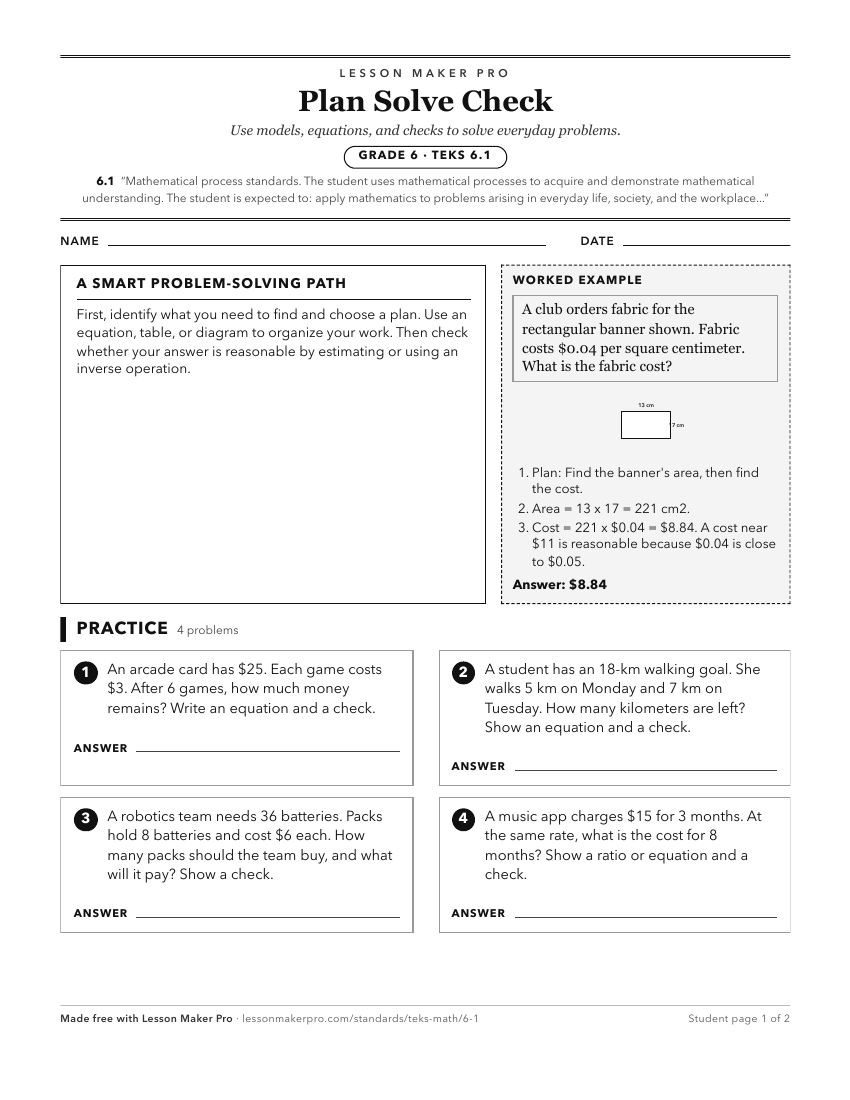
A ready-to-print activity worksheet aligned to 6.1, with an answer key for the teacher on its own page. No account needed.
PDF, US Letter, prints cleanly in black and white.
Download the worksheetKeep exploring
Related Standards
Turn this cluster into a lesson
Grade, subject, topic, and the complete cluster are prefilled. Create one free, no account needed.
Also for this cluster:Make a WorksheetMake a QuizMake a Sub Lesson