TEKS Math 5.1
Knowledge and Skills Statement (Standard Cluster)
The student uses mathematical processes to acquire and demonstrate mathematical understanding
Texas Essential Knowledge and Skills for Mathematics
Cluster contents
Student Expectations in This Statement
5.1 is a knowledge and skills statement. These are the student expectations under it.
- 5.1.A
apply mathematics to problems arising in everyday life, society, and the workplace
- 5.1.B
use a problem-solving model that incorporates analyzing given information, formulating a plan or strategy, determining a solution, justifying the solution, and ...
- 5.1.C
select tools, including real objects, manipulatives, paper and pencil, and technology as appropriate, and techniques, including mental math, estimation, and num...
- 5.1.D
communicate mathematical ideas, reasoning, and their implications using multiple representations, including symbols, diagrams, graphs, and language as appropria...
- 5.1.E
create and use representations to organize, record, and communicate mathematical ideas
- 5.1.F
analyze mathematical relationships to connect and communicate mathematical ideas
- 5.1.G
display, explain, and justify mathematical ideas and arguments using precise mathematical language in written or oral communication
Teacher's field guide
What This Cluster Means
What Students Need to Do
- Students make sense of real problems, choose a strategy and useful tools, then solve. They show their thinking with equations, models, tables, graphs, or words. They check whether answers are reasonable and explain why their methods work.
What Mastery Looks Like
- Students identify what is known, what is unknown, and which information matters. They choose a useful strategy or tool and show an accurate solution with a clear representation. They check the result and justify it with precise words, labels, and math symbols.
Common Misconceptions
- Students may use every number in a problem without deciding whether it matters. They may choose a familiar operation or tool even when it does not fit. They may give an answer without units, a clear model, or a check for reasonableness.
How to Assess It
- Give this exit ticket: “A teacher has $96 to buy notebooks costing $7 each. How many can she buy, and how much remains? Show a model or equation, estimate to check, and explain why your answer makes sense.”
Lesson moves
Ways to Teach It
Give pairs 96 play dollars and $7 notebook price cards; have them model maximum purchases, record an equation, and explain the remainder.
Post two solutions to 428 ÷ 4; students choose the clearer representation and write a three-sentence defense using quotient, divisor, and estimate.
Play Strategy Match: students pair word-problem cards with tool, model, and checking-method cards, then justify each match to a partner.
Use a grocery ad and a $35 budget; students plan a meal, total costs, estimate first, and explain whether the plan stays within budget.
Free download
Printable 5.1 Worksheet
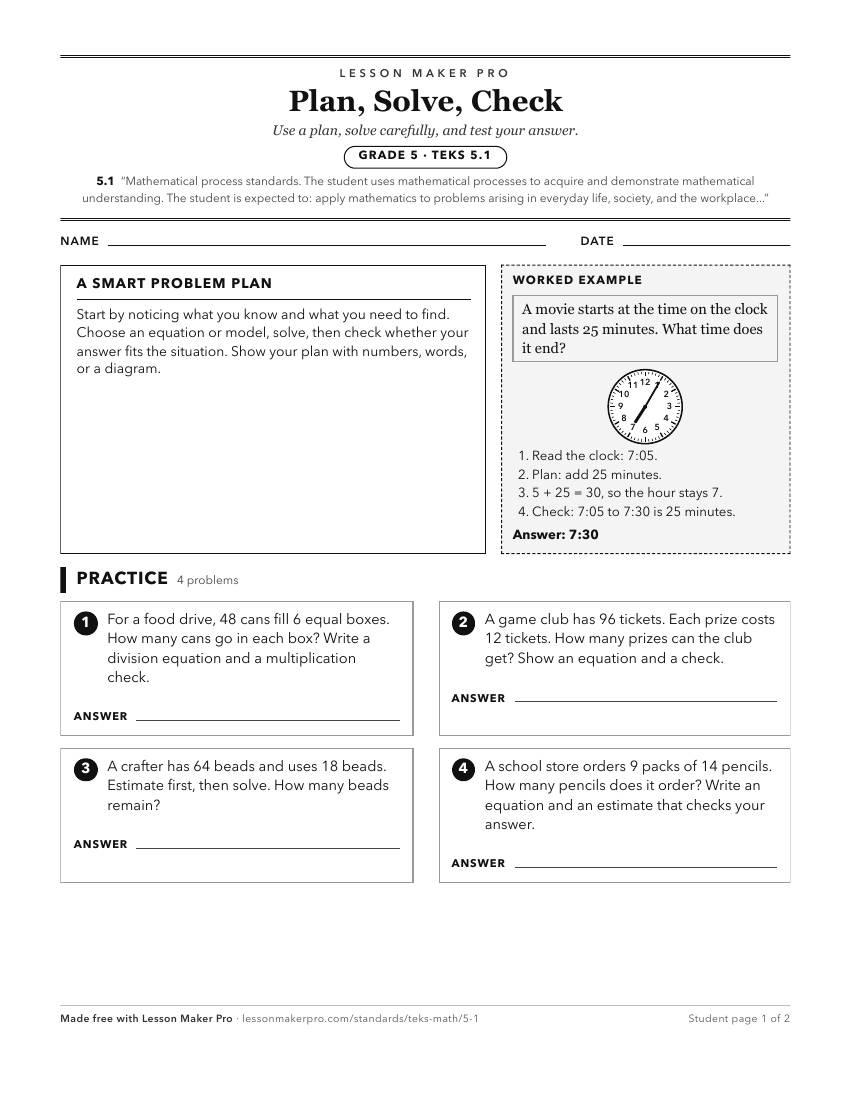
A ready-to-print activity worksheet aligned to 5.1, with an answer key for the teacher on its own page. No account needed.
PDF, US Letter, prints cleanly in black and white.
Download the worksheetKeep exploring
Related Standards
Turn this cluster into a lesson
Grade, subject, topic, and the complete cluster are prefilled. Create one free, no account needed.
Also for this cluster:Make a WorksheetMake a QuizMake a Sub Lesson