TEKS Math 5.1.D
The Standard
communicate mathematical ideas, reasoning, and their implications using multiple representations, including symbols, diagrams, graphs, and language as appropriate
Texas Essential Knowledge and Skills for Mathematics
Teacher's field guide
What This Standard Means
What Students Need to Do
- Students explain how they solved a problem using symbols, words, diagrams, tables, or graphs. They connect the representations and explain what the answer means in the problem.
What Mastery Looks Like
- A student can solve a grade-level problem, show the same thinking with an equation and a visual, and explain how the parts match. The student labels graphs and diagrams and states what the result means in context.
Common Misconceptions
- Students may draw a diagram that shows the numbers but not the operation. They may leave axes, units, or parts unlabeled, or give symbols without explaining their meaning. Some think each representation can show a different answer instead of the same reasoning.
How to Assess It
- A recipe uses 2 1/4 cups of flour, and 3/4 cup is removed. How much remains? Show an equation and diagram, then explain how both support your answer.
Lesson moves
Ways to Teach It
Give pairs fraction tiles and grid paper to model 3/4 + 1/2, then match the model to an equation and written explanation.
Have students write which representation makes their reasoning clearest and what a second representation shows that the first does not.
Play Representation Match with cards showing equivalent equations, diagrams, graphs, and explanations; teams justify each match before keeping the set.
Use a class survey, then have students present the results with a table, bar graph, number sentence, and two written conclusions.
Free download
Printable 5.1.D Worksheet
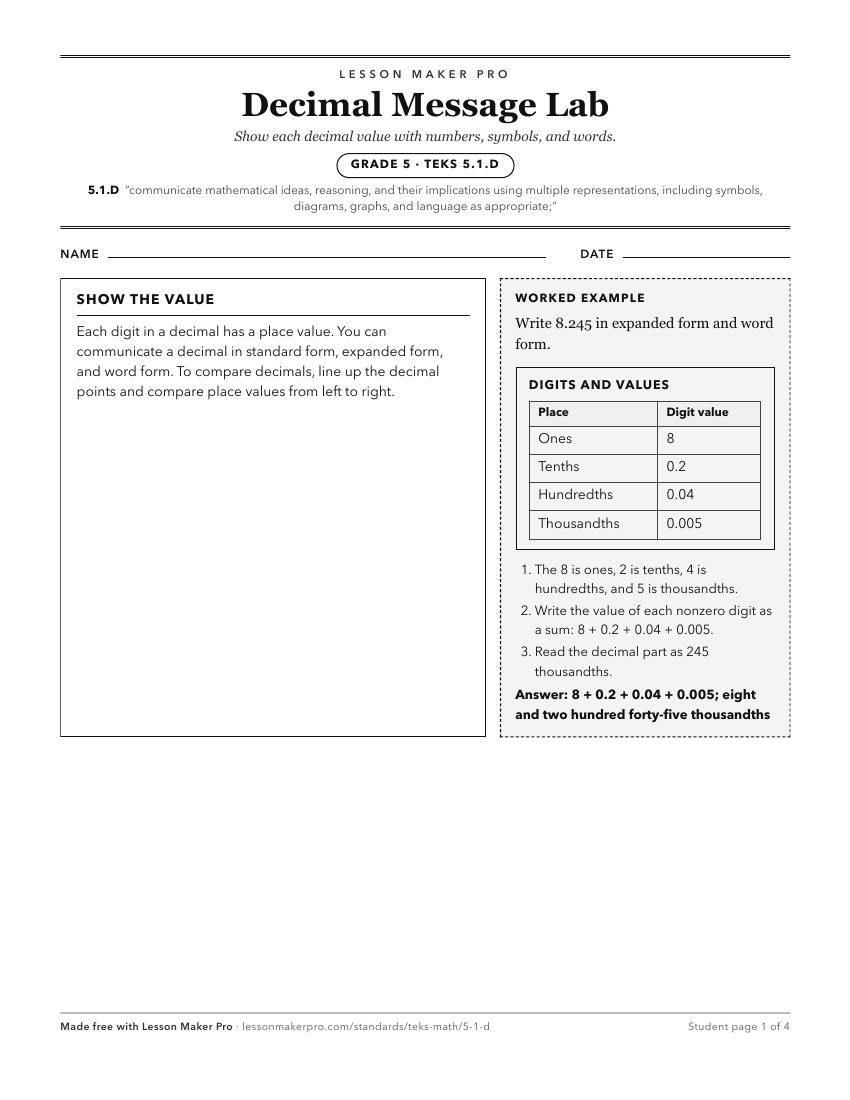
A ready-to-print activity worksheet aligned to 5.1.D, with an answer key for the teacher on its own page. No account needed.
PDF, US Letter, prints cleanly in black and white.
Download the worksheetKeep exploring
Related Standards
Turn this exact standard into a lesson
Grade, subject, topic, and the complete standard are prefilled. Create one free, no account needed.
Also for this standard:Make a WorksheetMake a QuizMake a Sub Lesson