TEKS Math 4.3
Knowledge and Skills Statement (Standard Cluster)
The student applies mathematical process standards to represent and generate fractions to solve problems
Texas Essential Knowledge and Skills for Mathematics
Cluster contents
Student Expectations in This Statement
4.3 is a knowledge and skills statement. These are the student expectations under it.
- 4.3.A
represent a fraction a/b as a sum of fractions 1/b, where a and b are whole numbers and b > 0, including when a > b
- 4.3.B
decompose a fraction in more than one way into a sum of fractions with the same denominator using concrete and pictorial models and recording results with symbo...
- 4.3.C
determine if two given fractions are equivalent using a variety of methods
- 4.3.D
compare two fractions with different numerators and different denominators and represent the comparison using the symbols >, =, or <
- 4.3.E
represent and solve addition and subtraction of fractions with equal denominators using objects and pictorial models that build to the number line and propertie...
- 4.3.F
evaluate the reasonableness of sums and differences of fractions using benchmark fractions 0, 1/4, 1/2, 3/4, and 1, referring to the same whole
- 4.3.G
represent fractions and decimals to the tenths or hundredths as distances from zero on a number line
Teacher's field guide
What This Cluster Means
What Students Need to Do
- Students build, break apart, compare, add, and subtract fractions, including fractions greater than one. They justify equivalence and reasonableness with models, benchmarks, symbols, and number lines. They also locate tenths and hundredths as distances from zero.
What Mastery Looks Like
- Students use fraction strips, drawings, and number lines to show equivalent fractions and multiple decompositions. They compare fractions accurately, solve equal-denominator problems, and check answers against familiar benchmarks. They place tenths and hundredths correctly on scaled number lines.
Common Misconceptions
- Students may add denominators, treat fractions greater than one as impossible, or change the size of the whole between models. They often compare numerators or denominators separately instead of comparing fraction values. They may confuse tenths with hundredths or ignore the scale on a number line.
How to Assess It
- Exit ticket: Decompose 7/4 two ways, decide whether 6/8 equals 3/4, and solve 7/8 minus 3/8. Mark 0.6 and the difference on a number line, then explain whether the difference is reasonable.
Lesson moves
Ways to Teach It
Give pairs fraction strips to build 7/4, record two decompositions, and verify each by aligning pieces on a number line.
Ask, “Which is greater, 5/8 or 2/3?” Students draw models, choose a benchmark, and write a two-sentence defense.
Play Fraction War with card pairs as numerators and denominators; partners compare values, earn the cards, and explain ties using equivalent fractions.
Measure classroom objects to the nearest hundredth of a meter, then place each decimal measurement on a one-meter number line.
Free download
Printable 4.3 Worksheet
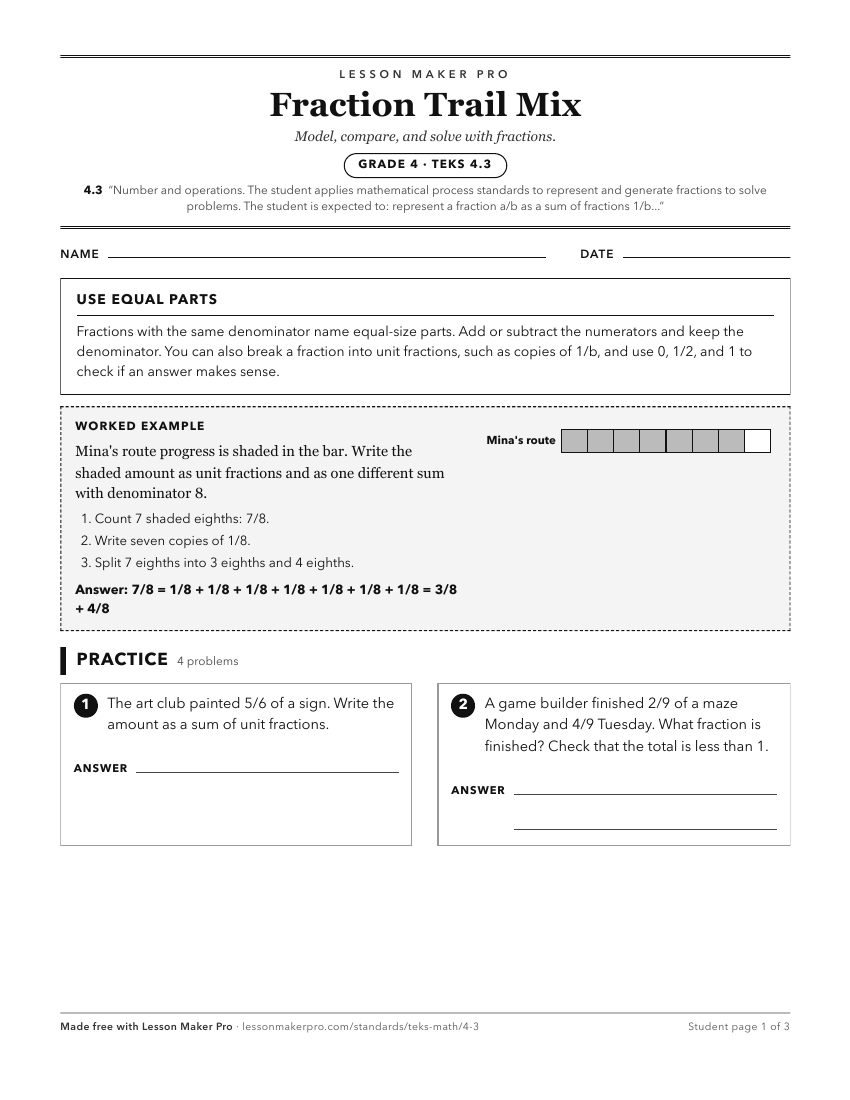
A ready-to-print activity worksheet aligned to 4.3, with an answer key for the teacher on its own page. No account needed.
PDF, US Letter, prints cleanly in black and white.
Download the worksheetKeep exploring
Related Standards
- 6.10
The student applies mathematical process standards to use equations and inequalities to solve problems
- 6.9
The student applies mathematical process standards to use equations and inequalities to represent situations
- 6.3
The student applies mathematical process standards to represent addition, subtraction, multiplication, and division while solving problems and justifying soluti...
- 7.3
The student applies mathematical process standards to add, subtract, multiply, and divide while solving problems and justifying solutions
Turn this cluster into a lesson
Grade, subject, topic, and the complete cluster are prefilled. Create one free, no account needed.
Also for this cluster:Make a WorksheetMake a QuizMake a Sub Lesson