TEKS Math 1.7
Knowledge and Skills Statement (Standard Cluster)
The student applies mathematical process standards to select and use units to describe length and time
Texas Essential Knowledge and Skills for Mathematics
Cluster contents
Student Expectations in This Statement
1.7 is a knowledge and skills statement. These are the student expectations under it.
- 1.7.A
use measuring tools to measure the length of objects to reinforce the continuous nature of linear measurement
- 1.7.B
illustrate that the length of an object is the number of same-size units of length that, when laid end-to-end with no gaps or overlaps, reach from one end of th...
- 1.7.C
measure the same object/distance with units of two different lengths and describe how and why the measurements differ
- 1.7.D
describe a length to the nearest whole unit using a number and a unit
- 1.7.E
tell time to the hour and half hour using analog and digital clocks
Teacher's field guide
What This Cluster Means
What Students Need to Do
- Students measure objects by lining up equal units or using a ruler correctly, then state the length with a number and unit. They compare measurements made with different-sized units and explain why the counts change. They also read and show times to the hour and half hour.
What Mastery Looks Like
- A student aligns a tool with an object’s endpoint, measures without gaps or overlaps, and reports a whole number with the unit named. The student explains why shorter units give a larger count. The student also reads hour and half-hour times on analog and digital clocks.
Common Misconceptions
- Students may begin at the ruler’s edge instead of zero, or leave gaps and overlaps between units. They may think different-sized units should give the same count, or that a larger count means a longer object. They may confuse the hour and minute hands or read 6:30 as 6:06.
How to Assess It
- Give each student an 8-inch paper strip, an inch ruler, two-inch tiles, and clock faces showing 3:00 and 6:30. Ask students to measure the strip both ways, explain the different counts, and write both digital times.
Lesson moves
Ways to Teach It
Have pairs measure classroom objects with linking cubes and paper clips, then compare counts and check for gaps or overlaps.
Ask students to write why measuring one book with cubes and paper clips gives two different numbers.
Play Clock Match by having students pair analog clock cards with digital time cards for hours and half hours.
Create a bus schedule with hour and half-hour times, then have students identify when each bus arrives.
Free download
Printable 1.7 Worksheet
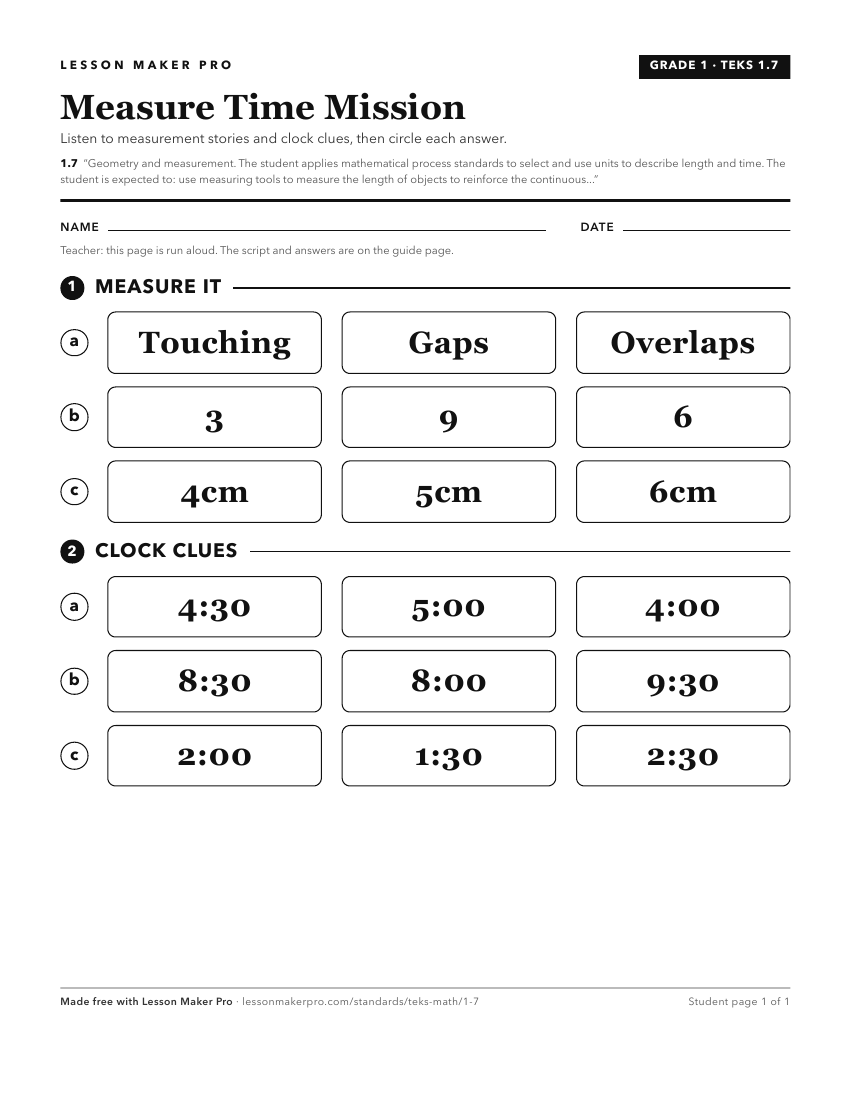
A ready-to-print activity worksheet aligned to 1.7, with an answer key for the teacher on its own page. No account needed.
PDF, US Letter, prints cleanly in black and white.
Download the worksheetKeep exploring
Related Standards
- 3.7
The student applies mathematical process standards to select appropriate units, strategies, and tools to solve problems involving customary and metric measureme...
- 4.8
The student applies mathematical process standards to select appropriate customary and metric units, strategies, and tools to solve problems involving measureme...
- 5.7
The student applies mathematical process standards to select appropriate units, strategies, and tools to solve problems involving measurement. The student is ex...
- 6.4
The student applies mathematical process standards to develop an understanding of proportional relationships in problem situations
Turn this cluster into a lesson
Grade, subject, topic, and the complete cluster are prefilled. Create one free, no account needed.
Also for this cluster:Make a WorksheetMake a QuizMake a Sub Lesson