TEKS Math 4.8
Knowledge and Skills Statement (Standard Cluster)
The student applies mathematical process standards to select appropriate customary and metric units, strategies, and tools to solve problems involving measurement
Texas Essential Knowledge and Skills for Mathematics
Cluster contents
Student Expectations in This Statement
4.8 is a knowledge and skills statement. These are the student expectations under it.
- 4.8.A
identify relative sizes of measurement units within the customary and metric systems
- 4.8.B
convert measurements within the same measurement system, customary or metric, from a smaller unit into a larger unit or a larger unit into a smaller unit when g...
- 4.8.C
solve problems that deal with measurements of length, intervals of time, liquid volumes, mass, and money using addition, subtraction, multiplication, or divisio...
Teacher's field guide
What This Cluster Means
What Students Need to Do
- Students compare the sizes of common customary and metric units. They use given equivalent measures to convert within one system. They also choose operations to solve problems with length, time, volume, mass, and money.
What Mastery Looks Like
- Students choose a sensible unit and tool for a measurement task. They use a given equivalence table to convert accurately and solve multistep problems involving measurement or money. Their answers include correct units and make sense.
Common Misconceptions
- Students may think a larger unit should have a larger number, so they reverse conversions. They may mix customary and metric units or choose an operation from a keyword without considering the situation. Elapsed time across an hour is also a common trouble spot.
How to Assess It
- Give students a small conversion table and ask them to convert 6 yards to feet, find 125 minutes after 2:40, and explain each step.
Lesson moves
Ways to Teach It
Set up stations with rulers, meter sticks, scales, measuring cups, and containers, then have students measure, record, and compare results.
Ask students to explain why 3 meters and 300 centimeters name the same length even though the numbers are different.
Play Conversion Match with cards showing equivalent measures, such as 4 feet, 48 inches, 2 kilograms, and 2,000 grams.
Give students a grocery receipt and a budget, then have them find totals, change, package masses, and liquid amounts.
Free download
Printable 4.8 Worksheet
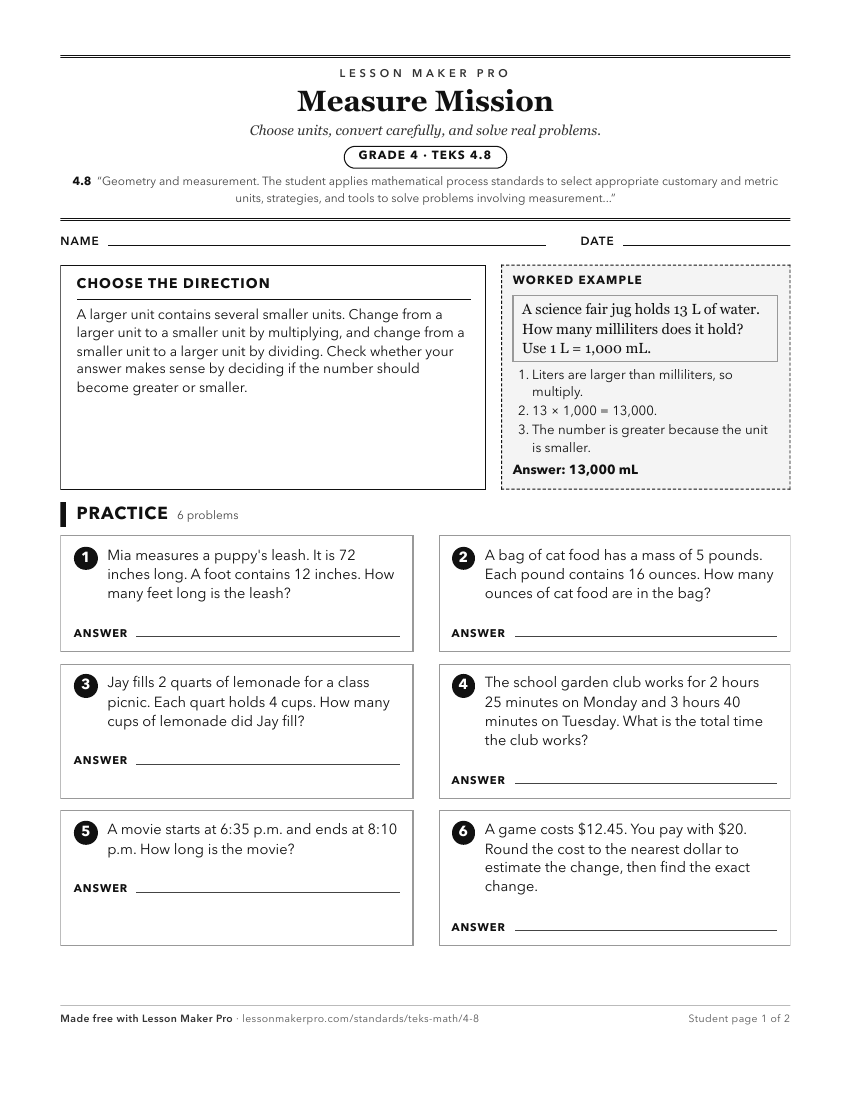
A ready-to-print activity worksheet aligned to 4.8, with an answer key for the teacher on its own page. No account needed.
PDF, US Letter, prints cleanly in black and white.
Download the worksheetKeep exploring
Related Standards
- 3.7
The student applies mathematical process standards to select appropriate units, strategies, and tools to solve problems involving customary and metric measureme...
- 5.7
The student applies mathematical process standards to select appropriate units, strategies, and tools to solve problems involving measurement. The student is ex...
- 1.7
The student applies mathematical process standards to select and use units to describe length and time
- 6.13
The student applies mathematical process standards to use numerical or graphical representations to solve problems
Turn this cluster into a lesson
Grade, subject, topic, and the complete cluster are prefilled. Create one free, no account needed.
Also for this cluster:Make a WorksheetMake a QuizMake a Sub Lesson